
When you purchase through links on our site, we may earn an affiliate commission. Here’s how it works .
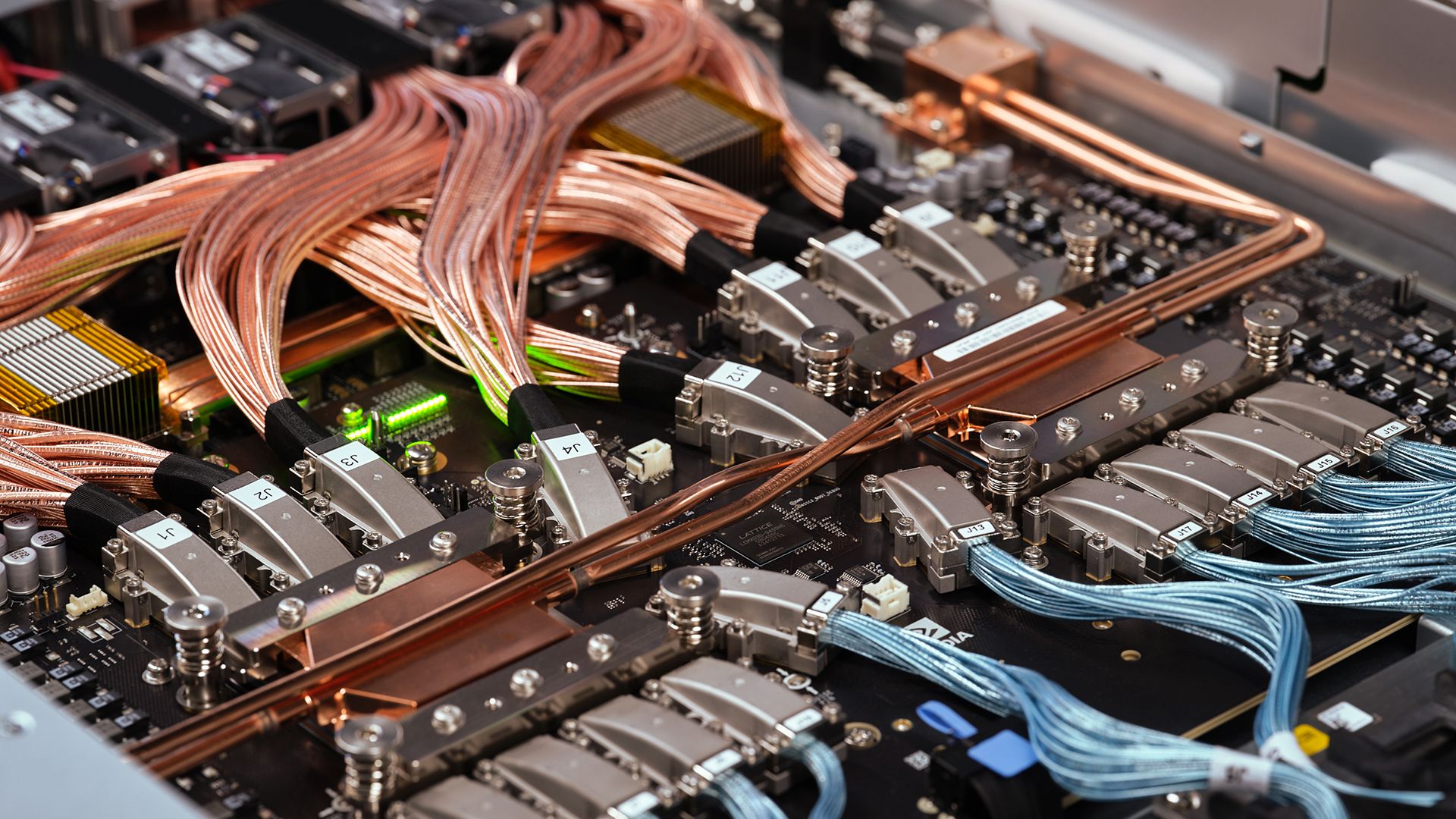
Apple is reportedly considering at least two server configurations: a smaller machine equipped with two M8 Ultra processors and a higher-end version featuring four M8 Ultra system-on-chips. Although Apple has its own UltraFusion technology for stitching two high-end SoCs together seamlessly, it looks like the company does not have a proper solution for scale-up and scale-out connectivity of its processors, which is where Nvidia's NVLink Fusion comes into play. Apparently, Apple wants to use NVLink infrastructure, which includes not only an interconnection protocol, but also switches, chiplets that add NVLink connectivity, and a software stack, for its servers. The project was reportedly initiated around a year ago and was backed by John Ternus while he headed Apple's hardware engineering organization.
Apple already builds custom servers for Private Cloud Compute, which handle AI workloads too demanding for local execution on iPhones and Macs, The Information claims. Most of these machines use Apple's internally developed connectivity technologies, which are reportedly too slow and costly for large-scale commercial deployments, which is why Apple is looking elsewhere.
The Information specifically mentions Apple's need for connectivity technology suitable for large-scale deployments, although it does not explain exactly what this means architecturally. If the publication is referring to connecting multiple servers into larger clusters, this would normally be the job of scale-out technologies such as Ethernet or InfiniBand, rather than a scale-up fabric such as NVLink. Nvidia originally developed its NVLink fabric technology to scale-up performance of its accelerators, so the technology is optimized for accelerator-to-accelerator connectivity and enables a rack of Nvidia GPUs to function as a tightly coupled compute domain. There is a different implementation called NVLink-C2C, which is a coherent chip-to-chip interface for connecting CPUs to accelerators and CPUs to CPUs
Meanwhile, modern Apple M Pro and M Ultra processors are system-in-packages consisting of a CPU chiplet and a GPU/neural engine chiplet, which are stitched together using TSMC's SoIC-mH technology. If Apple continues to use this architecture (very likely), an M8 Ultra processor can be considered as a CPU and an accelerator. However, this raises the question of how Apple intends to connect M8 Ultra processors to NVLink and which components of the SiP would participate in the NVLink domain. One possibility is that Apple could expose the accelerator portion of M8 Ultra to NVLink through an NVLink Fusion chiplet, which effectively means it will treat it as an accelerator for a scale-up domain. Another possibility is that Apple is developing a different accelerator architecture for its servers, perhaps by simply placing the GPU/NPU chiplet onto a separate substrate/interposer and equipping it with its own memory, though there is currently no evidence that confirms such a design for a chip that is years away.
Apple's rumored M7 Ultra targets 1.5TB of memory and Blackwell-class AI performance, report claims
Google could build more AI accelerators than Nvidia sells in 2028, analyst claims
Apple will skip its high-end M6 Mac chips and fast-track an AI-focused M7 generation for 2027, report claims
Another thing to keep in mind is that Apple is a member of the UALink Consortium, an organization overseeing development of industry-standard UALink accelerator-to-accelerator interconnections that supports up to 1,024 accelerators. While for now there is a limited choice of UALink switches, by 2029, there will be industry-standard switches offering different performance and capabilities, which makes the choice of NVLink as a scale-up fabric even stranger.
One possible explanation is that Apple is interested in considerably more than NVLink itself. NVLink Fusion is part of Nvidia's rack-scale and data center infrastructure architecture, which can combine NVLink scale-up connectivity with Nvidia's Spectrum-X Ethernet or Quantum-X InfiniBand scale-out networks, including switches equipped with co-packaged optics. Thus, Apple could potentially adopt Nvidia technology for both scale-up and scale-out connectivity instead of developing an entire data center networking stack of its own. This is merely speculation for now, but such an approach would effectively mean that Apple is building AI servers around significant portions of Nvidia's data center architecture while retaining its own processors and not using Nvidia accelerators. If this happens, this will be a testament that Nvidia is now setting de facto standards for AI data centers, no matter which AI accelerators and CPUs are used.
Get Tom's Hardware's best news and in-depth reviews, straight to your inbox.
Key considerations
- Investor positioning can change fast
- Volatility remains possible near catalysts
- Macro rates and liquidity can dominate flows
Reference reading
- https://www.tomshardware.com/tech-industry/artificial-intelligence/SPONSORED_LINK_URL
- https://www.tomshardware.com/tech-industry/artificial-intelligence/apple-eyes-nvidia-nvlink-to-power-its-new-custom-m8-ultra-ai-servers-historically-bitter-rivals-reportedly-team-up-for-2029-data-center-push#main
- https://www.tomshardware.com/membership
- SK hynix reportedly discussing US memory chip manufacturing with Intel — options include leasing Ohio plant or forming joint venture with other AI hyperscalers
- New York State recommends demanding AI data centers pay $1 million in community investment per megawatt — framework advises towns to plan for maintenance costs,
- AI Infra Summit: NVIDIA Vera Rubin and DSX Platform Advancements Showcase Energy Efficiencies of Optimizing Tokens Per Watt for AI Factories
- Corsair's 32GB Vengeance kits are the cheapest DDR5 RAM on the market right now — lock down 6,200 MT/s speeds for $419.99 or save $10 on a slower RGB kit for $4
- Developer builds viral 3D source code visualizer that consumes 21GB of RAM — flies around 2.5 million lines of code at over 120 frames per second
Informational only. No financial advice. Do your own research.