
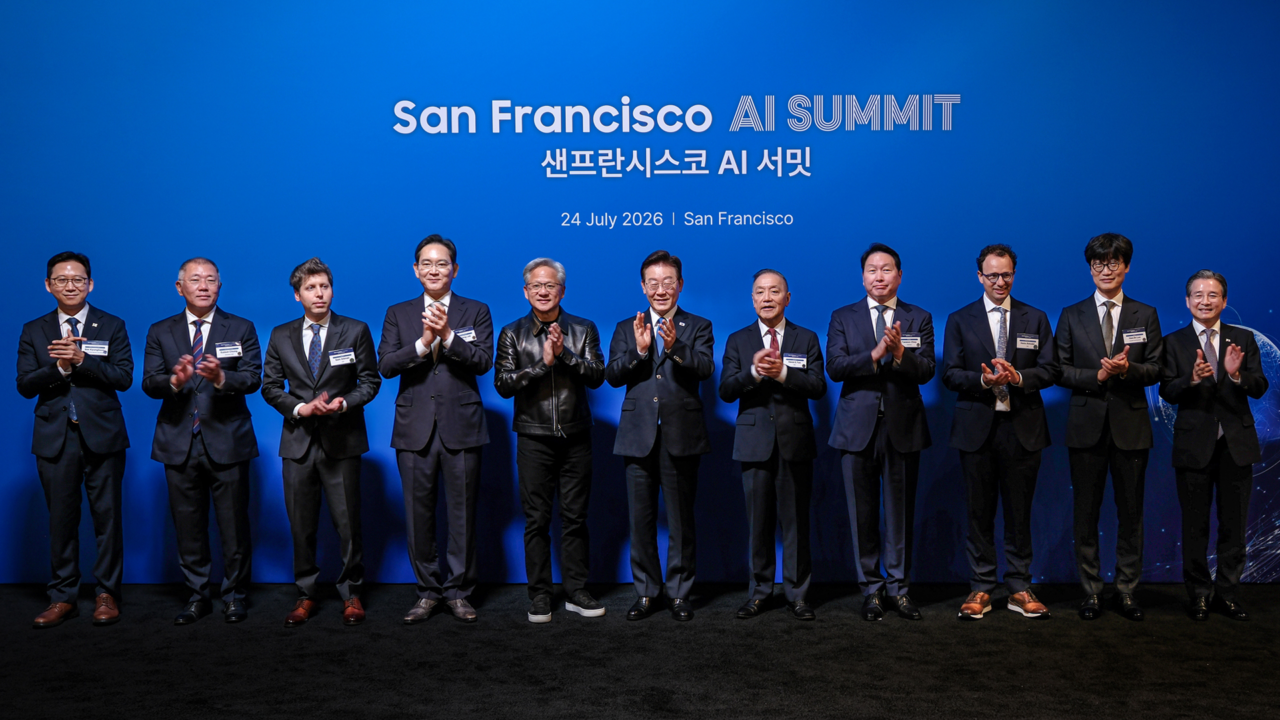
At this week’s AI Summit in San Francisco, South Korean President Jae Myung Lee and some of the country’s top business leaders and researchers are meeting with NVIDIA and ecosystem partners to chart Korea’s AI progress.
Building on NVIDIA founder and CEO Jensen Huang’s visit to Korea last month , this week’s discussions and announcements advance the nation’s full-stack push to expand Korea’s AI infrastructure and expertise on its path toward becoming a global center for AI innovation.
To start, NVIDIA and the Korea Advanced Institute of Science and Technology (KAIST) today announced a joint AI research lab at the KAIST Kim Jaechul Graduate School of AI in Seoul, dedicated to advancing agentic AI for South Korea. It’s the first joint AI lab between a Korean university and any global technology company.
The collaboration will establish a robust academic AI research program, bringing together NVIDIA full-stack AI expertise, NVIDIA Nemotron open models and NVIDIA AI Cloud partner computing with the world-class scientific talent at KAIST, one of Asia’s premier research universities.
Check back here for updates as the summit continues, including Huang’s meetings with President Lee as well as Korea and U.S. business leaders.
NVIDIA and its Korea ecosystem partners — from NAVER, SK Telecom and Hyundai Motor Group to the nation’s top research universities, KAIST and Seoul National University (SNU) — are committing to developing national AI factories and physical AI platforms, as well as advancing joint research in agentic AI.
Core to it all: NAVER, Brookfield and NVIDIA will expand NAVER’s NVIDIA DSX AI factory at its GAK Sejong data center to 200 megawatts — roughly 100,000 GPUs, built on the NVIDIA Vera Rubin platform — more than tripling the initial buildout announced in June .
Plus, SK Group and NVIDIA today announced plans for a $500-billion-plus comprehensive partnership to establish AI infrastructure serving the surging demand for global compute. Broadening initial plans announced in June , the expanded collaboration will deploy NVIDIA Vera Rubin infrastructure powered by SK hynix HBM4 memory.
And Hyundai Motor Group outlined a physical AI strategy anchored by a robot reference platform developed with NVIDIA, extending a buildout with 50,000 NVIDIA Blackwell GPUs. The collaboration also includes the integration of NVIDIA DRIVE Hyperion — an autonomous vehicle development platform combining NVIDIA DRIVE AGX in-vehicle computing running on the safety-certified NVIDIA DriveOS operating system — with HMG’s vehicle platforms.
NVIDIA and KAIST’s Department of Mechanical Engineering are planning an NVIDIA AI Technology Center (NVAITC) for collaborative research, talent development and knowledge exchange in physical AI — including projects that tap into NVIDIA Nemotron open models.
This is in addition to the NVIDIA-KAIST joint research lab for agentic AI at the KAIST Kim Jaechul Graduate School of AI in Seoul — built for the Korean language and local industry, backed by a multiyear commitment to fund and train Korean researchers.
NVIDIA and Seoul National University are also planning an NVAITC covering AI research, talent development and education — spanning foundation models, accelerated computing, physical AI and AI for science, with potential cooperation on AI infrastructure. This will include work harnessing NVIDIA Nemotron and NVIDIA Cosmos open world foundation models .
President Lee met with Huang Friday at the Fairmont San Francisco ahead of the AI Summit to discuss deepening the partnership behind Korea’s national AI ambitions.
President Lee opened by noting he’d seen reports of Huang eating beer and fried chicken in Seoul — and that he’d hoped to join.
Huang said the enthusiasm he felt across Korea during the visit, “from the fried chicken restaurant to the Korean barbecue restaurant, was incredible. Everyone in Korea loves AI.”
The meeting was substantive. President Lee outlined South Korea’s vision to become a pivotal hub in the global AI supply chain — spanning semiconductor manufacturing, AI infrastructure deployment and industrial integration.
Huang noted that NVIDIA and Korea have been partners for over 25 years — from PC gaming to the AI revolution — and committed to deepening that partnership across AI infrastructure, semiconductors, physical AI and research. “From AI chips and physical AI to AI infrastructure, Korea has achieved remarkable results under your leadership over the past year,” Huang said. “This is truly the beginning of a golden age for Korea.” President Lee’s response: “I hope this is only the beginning.”
The sheer gravity of the global AI boom was displayed Friday on stage at the Midway, a premier event venue in San Francisco. The city’s Dogpatch neighborhood has never been so well dressed. South Korean President Lee Jae Myung laid out a bold vision: South Korea isn’t merely going to participate in the AI revolution. It’s aiming to be one of its key engines. The gathering was a high-stakes meeting of global compute leadership. Moderated by Stanford University’s Soh Kim, the stage brought together an eye-popping lineup of tech leaders. Sharing the floor with President Lee: NVIDIA’s Jensen Huang, OpenAI’s Sam Altman, Broadcom’s Hock Tan and Anthropic’s Dario Amodei. Joining them was South Korea’s industrial vanguard — Samsung Electronics Chairman Jay Y. Lee, SK Group Chairman Chey Tae-won, Hyundai Motor Group Executive Chair Euisun Chung and NAVER founder Hae-jin Lee. President Lee opened with his “San Francisco AI Declaration,” drawing a line from the city’s rebirth after the 1906 earthquake to Korea’s post-war rise into an IT powerhouse. He pitched a multitrillion-dollar push into AI semiconductors, hyperscale data centers and physical AI, comparing the emergence of artificial intelligence to “humanity discovering fire anew.” He framed Korea’s ambition around compute infrastructure, education and public services designed to spread AI’s benefits broadly.
Huang matched the moment. Looking back over a 25-year partnership, from seeding Korea’s gaming culture to the memory chips that make modern AI run, he put it simply: “If not for the invention of HBM memory in Korea, NVIDIA wouldn’t have been able to invent the supercomputers that power AI today.
“This really is the golden age for Korea,” he added.
Key considerations
- Investor positioning can change fast
- Volatility remains possible near catalysts
- Macro rates and liquidity can dominate flows
Reference reading
- https://blogs.nvidia.com/blog/ai-summit-korea-partners-and-nvidia/#primary
- https://blogs.nvidia.com/blog/author/nvidiawriters/
- https://blogs.nvidia.com/blog/ai-summit-korea-partners-and-nvidia/#disqus_thread
- AMD’s new X100 chip lineup puts embedded Ryzen AI 'Strix Halo' chips into robots – APUs for physical AI bring Zen 5 CPU, RDNA 3.5 GPU cores to compete with Inte
- Nemotron Labs: How Open Models Give Enterprises and Nations AI They Can Trust, Control and Customize
- Dell 14S review: High-class design and 20+ hour battery life
- Jensen Huang argues American companies should be allowed to use Chinese AI models — Nvidia CEO says backdoors connected to China are misconceptions
- Why Performance per Watt Is the Ultimate Metric for AI Infrastructure Efficiency
Informational only. No financial advice. Do your own research.