
(Image credit: Tom's Hardware) (Image credit: Tom's Hardware) Image 1 of 2 View Original
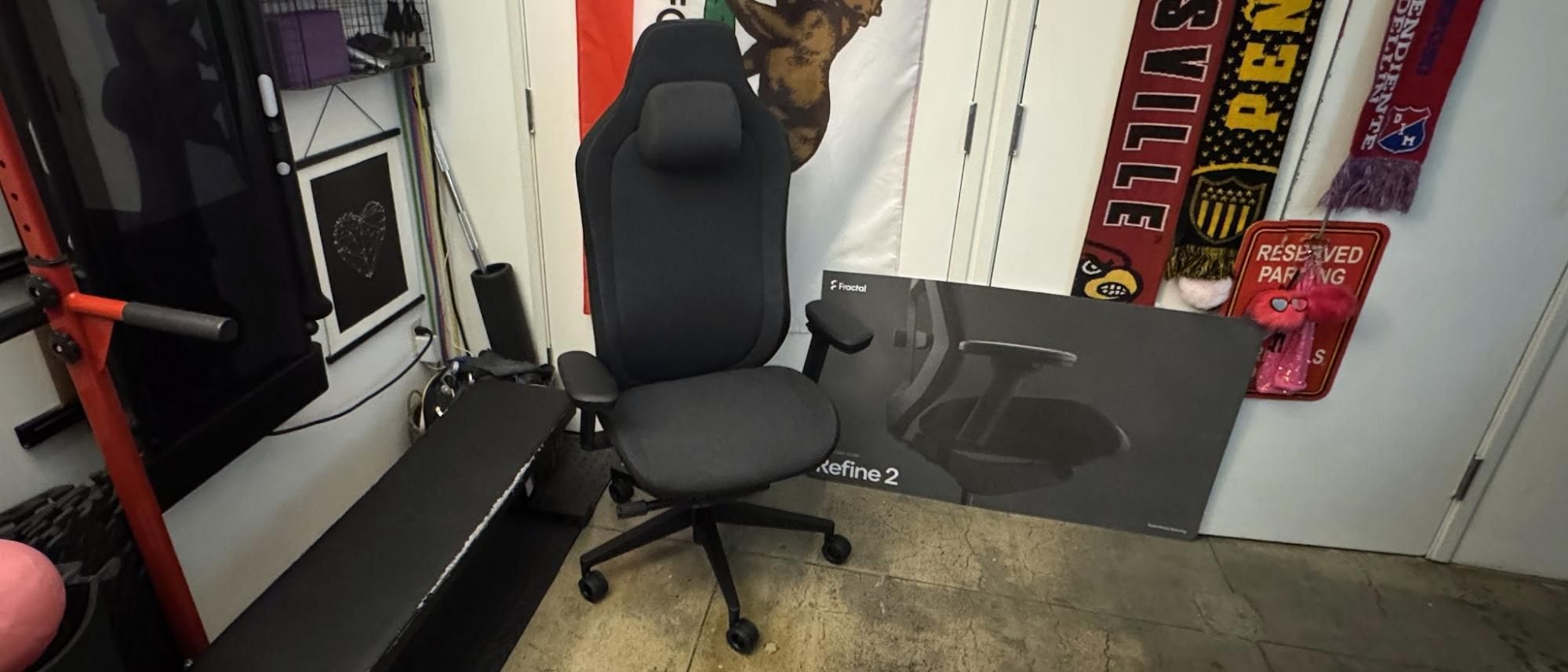
Fabric aside, the Refine 2 looks very similar to its predecessor, with the same "refined" racing-inspired silhouette. It sits on a sturdy, five-spoke metal base with large, hollow plastic casters and a class 4 pneumatic gas lift. It features a glass-fiber reinforced frame with a thick, padded seat that has slightly raised sides — not quite a bucket seat, though it does have the traditional forward hump that bucket seats have. The seat width is approximately 17 inches (431.8mm) between the sides; with the sides included it's closer to 20.5 inches (520.7mm).
(Image credit: Tom's Hardware) (Image credit: Tom's Hardware) (Image credit: Tom's Hardware) (Image credit: Tom's Hardware) (Image credit: Tom's Hardware) Image 1 of 5 View Original
The chair has a tall, racing-style backrest with slightly winged shoulder support and a headrest. The chair measures 18.75 inches (476.25mm) wide at the shoulders, and is approximately 53.7 – 58.5 inches (1365 – 1485mm) tall overall. The backrest consists of fabric stretched over a plastic frame for firm, suspension-style support. The chair also features manually-adjustable lumbar support, which presses through the backrest and can be moved vertically and adjusted for strength.
The Refine 2 is not a bad-looking chair, but it is big, heavy, and difficult to maneuver once it's been assembled. It weighs almost 80 pounds (36kg), and is fairly bottom-heavy, which I suppose is good for those who want to spend a lot of time tilting in this chair.
The Refine 2 is highly adjustable, though it doesn't offer some of the traditional gaming chair adjustments, such as the ability to lie almost completely flat. There are two levers on the right side of the chair, just under the seat, that control seat depth and height. The front lever controls height, and works as expected — pulling it raises and lowers the chair's height via its gas lift. The floor-to-seat height ranges from 19.3 – 24 inches (490 – 610mm).
(Image credit: Tom's Hardware) (Image credit: Tom's Hardware) Image 1 of 2 View Original
The back lever controls seat depth, which starts at around 16.7 inches (425mm) and can be adjusted to approximately 19.69 inches (500mm), which is pretty deep. Under the two levers there's a knob for adjusting the strength of the chair's tilt limiter — twisting forward (clockwise) makes it stronger, while twisting backward (counter-clockwise) makes it weaker. One of my main issues with the original Refine was that the tilt limiter was far too strong, even at its weakest setting. I'm pleased to see that the Refine 2 has toned down the absolute strength of the tilt limiter, but unfortunately it's still just a little too strong for me to be able to easily lean back. While I did manage to find a comfortable position with the Refine 2 by tilting back and locking the chair into a slightly reclined position, I would still prefer more flexibility in the seatback while I'm working.
(Image credit: Tom's Hardware) (Image credit: Tom's Hardware) Image 1 of 2 View Original
The Refine 2 has adjustable lumbar support in the form of a moving lumbar pad that presses through the seat's suspension back. The lumbar pad can be moved up and down (you'll need to move it manually), and support can be dialed up by twisting the knob clockwise, or dialed down by twisting the knob counter-clockwise. The lumbar support now features dual pads on either side of your spine (instead of just one pad, like the original Refine had), which flex and adapt as you move to better support your lower back. The dynamic support was nice, though I think I still prefer vertically-adaptable support (like what's on the Herman Miller x Logitech G Vantum ).
(Image credit: Tom's Hardware) (Image credit: Tom's Hardware) Image 1 of 2 View Original
Like its predecessor, the Refine 2 has 4D adjustable armrests — you can adjust the height, width, depth, and angle. Unlike its predecessor, these arm rests do fully lock in place, as the depth (back/forward) movement is now locked to the small button (on the inside of the armrest, near the front) that also locks angle. There's a lever on the outside of each armrest for adjusting height, and a button on the inside (in the middle) for adjusting width. You can also adjust overall armrest width at the base, though you'll need to break out the hex wrench to do this.
The armrests have wide, padded polyurethane-covered tops and are fairly comfortable. I did find the depth/angle lock to be a little difficult to easily maneuver — especially when I wanted to adjust angle (there are only three angles — neutral/straight, and about 20 degrees inward and outward), but I suppose that's the price we pay for locking arm rests.
(Image credit: Tom's Hardware) (Image credit: Tom's Hardware) (Image credit: Tom's Hardware) (Image credit: Tom's Hardware) Image 1 of 4 View Original
The chair has a built-in, detachable neck pillow implemented the same way it is on the original Refine — attached to the chair via two sturdy metal attachments that click into place. The neck pillow can be manually raised or lowered, or it can be removed completely by pressing the button at the top of the backrest. The neck pillow is very similar to the one in the original Refine — moderately dense fabric-covered memory foam with a bottom-heavy sloped shape designed to sit at the base of your neck.
The maximum recommended weight for the Refine 2 is approximately 300 pounds (135kg). However, the recommended weight range is 132 – 300 pounds (60 – 135kg) and the recommended height range is 5'5" – 6'7" (160 – 200cm). I'm right at the lower end of this range (I'm around 5'7" / 171cm and I weigh around 135 pounds / 61kg), and the chair still seemed too heavy for me. While the tilt limiter was weaker than the tilt limiter on the original Refine, I still found it hard to easily tilt back and ended up having to lock the chair into position for comfort. My husband, who's 5'11" (180cm) and weighs around 190 pounds (86kg) had a much easier time tilting and maneuvering the chair.
The Fractal Refine 2 is actually a pretty nicely refined version of the original Refine. The company definitely took some feedback into account and made some adjustments — but are they enough? This chair is practically identical to its predecessor, and the relatively minor changes aren't really enough to warrant an upgrade if you already have the original. If you don't already have the Fractal Refine, the Refine 2 is a pretty nice halfway point between racing-style gaming chairs and pricier task/office chairs — and the price is about halfway, too. At $640, this is a little more than you'll spend on a typical racing-style chair, such as SecretLab's Titan Evo NanoGen , but it's significantly less than you'll spend on most office-style chairs, such as SteelCase's Karman .
Sarah Jacobsson Purewal Social Links Navigation Senior Editor, Peripherals Sarah Jacobsson Purewal is a senior editor at Tom's Hardware covering peripherals, software, and custom builds. You can find more of her work in PCWorld, Macworld, TechHive, CNET, Gizmodo, Tom's Guide, PC Gamer, Men's Health, Men's Fitness, SHAPE, Cosmopolitan, and just about everywhere else.
Key considerations
- Investor positioning can change fast
- Volatility remains possible near catalysts
- Macro rates and liquidity can dominate flows
Reference reading
- https://www.tomshardware.com/peripherals/gaming-chairs/SPONSORED_LINK_URL
- https://www.tomshardware.com/peripherals/gaming-chairs/fractal-design-refine-2-review#main
- https://www.tomshardware.com/membership
- Steve Wozniak-signed Apple 1 motherboard expected to achieve up to $800,000 at auction — fully working board also comes with a signed letter from Steve Jobs
- Leading Publishers Bring Blockbuster PC Games and Technology to NVIDIA RTX Spark
- Nvidia's RTX Spark N1X launches in October for laptops and desktops — 18 or 20 CPU cores, paired with 5,120 or6,144 CUDA cores, up to 128GB of unified memory
- Bring the Fire: Play Games on GeForce NOW With New Firefox Browser Support
- RPCS3 emulator devs slam Nvidia DLSS 5 as 'AI-slop generator' — says industry pushing 'more upscalers and frame generation to hallucinate games and hide their l
Informational only. No financial advice. Do your own research.