
Ingenious modder converts countertop ice machine into an RTX 3060 GPU cooler with a beer fridge thermostat
Hotspot temperature sensor on Nvidia's Blackwell gaming GPUs is still accessible if you have access to Nvidia's internal MODS tool
Frore claims that delidding the Rubin package dramatically lowers thermal resistance (while this is obvious, I must add again that the paper is based on an analytical thermal model*). According to the paper, an unlidded Rubin package can reduce junction temperature by as much as 20°C compared to one with an integrated heatspreader (IHS), which potentially improves tokens/Watt by up to 35%. Of course, there are disadvantages, as delidded GPUs have lower mechanical reliability. We will talk about it later on. In any case, there are cloud system providers that explore the use of delidded Rubin GPUs to boost their token money generation despite all the risks, according to Frore.
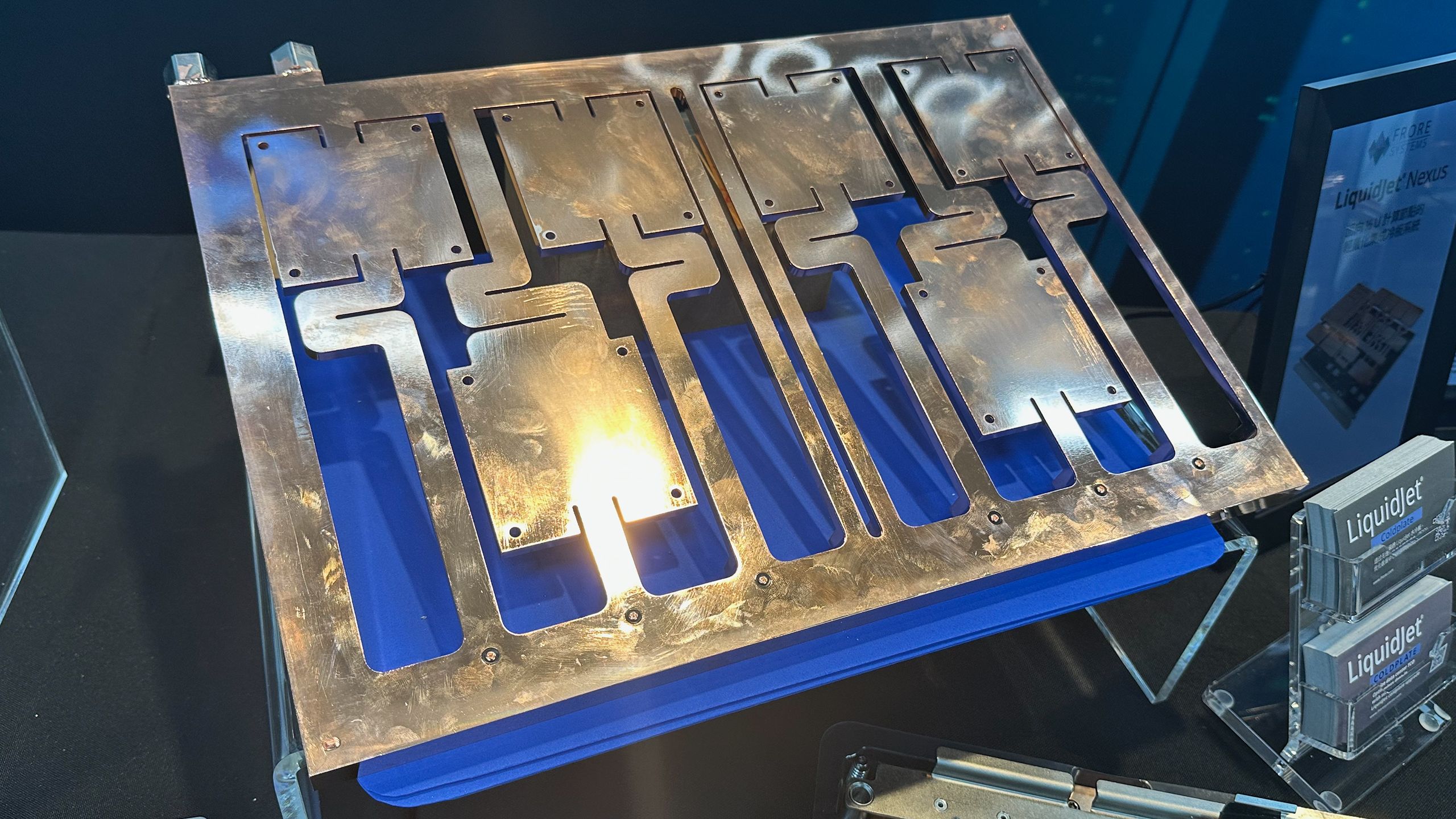
Frore's own contribution is, of course, its coldplate. Conventional coldplates are typically manufactured using skiving, a machining process that creates long, straight microchannels inside a copper block. Frore instead borrows manufacturing techniques from semiconductor fabrication — etching and bonding — to build intricate three-dimensional copper microstructures that address hotspots on the accelerator's silicon. These unique microstructures cannot be produced using traditional machining, at least not cost-efficiently, according to Frore.
The LiquidJet design features short microchannels that are etched around hot spots, multiple cooling stages, and flow routing optimized for the GPU's power-density map. According to the company's analysis, this enables a 6°C to 12°C reduction in junction temperature and improves tokens/Watt by 10% to 25% in the case of the Nvidia Rubin GPU*. A roughly 10°C temperature reduction would therefore correspond to about a 15% increase in token generation efficiency, the paper claims.
(Image credit: Frore Systems) (Image credit: Frore Systems) (Image credit: Frore Systems) Image 1 of 3 View Original
Frore argues that improved coldplate efficiency changes the economics of facility cooling, which is obviously the most important part of the hyperscalers' consideration. Nvidia designed Rubin to operate with coolant entering at up to 45°C, which enables many AI data centers to rely entirely on 'free' cooling without mechanical chillers. While lowering the inlet temperature can further improve GPU efficiency, doing so only makes economic sense if the energy consumed by the chillers is offset by the resulting increase in money token generation. Meanwhile, because LiquidJet requires a lower coolant flow rate to maintain the same junction temperature, it also reduces the chiller coefficient of performance (COP) required for additional cooling to become worthwhile.
In Frore's example, a Rubin GPU equipped with a conventional skived coldplate requires a chiller COP of approximately 6.7 before colder coolant delivers a net efficiency benefit, whereas LiquidJet lowers the break-even COP to around 4.1, which makes mechanical chilling economically attractive across various deployments.
One interesting thing about Frore's analysis is that its LiquidJet is more efficient on Rubin data center GPUs compared to Blackwell data center GPUs* due to the higher transistor density of the former.
Frore's analysis does not stop at exploring the advantages of its own cooling systems, so the company's analytical thermal model extends to other means by which improved cooling and/or lowered thermal resistance can affect temperatures and therefore money token generation.
One of the most striking claims by Frore concerns Nvidia's upcoming Rubin is that Frore claims that delidding the GPU package — removing the IHS and the graphene TIM placed between the die and the lid — dramatically lowers thermal resistance, which therefore reduces junction temperature by as much as 20°C compared to regular GPUs with IHS, which therefore improves tokens per Watt by up to 35%, according to the model used by Frore.
Meanwhile, mechanical reliability becomes a major concern for delidded GPUs. Without the IHS, the bare Rubin GPU packaged using TSMC's CoWoS-L technology becomes considerably more vulnerable to cracking of bridges that connect the two Rubin dies. In fact, even in the Hopper era, some GPUs literally cracked with certain liquid coolers. Furthermore, maintaining uniform contact pressure across multiple exposed dies is substantially more difficult than in the case of monolithic processors. Nonetheless, there are hyperscalers that are exploring the use of delidded Rubin GPUs to increase their token generation and money output.
Thermal interface materials play an equally important role. By default, Nvidia's Rubin reportedly addresses the thermal penalty of a lidded package by using liquid indium metal TIM with gold-plated contact surfaces. Frore argues that an unlidded package paired with a high-performance phase-change material such as PTM7950 still exhibits lower overall thermal resistance than a lidded package using liquid metal, which turns into as much as a 14°C junction-temperature advantage and up to a 28% increase in money tokens/Watt, according to Frore's model.
The key point of Frore's white paper is that cooling has become a key determinant of AI data center profitability, as lower GPU junction temperatures improve token generation efficiency rather than 'just' preventing overheating.
In a white paper based on an analytical thermal model, the company claims that its LiquidJet coldplate can lower Nvidia Rubin junction temperatures by 6°C to 12°C and increase tokens/Watt by 10% to 25%, while a 10°C reduction could boost token generation by about 15%.
In addition, the company argues that more efficient coldplates make mechanical chilling economically viable across a wider range of AI data centers as it lowers the break-even chiller efficiency required to offset cooling power consumption.
Finally, Frore claims that delidding Rubin and optimizing thermal interface materials can reduce thermal resistance further and improve tokens/Watt by up to 35%, albeit at the cost of greater mechanical risk for these accelerators.
*It should be noted that Frore's analysis is based on an analytical thermal model rather than experimental results. The paper builds on the thermal resistance equation (Tj = Tinlet + Q × Rtotal), published or assumed operating parameters for Nvidia's Rubin GPU, and the company's own estimates of how different coldplate designs affect thermal resistance.
Follow Tom's Hardware on Google News , or add us as a preferred source , to get our latest news, analysis, & reviews in your feeds.
Anton Shilov is a contributing writer at Tom\u2019s Hardware. Over the past couple of decades, he has covered everything from CPUs and GPUs to supercomputers and from modern process technologies and latest fab tools to high-tech industry trends. ","collapsible":{"enabled":true,"maxHeight":250,"readMoreText":"Read more","readLessText":"Read less"}}), "https://slice.vanilla.futurecdn.net/13-4-25/js/authorBio.js"); } else { console.error('%c FTE ','background: #9306F9; color: #ffffff','no lazy slice hydration function available'); } Anton Shilov Social Links Navigation Contributing Writer Anton Shilov is a contributing writer at Tom’s Hardware. Over the past couple of decades, he has covered everything from CPUs and GPUs to supercomputers and from modern process technologies and latest fab tools to high-tech industry trends.
Key considerations
- Investor positioning can change fast
- Volatility remains possible near catalysts
- Macro rates and liquidity can dominate flows
Reference reading
- https://www.tomshardware.com/pc-components/liquid-cooling/SPONSORED_LINK_URL
- https://www.tomshardware.com/pc-components/liquid-cooling/frore-claims-its-liquidjet-can-drop-nvidia-rubin-gpu-temperatures-by-10-c-can-also-boost-performance-by-15-percent-as-hyperscalers-eye-using-delidded-gpus-in-production-environments#main
- https://www.tomshardware.com/membership
- 16GB GPUs and 8-core CPUs officially become the most popular configs on Steam — Latest hardware survey shows modern gaming's growing hunger for more resources
- Hideo Kojima unveils a Death Stranding 2-themed wireless CD player — Limited edition device costs ~$160, comes with Bluetooth 5.3 & exclusive artwork
- Texas slams on the brakes for 1,800 data centers, power grid requirements are five times higher than peak record demand — 474 gigawatts of power requests are no
- AMD doubles data center revenue year over year, but gaming revenue plunged by 31% — CEO Lisa Su says prices have 'weighed on' consumer demand but is 'optimistic
- NVIDIA AI Supercomputer Comes Online at Naval Postgraduate School
Informational only. No financial advice. Do your own research.