
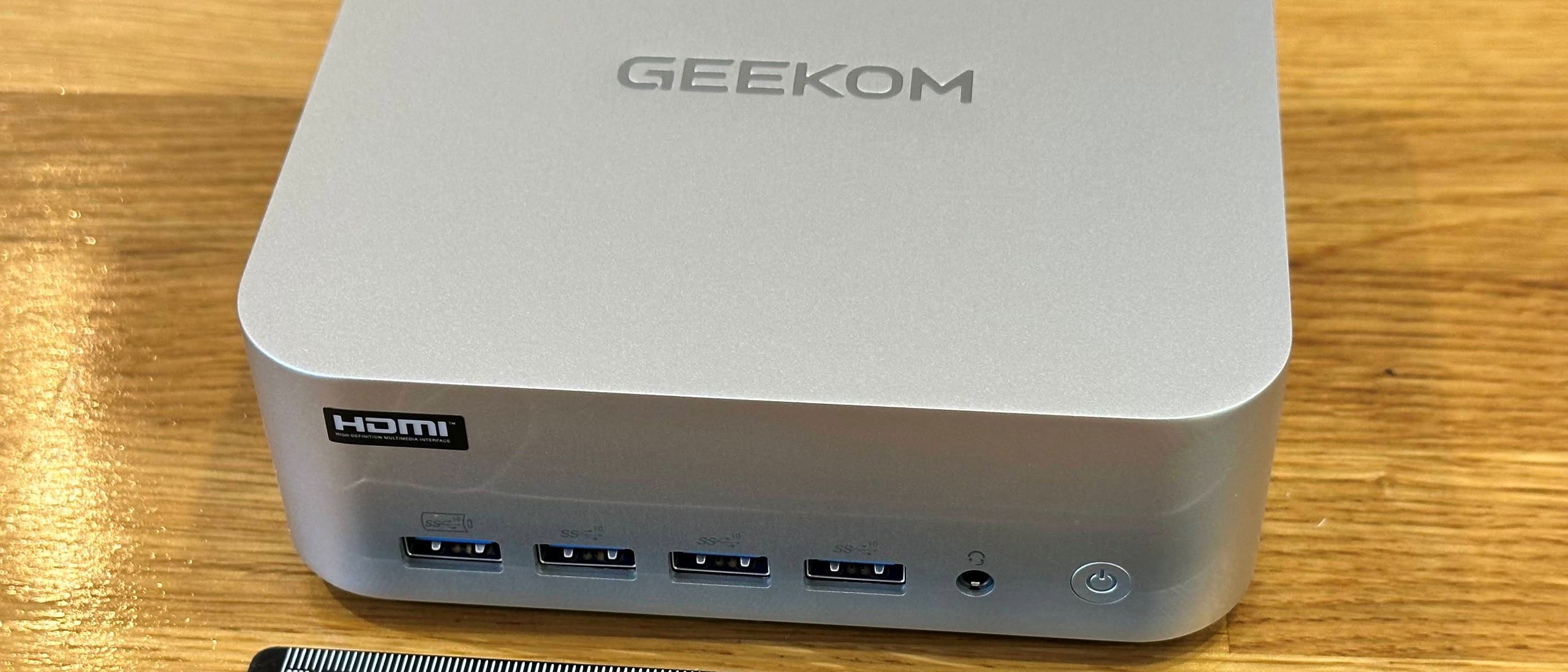
AMD’s Ryzen AI 9 HX 470, with its Zen 5 CPU architecture and 24 threads running at up to 5.2 GHz, won’t be holding anyone back in office productivity, general computing, and similar day-to-day tasks. It also has a great reputation for efficiency, inheriting the mantle of its predecessor, the Ryzen AI 9 HX 370, which gathered many design wins for AMD. Here, the CPU is fed by an ample 32GB of system RAM, and the 2TB PCIe Gen4 x4 SSD storage equipped is pretty fast too, with read/write transfer speeds of up to 6,139 MB/s and 5,499 MB/s, respectively, according to CrystalDiskMark.
(Image credit: Tom's Hardware) (Image credit: Tom's Hardware) (Image credit: Tom's Hardware) (Image credit: Tom's Hardware) (Image credit: Tom's Hardware) (Image credit: Tom's Hardware) (Image credit: Tom's Hardware) (Image credit: Tom's Hardware) Image 1 of 8 View Original
Multi-Threaded Image 1 of 11 (Image credit: Tom's Hardware) (Image credit: Tom's Hardware) (Image credit: Tom's Hardware) (Image credit: Tom's Hardware) (Image credit: Tom's Hardware) (Image credit: Tom's Hardware) (Image credit: Tom's Hardware) (Image credit: Tom's Hardware) (Image credit: Tom's Hardware) (Image credit: Tom's Hardware) (Image credit: Tom's Hardware) Image 1 of 11 View Original
In Cinebench 2026, the A9 Max 2026 scored 4,667 points in the multi-core test. That's very similar to the Beelink SER10 MAX with the exact same processor. No surprise. However, the Beelink has dual-channel RAM, which doesn't make a lot of difference in this kind of CPU-heavy rendering workload, as you can see. In the HandBrake video encoding test we see a similar story, with the Geekom middle of the pack, outpacing the Intel competition, but a smidgen behind its AMD brethren.
During our demanding tests, the Geekom A9 Max 2026 stayed admirably cool, but its peak noise level might make you want to move it to a less prominent area of the desk, or use the VESA mounting option to hide it behind your monitor.
In its marketing materials, Geekom pitches the new A9 Max as a computer for all niches, mentioning its CPU and AI compute power, as well as indeed gaming and being able to “conquer AAA titles with ease” thanks to the “Radeon 890M integrated graphics, clocked at a high frequency of 3.1GHz.” So, without further ado, let’s run through our standard set of synthetic 3D engine and gaming tests.
Before beginning the games benchmarking proper, I felt like firing up the old-but-gold Far Cry 5 for a bit of mayhem in Montana. After trying a few preset settings, I settled on 1080p Medium. The High preset was just a bit too slow, and Low settings seemed barely any faster. With Medium settings chosen as the sweet spot for this configuration, I adventured through the attractive wilderness and enjoyed eliminating a few crazy cult members. The average FPS of just above 30 FPS, with a minimum of 26 FPS (according to the built-in benchmark) was enough to enjoy the single-player game without being too distracted by performance issues. I am accustomed to 1440p gaming in this title with a higher quality level and a better frame rate. But it wasn’t insufferable on the A9 Max configuration we tested.
(Image credit: Tom's Hardware) (Image credit: Tom's Hardware) Image 1 of 2 View Original
Our benchmarks included a trio of 3DMark synthetics and two PC gaming standards. 3DMark Solar Bay is a great way to frame and compare cross-platform iGPU performance. Meanwhile, Steel Nomad turns to screws on raw graphics performance with its heavy modern GPU load, and will be better for comparisons when we start testing the higher-end mini PCs. Last and definitely not least, Speed Way is a 2025 benchmark from UL that uses DirectX Raytracing tier 1.1 for real-time global illumination and real-time ray-traced reflections.
3DMark Solar Bay tests seem like the best fit for this iGPU, with frame rates smooth enough that it doesn't hurt your eyes to watch. Sadly for the Geekom, it placed last in the pack in this test, even behind the office productivity targeted MSI Cubi NUC AI+ 3MG.
(Image credit: Tom's Hardware) (Image credit: Tom's Hardware) (Image credit: Tom's Hardware) (Image credit: Tom's Hardware) (Image credit: Tom's Hardware) (Image credit: Tom's Hardware) Image 1 of 6 View Original
Next up, built-in real game benchmarks courtesy of Shadow of the Tomb Raider and Cyberpunk 2077. The former scales well with processor resources and can still often look and run great on humble iGPUs. As for Cyberpunk 2077 , it can really push and tax even the strongest modern GPUs, so here we've used two settings to show how the little A9 Max 2026 can – and can't – play this game. High settings in this game resulted in a grating 17 FPS. Using the Steam Deck preset resulted in a far more playable 29 FPS.
Moving over to Shadow of the Tomb Raider (SOTTR), and the A9 Max 2026 as configured managed just a 26 FPS average. If you have no other avenues to enjoy this game, you’ll have to nudge settings lower to get above a consistent 30 FPS. Opting for 720p visuals could also help, if you were willing to do so.
We had a similarly disappointing gaming experience during the Minisforum X1 AI Pro 470 review , which also combined this exact AMD Zen 5 mobile processor with a single 32GB stick of DDR5-5600. Check the details of that article to learn exactly the difference reconfiguring the DDR5 to dual-channel can make (spoiler: equipping dual-channel memory made a very big difference in our 3D gaming performance tests). In our newest mini PC tests, the Beelink SER10 MAX comes with the same AMD Ryzen AI 9 HX 470 processor but is kitted out with dual-channel RAM and can hit a far smoother 54 FPS in the SOTTR High preset.
This little computer was pleasingly thrifty when it came to power use. Measured at the wall, I observed a mere 7W of power was being pulled by the system when idling in Windows 11 . Under the heaviest loads I could muster, the system power consumption rose to about 79W. System tools showed that the idle / stress CPU temperatures were around 34C and 79C, respectively. Perhaps Geekom could quiet the IceBlast 3.0 fans, then? Or, if you buy this, you’d have latitude to slow the fan profiles in the BIOS.
Geekom’s A9 Max 2026 was quiet at idle, with my readings showing it made about 29 to 30dB noise. The loudest it got was around 41dB, when I was trying to stress the system by running CPU and GPU benchmark tests simultaneously.
Geekom boasts about its new IceBlast 3.0 system here. I found that it works well enough as shipped, but it isn’t the quietest under load and may benefit from user tweaks. There’s no software for these kinds of adjustments, though, so it is a BIOS tweak / reboot process you’ll have to work through.
Geekom ships the A9 Max 2026 with no custom software at all. It's just clean Windows 11 Pro, as supplied. Also, we note that the marketing material boasts the system fully supports both Windows 11 and Linux. At the time of writing, there is only one fully populated option for would-be buyers of the A9 Max 2026 – identical to our test unit – so you can’t potentially save money by going barebone / Linux.
A 3-year warranty is provided with the A9 Max 2026.
Key considerations
- Investor positioning can change fast
- Volatility remains possible near catalysts
- Macro rates and liquidity can dominate flows
Reference reading
- https://www.tomshardware.com/desktops/mini-pcs/SPONSORED_LINK_URL
- https://www.tomshardware.com/desktops/mini-pcs/geekom-a9-max-2026-mini-pc-review#main
- https://futureplc.com/privacy-policy/
- Delaware’s Printed Solid rebrands to Prusa USA
- NVIDIA Vera Rubin Maximizes Intelligence per Dollar for Post-Training Workloads — a Key Metric for Agentic AI
- Game Compressor can save you hundreds of GB across your game library — as storage prices remain high, utility leverages Windows' built-in LZX compression for su
- Why Performance per Watt Is the Ultimate Metric for AI Infrastructure Efficiency
- AMD’s new X100 chip lineup puts embedded Ryzen AI 'Strix Halo' chips into robots – APUs for physical AI bring Zen 5 CPU, RDNA 3.5 GPU cores to compete with Inte
Informational only. No financial advice. Do your own research.