
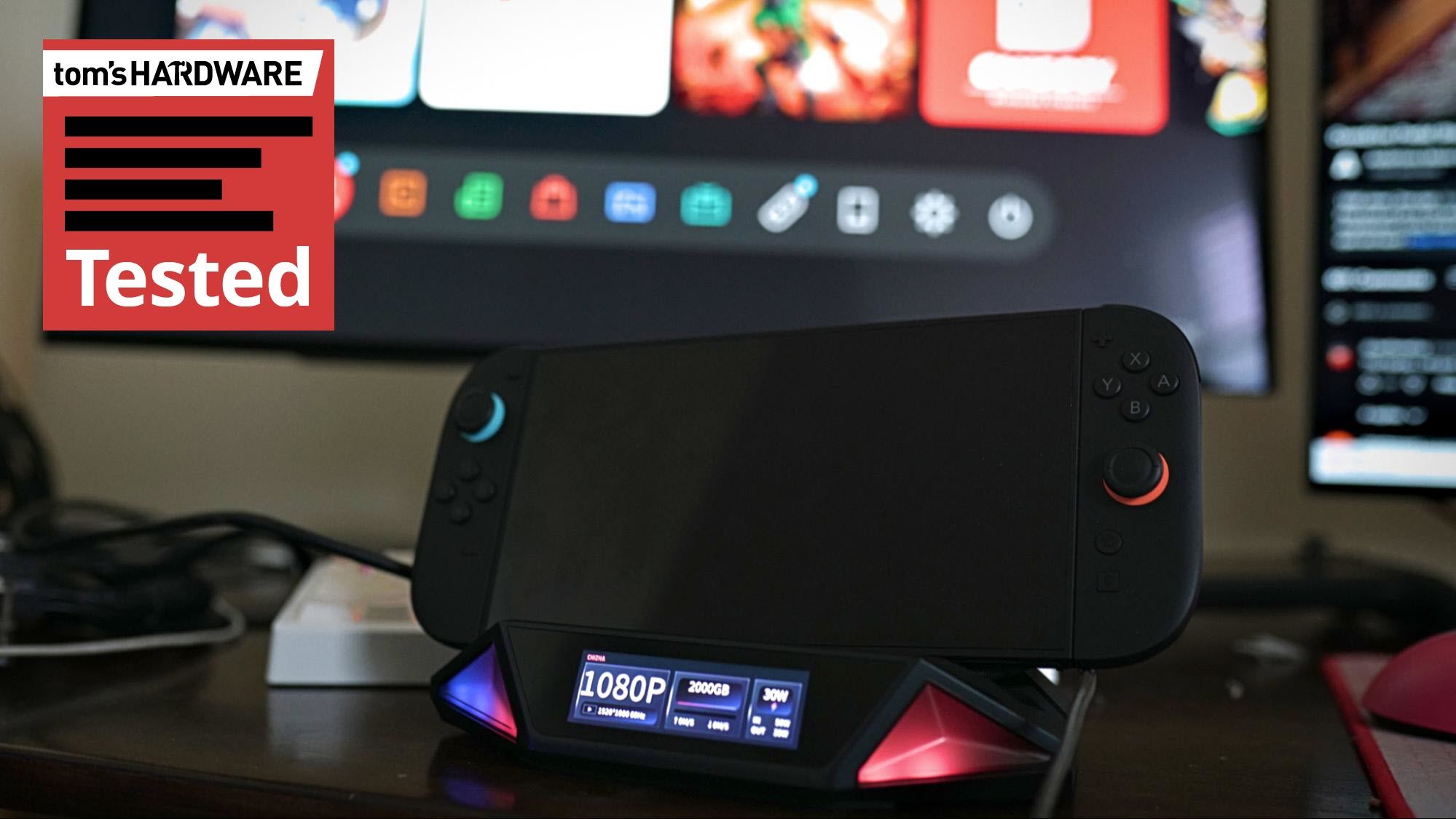
Setting up the Mount Ling 2 Pro is mostly a matter of plugging everything in and getting on your way. The dock goes through a connecting phase when you hook up a new device, and it’s finicky. Sometimes it would drop one part of the connection, like charging, while picking up another, particularly with the Switch 2. You want to have the dock fully connected before hooking up your host.
For the dock itself, you have some small control over the fan and built-in lighting. For the fan, you can adjust the speed manually, turn it off, or leave it on the default automatic mode. The lighting settings are surprisingly bare. You can choose between blue, red, or a gradient between them, and that’s it. Otherwise, you can just dim or turn off the lights. If you find the screen and lights distracting, there’s a dedicated button on the back of the dock to turn all the lights off (including the screen).
Although the screen is responsive with minimal lag between swipes and taps, the software running here isn’t perfect. Particularly with the Switch 2, if I connected things in the wrong order, the dock would force itself to reboot, only sometimes picking up the Switch 2 when it came back. DockCase offers firmware updates over USB, and hopefully it gets a patch between units shipped to fix some of these quirks.
The firmware updates are a nice sign, but they bring up an unfortunate reality of creating a device for the Switch 2 without Nintendo’s seal of approval. Both the Switch and Switch 2 are infamously fickle with third-party docks and hubs. A system update could break compatibility, forcing a firmware update.
DockCase plays up Switch 2 support on its product page, and that is a big draw. However, the dock can’t get around the limitations that Nintendo itself has placed on its handheld. You may as well fill the SSD slot with concrete if you’re docking a Switch 2, and docking the device is troublesome. It took multiple emails for me to get the Switch 2 to pass through its HDMI signal at all. You have to connect everything in a specific way, and critically, have the Switch 2 already unlocked when you plug it into the bottom USB-C port; the top port won’t work.
With the Steam Deck, everything was seamless, and although I didn’t have a Windows handheld on hand to try out, I don’t anticipate there will be major issues. DockCase may offer a lot of functionality in a single box with the Mount Ling Pro 2, but it’s all operating over standard connections that are well supported in the Windows ecosystem.
You can use the SSD with the Steam Deck, though you’ll need to head to desktop mode to partition the drive and add a folder for Steam games. The process is similar on Windows handhelds if you’re using some sort of handheld-native overlay.
For the capture portion, it serves its purpose. Critically, DockCase doesn’t have any software for capturing or recording like the mainstream capture cards you’ll find from Elgato and AVerMedia, so you’ll need to use something else like OBS. For any of these types of recording/streaming platforms, the DockCase shows up as a simple video capture device, with resolution and frame rate determined by your settings on the host device (assuming it’s within that 4K60 limit that HDMI 2.0 is capable of).
There isn’t much of a need here for HDMI 2.1, considering the types of devices connecting to the Mount Ling Pro 2, though it would’ve been a nice upside. You can still push the refresh rate higher, just not at 4K. And in fairness to DockCase, the devices it’s targeting really have no business driving a 4K display.
You shouldn’t expect wonders out of SSD performance with the Mount Ling 2 Pro, given that it uses a USB 3.2 Gen 2 connection that’s only capable of up to 10 Gbps. High performance in an external enclosure is the game of Thunderbolt 5 docks with M.2 storage, which can often reach sequential reads above 5,000 MB/s over the 80 Gbps Thunderbolt 5 interface. Here, the connection will bottleneck your speeds, all the way down to typical PCIe 3.0 NVMe SSDs.
Still, in the context of gaming on a handheld, that isn’t the end of the world. It’s nice to have that much storage on tap for a device like the Steam Deck, which is otherwise only expandable with a larger internal SSmicroSDicro SD card.
In CrystalDiskMark, the Mount Ling 2 Pro landed with sequential reads and writes around 820 MB/s, with random performance far lower. We tested with a 2 TB WD_Black SN770, which is a PCIe 4.0 drive that boasts sequential reads up to 5150 MB/s when installed directly in a motherboard. In the Mount Ling 2 Pro, it behaves more like an external SSD like the SK hynix Beetle X31 2TB , naturally hamstrung by the connection.
The Mount Ling 2 Pro does a lot, combining external storage, a capture card, and an attractive dock into a single package that works with both PC handhelds and the Nintendo Switch 2. The SSD performance isn’t great, as is to be expected out of a dock that uses a 10 Gbps USB link for connection, but that downside isn’t much of a concern considering the devices this dock targets.
Although Switch 2 support is a big upside, it’s also fickle. You don’t get access to the SSD, and the connection can fail if you don’t follow the order of operations for connection. The Mount Ling 2 Pro makes sense if you have a Switch 2 and a PC handheld of some kind, but as a pure Switch 2 dock, it doesn’t make much sense. You’d be better off buying an external capture card for use with the official dock.
Jake Roach Social Links Navigation Senior Analyst, CPUs Jake Roach is the Senior CPU Analyst at Tom’s Hardware, writing reviews, news, and features about the latest consumer and workstation processors.
Air2004 "It’s a dock for handhelds like the Steam Deck and Switch 2," "Of course, this external storage only works with platforms that normally support external storage (so, not the Switch or Switch 2)." "For the Switch and Switch 2 , the usefulness isn’t as clear." So, why would you mention the Switch 2 in the first paragraph???? Reply
Key considerations
- Investor positioning can change fast
- Volatility remains possible near catalysts
- Macro rates and liquidity can dominate flows
Reference reading
- https://www.tomshardware.com/peripherals/docking-stations-hubs/SPONSORED_LINK_URL
- https://www.tomshardware.com/peripherals/docking-stations-hubs/hands-on-with-the-dockcase-mount-ling-2-pro-handheld-dock-with-a-built-in-capture-card-and-space-for-up-to-4tb-of-nvme-storage#main
- https://www.tomshardware.com/membership
- 8 converted jet engines are powering xAI data centers as companies look for new energy sources
- Apple finally has a touchscreen MacBook. Why now?
- OpenAI introduces program to reduce AI data center energy demand during peak hours
- Apple faces unprecedented memory cost increases as RAM prices continue to surge, manufacturing bill climbs by $33 billion
- Engineer creates retro FPGA Game Boy console that can rip your cartridges to an SD card natively
Informational only. No financial advice. Do your own research.