
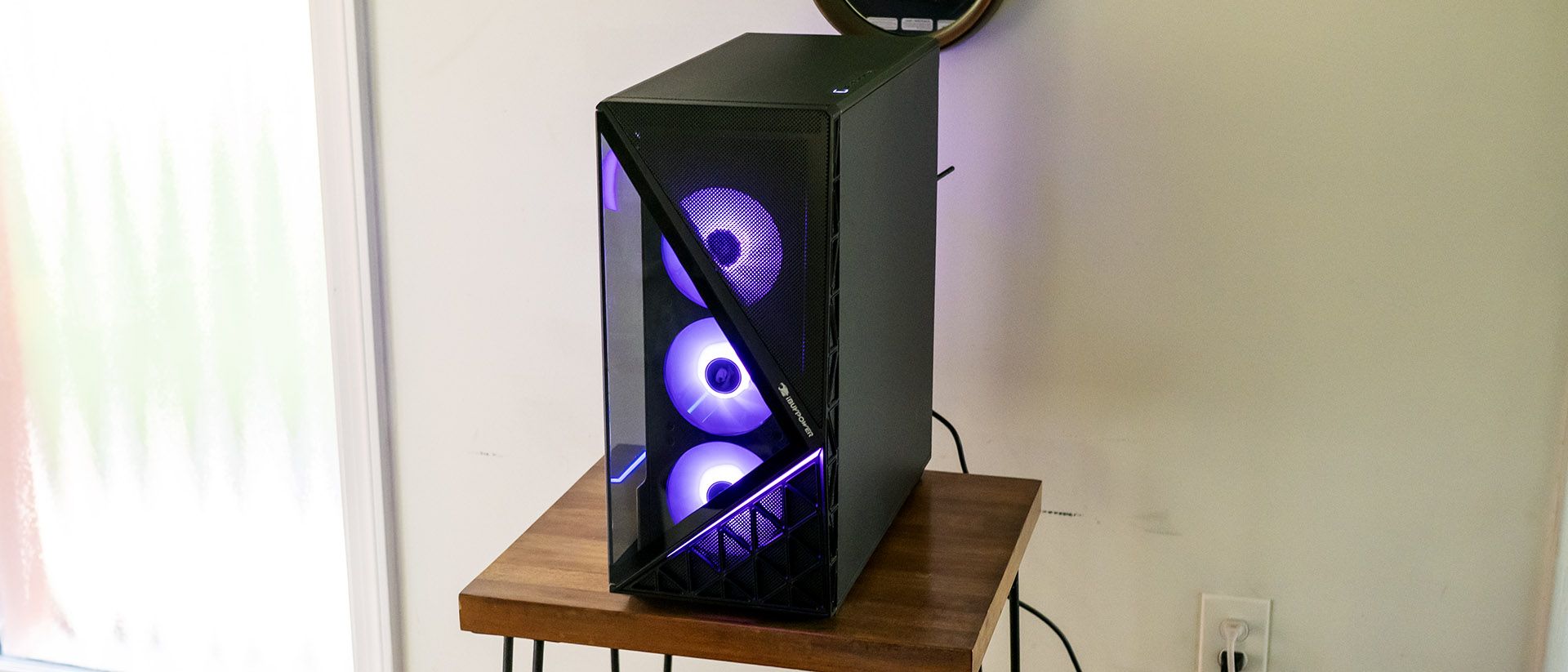
The side panels come off with a tug at the top rear, hinging outward and away. Seven 120 mm fans – three front, three on the top-mounted 360 mm CPU cooling radiator, and one rear – provide plentiful airflow. Cabling is reasonably tidy, though the bundle of unused cables from the non-modular 750-watt power supply is a bit of a mess.
The CPU cooler is more than a basic model, with an LED screen showing CPU temperature, frequency, and load. The display can’t be customized, though it can be toggled off in the Hyte Nexus app.
(Image credit: Tom's Hardware) (Image credit: Tom's Hardware) Image 1 of 2 View Original
The Slate’s expansion options include one open PCIe x16 slot and four DIMM slots, two of which are unpopulated. The motherboard offers two M.2 2280 drive slots. There are two 2.5-inch drive sleds behind the motherboard, but no room for a 3.5-inch drive.
We are testing the iBuyPower Slate with a Ryzen 7 7700X3D processor, GeForce RTX 5070 GPU, and 32GB of RAM.
Playing 007 First Light , at 3840 x 2160 with High settings and DLSS enabled, I observed between 60 and 70 frames per second (FPS) in outdoor scenes and closer to 80 FPS indoors. Using DLSS was required for smooth gameplay, as I saw roughly half the FPS without it.
Our comparison desktops include the Asus ROG G700 (Core Ultra 7 265KF, RTX 5070, $2,029.99 when reviewed) and the CyberPowerPC Gaming Desktop GXi3800BSTV2 (Core Ultra 7 270K Plus, RTX 5070, $2,309.99), both mid-tower systems with the same GPU but Intel processors.
(Image credit: Tom's Hardware) (Image credit: Tom's Hardware) (Image credit: Tom's Hardware) (Image credit: Tom's Hardware) (Image credit: Tom's Hardware) Image 1 of 5 View Original
At 1080p, iBuyPower’s Slate proved competitive overall, matching the Asus and CyberPowerPC in Shadow of the Tomb Raider (Highest settings), Cyberpunk 2077 (Ray Tracing Ultra), and Black Myth: Wukong (Cinematic). However, its Ryzen 7 7700X3D paid dividends in Far Cry 6 (Ultra), where its 185 FPS was well ahead of the Asus (110 FPS) and CyberPowerPC (141 FPS). It led by a similar amount in Red Dead Redemption 2 , with 145 FPS against the Asus’ 120 FPS and the CyberPowerPC’s 126 FPS.
The Slate generally didn’t differentiate itself from the other desktops at the 4K resolution, an expected result since that resolution is almost always GPU-limited and these systems all rely on an RTX 5070. The exception was Far Cry 6 , where the Slate’s 97 FPS greatly outperformed the 80 and 81 FPS produced by the Asus and CyberPowerPC, respectively.
Overall, despite its Ryzen 7 7700X3D not being nearly as powerful for general use as the Core Ultra 7 265K and Core Ultra 7 270K Plus featured in our competing systems, it can outperform both chips in games.
We stress-test gaming desktops running 15 loops of the Metro: Exodus benchmark at RTX settings. The iBuyPower desktop posted highly stable performance, averaging 145.7 FPS across all runs with less than a one frame variance across all runs. The Ryzen 7 7700X3D’s average temperature was 43 degrees Celsius and its average clock was 4.29 GHz. The RTX 5070 ran at 64 C and had an average core clock of 2.64 GHz.
I noticed a decent amount of fan noise from the Slate particularly when the CPU was stressed, causing the triple-fan CPU cooler to quickly ramp up to high speed. The fan noise was hardly noticeable for daily use and was relatively low while gaming as well.
We tested the iBuyPower Slate gaming desktop featuring a Ryzen 7 7700X3D processor, 32GB of dual-channel DDR5-5200 RAM, and a 1TB PCIe 4.0 solid-state drive (a Patriot P410 as tested).
(Image credit: Tom's Hardware) (Image credit: Tom's Hardware) (Image credit: Tom's Hardware) Image 1 of 3 View Original
Productivity performance isn’t a strong point for this Slate configuration. Though its Ryzen 7 7700X3D remains potent for gaming, its previous generation eight-core architecture is outmuscled by the Core Ultra 7 K-class chips in both the Asus and CyberPowerPC systems, particularly the latter with its refreshed Core Ultra 7 270K Plus . The delta was significant: iBuyPower's system scored 14,222 in Geekbench multi-core versus 22,485 for CyberPowerPC, and took 3:35 to complete our 4K to 1080p Handbrake transcoding test versus just 2:03 for the Asus and 1:45 for the CyberPowerPC. The iBuyPower system does, however, include a decent storage drive, proving competitive in our 25GB file transfer test.
Despite the Slate’s performance delta versus the Core Ultra 7 systems, this PC is still highly capable for daily productivity and moderate content creation, such as video editing. Only those squeezing every last drop of performance out of their CPU will find it compelling to go with a more powerful chip than the Ryzen 7 7700X3D.
The Slate includes much better than average peripherals. The mechanical keyboard is the standout. Though not stated in the specs, it feels like it uses linear switches favored by gamers for their predictability. It felt rock solid in my testing and wasn’t overly loud. The keyboard supports RGB backlighting, though not per-key – the lighting can be set in the included Hyte Nexus app for various colors and patterns. You can also control the lighting through keyboard shortcuts – Fn+Ctrl cycles colors, Fn+Left/Right arrows alter brightness, Fn+Space Bar disables lighting, and Fn+Alt cycles through 16 backlighting patterns, such as breathing, pulsing, and steady. It’s also nice to see that the keyboard uses a detachable USB-C cable.
The mouse is also better than average, though it’s only for right handers. The standard buttons offer a solid feel, with two side buttons and a notched scroll wheel. The DPI button behind the scroll wheel switches between 1,200, 2,400, 3,500, 5,500, and 7,200 DPI, which are visually indicated by the DPI button illuminating in red, blue, green, purple, and yellow, respectively. The mouse fits my medium-size hand well. It’s internally backlit in RGB color, which can be configured in Hyte Nexus or toggled through 10 modes pressing the button on the underside. Patterns include color streaming, steady, and breathing, to name a few.
(Image credit: Tom's Hardware) (Image credit: Tom's Hardware) Image 1 of 2 View Original
Software and Warranty on the iBuyPower Slate Gaming Desktop Besides the usual preinstalled Windows 11 apps, iBuyPower only preloads one app – Hyte Nexus. It provides basic component temperature and frequency monitoring, but its real focus is RGB lighting control.
That said, there’s no way to control lighting on a per-component basis – colors and patterns apply to all components at once since they are all connected to ARGB header 1. Confusingly, the app lets you change settings for the other headers, but this has no effect since nothing is connected to them. If the app indicated that those headers aren’t connected, this would have been more straightforward. The Slate nonetheless allows a decent amount of lighting customization despite lacking an advanced lighting controller, which would have increased the cost.
iBuyPower covers the Slate with a one-year parts and labor warranty.
Key considerations
- Investor positioning can change fast
- Volatility remains possible near catalysts
- Macro rates and liquidity can dominate flows
Reference reading
- https://www.tomshardware.com/desktops/gaming-pcs/SPONSORED_LINK_URL
- https://www.tomshardware.com/desktops/gaming-pcs/ibuypower-slate-gaming-desktop-review#main
- https://www.tomshardware.com/membership
- AI Chip Design Week
- Meta's Muse AI agent accused of ignoring user permissions and accessing forbidden personal user data
- Former EVGA employee recounts company’s degrading relationship with Nvidia before 2022 blow-up
- Developer trains a small AI on a single RTX 3080 Ti gaming GPU to 'play' Pokémon Red
- NVIDIA Isaac ROS 5.0 Advances Agentic, Open Source Robotics Development
Informational only. No financial advice. Do your own research.