
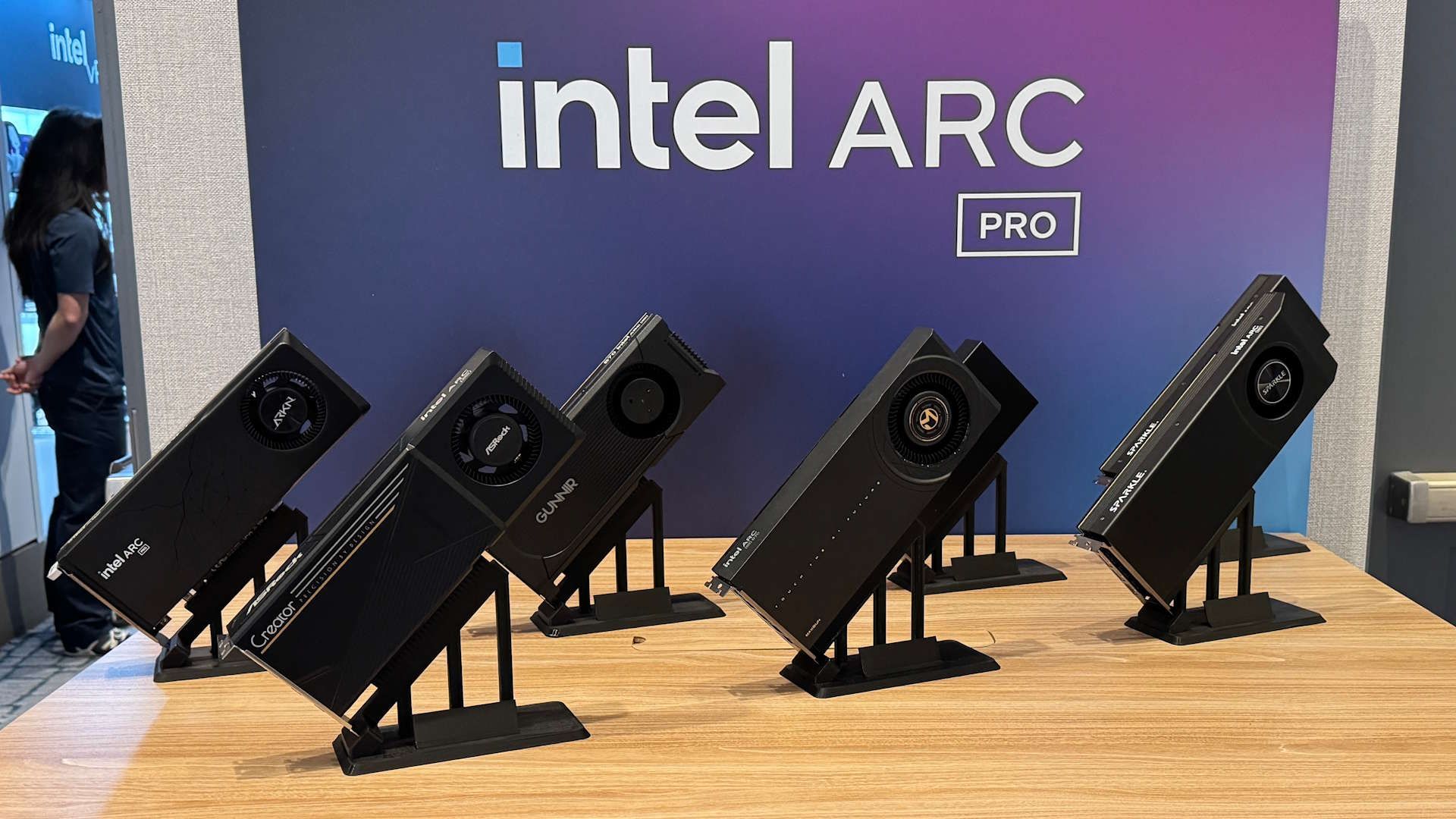
Of course, that'll remind many of the forever-rumored Arc B770 , the successor to the Arc A770 and a flagship gaming GPU that has been in the news cycle for years with no release in sight. Recent reports have even pointed that that the Xe3P "Celestial" family will have no discrete gaming GPU , along with the next-gen Xe4 "Druid" lineup, so we're stuck with the Arc B580 as the Blue Team's best offering for now.
Then there's the issue of pricing; if an Arc B770 were to come out, it will need to be positioned under $500 if it actually wants to compete with AMD and Nvidia, besting their 70-series MSRPs. As it stands, the Arc Pro B70 in this test costs $949, mostly because of the 32GB VRAM and the fact that the AI focus. For that price, you can instead get a used RTX 3090 or RX 7900 XTX easily, if gaming's your only concern, and both of them will destroy any GPU featured here.
Follow Tom's Hardware on Google News , or add us as a preferred source , to get our latest news, analysis, & reviews in your feeds.
Hassam Nasir is a die-hard hardware enthusiast with years of experience as a tech editor and writer, focusing on detailed CPU comparisons and general hardware news. When he\u2019s not working, you\u2019ll find him bending tubes for his ever-evolving custom water-loop gaming rig or benchmarking the latest CPUs and GPUs just for fun. ","collapsible":{"enabled":true,"maxHeight":250,"readMoreText":"Read more","readLessText":"Read less"}}), "https://slice.vanilla.futurecdn.net/13-4-22/js/authorBio.js"); } else { console.error('%c FTE ','background: #9306F9; color: #ffffff','no lazy slice hydration function available'); } Hassam Nasir Social Links Navigation Contributing Writer Hassam Nasir is a die-hard hardware enthusiast with years of experience as a tech editor and writer, focusing on detailed CPU comparisons and general hardware news. When he’s not working, you’ll find him bending tubes for his ever-evolving custom water-loop gaming rig or benchmarking the latest CPUs and GPUs just for fun.
Notton There's definitely a reason for bundling B70 with 32GB VRAM and selling it at $950, rather than 16GB and closer to $400 B70 is estimated to have 368~375mm² RTX 5060 Ti is 181mm² with $430 MSRP For comparison purposes, RTX 5080 is 378mm² with $1000 MSRP Reply
Juan-PierreC It would have been nice if you tested the GPU in a local LLM scenario against 5060ti or the 5070ti/RX 7090 XT which is where I'm currently aiming at, As a tinkerer with shallow pockets it would be nice to see which is the best of both worlds. As far as I under stand it the extra ram is better for a bigger context window and more accuracy, but one has to weigh whether accuracy is what you need in terms of learning and having a fun gaming experience too. GPU pass through on linux is fairly painless for instance with NVidia. I have not attempted it with another brand yet. Reply
bit_user This is actually rather poor, considering the B70's greater memory bandwidth and die area. The B70 die is 368 mm^2, according to TechPowerUp's database, while the RTX 5060 Ti has only a 181 mm^2 die. They're both on N5-family nodes, although the RTX 5000 series is using a newer iteration. Still, the Intel GPU should easily overcome that, with a 2.03x area advantage! In terms of memory bandwidth, Nvidia is again using a newer technology (GDDR7), but has a data path only half as wide. That gives the Intel card a 35.7% net advantage. So, unless there are some key driver optimizations still missing, I think we might be getting some insight into why Intel didn't release a gaming card with this GPU. Based on how it would've been priced, I think they really needed it to match up against the RTX 5070, at least. That card still has a significantly smaller die, but actually a little more memory bandwidth. Maybe a B770 could've clocked it s GDDR6 high enough to nullify that, which the RX 9070 managed to do. Reply
bit_user Notton said: B70 is estimated to have 368~375mm² RTX 5060 Ti is 181mm² with $430 MSRP They're on slightly different nodes, but yeah. My thoughts went immediately to die size & memory bandwidth. Reply
thestryker bit_user said: This is actually rather poor, considering the B70's greater memory bandwidth and die area. The B70 die is 368 mm^2, according to TechPowerUp's database, while the RTX 5060 Ti has only a 181 mm^2 die. They're both on N5-family nodes, although the RTX 5000 series is using a newer iteration. Still, the Intel GPU should easily overcome that, with a 2.03x area advantage! In terms of memory bandwidth, Nvidia is again using a newer technology (GDDR7), but has a data path only half as wide. That gives the Intel card a 35.7% net advantage. So, unless there are some key driver optimizations still missing, I think we might be getting some insight into why Intel didn't release a gaming card with this GPU. Based on how it would've been priced, I think they really needed it to match up against the RTX 5070, at least. That card still has a significantly smaller die, but actually a little more memory bandwidth. Maybe a B770 could've clocked it s GDDR6 high enough to nullify that, which the RX 9070 managed to do. Welcome to Intel Arc? This is exactly the same as the B580 with regards to die size vs performance level. With 60% more cores than the B580 the chances of that performance increase being linear is basically zero since it only has a third more memory bandwidth. Roughly the performance of a 4070 was always the best case scenario and I imagine when tested among a wider amount of games that's probably about where this would end up. Until Intel catches up on die size vs performance and/or is using their own nodes to manufacture dGPUs I don't expect to see client cards again. The margins simply aren't there compared to the entry level enterprise market the B70 exists in or the integrated market. The positive side of this of course being that both of those markets should continue to be viable for Intel which means client dGPUs can come back at any time should the economics be sufficient for leadership. Reply
beyondlogic bit_user said: This is actually rather poor, considering the B70's greater memory bandwidth and die area. The B70 die is 368 mm^2, according to TechPowerUp's database, while the RTX 5060 Ti has only a 181 mm^2 die. They're both on N5-family nodes, although the RTX 5000 series is using a newer iteration. Still, the Intel GPU should easily overcome that, with a 2.03x area advantage! In terms of memory bandwidth, Nvidia is again using a newer technology (GDDR7), but has a data path only half as wide. That gives the Intel card a 35.7% net advantage. So, unless there are some key driver optimizations still missing, I think we might be getting some insight into why Intel didn't release a gaming card with this GPU. Based on how it would've been priced, I think they really needed it to match up against the RTX 5070, at least. That card still has a significantly smaller die, but actually a little more memory bandwidth. Maybe a B770 could've clocked it s GDDR6 high enough to nullify that, which the RX 9070 managed to do. From a tech perspective like that sure it's not that impressive but then again these cards were not ment to gaming and don't have the drivers for it which from my experience is vital for intel cards I couldn't see on the review what CPU was paired with it we know past driver overhead dunno if faster x3d would have made a difference ?. My cousin's a750 performs extremely well for price I paid for example and every driver made it far better. Reply
bit_user beyondlogic said: From a tech perspective like that sure it's not that impressive but then again these cards were not ment to gaming and don't have the drivers for it which from my experience is vital for intel cards Yeah, I get that. I was contemplating buying a B770, if it got released, even if the perf/$ was a bit worse than Nvidia or AMD. But, I was hoping for a bit better than this showing. We don't know how much it's suffering from a lack of driver optimizations or the pairing of CPU, as you mentioned. So, I don't take it as the final word, but not a really promising sign. Reply
thestryker beyondlogic said: review what CPU was paired with 9950X so it would definitely be more interesting with a single CCD X3D part. bit_user said: But, I was hoping for a bit better than this showing. This is also a 290W TDP SKU (Intel's model is 230W) which in theory should put it in its best light boost clocks wise. I couldn't tell what they were using to poll the power data but it did seem to fluctuate quite a bit (3DMark) which would point towards a utilization problem. Whether this is driver related (their conclusion indicated they thought there were driver issues) or architecture related it's hard to say since they didn't show any other power results. Reply
greenreaper "Roughly twice as fast as Arc B580 on average" – I'm sorry, what? No. This is just a false headline. In the tests it is roughly 40-50% faster on average, in one case 65%, in many cases 30% or less. Which is what you would expect since it has 1.6x cores over the B580. The only case where it might be faster than that would be tests in which the memory requirements exceed the 12GB buffer, which likely didn't happen much if at all in this testing. Reply
beyondlogic bit_user said: Yeah, I get that. I was contemplating buying a B770, if it got released, even if the perf/$ was a bit worse than Nvidia or AMD. But, I was hoping for a bit better than this showing. We don't know how much it's suffering from a lack of driver optimizations or the pairing of CPU, as you mentioned. So, I don't take it as the final word, but not a really promising sign. Lol so was I was very disappointed when it didn't amount to anything cause I feel intel only got it's toes wet in that market and it's going to cause users that have bought b580 to reconsider any intel GPU in future since there rug pulling everything which to me is pretty much a slap to there current base. Reply
Key considerations
- Investor positioning can change fast
- Volatility remains possible near catalysts
- Macro rates and liquidity can dominate flows
Reference reading
- https://www.tomshardware.com/pc-components/gpus/SPONSORED_LINK_URL
- https://www.tomshardware.com/pc-components/gpus/intels-arc-pro-b70-workstation-gpu-with-32gb-of-vram-gets-tested-in-games-roughly-twice-as-fast-as-arc-b580-on-average-beats-rtx-5060-ti-in-some-titles#main
- https://www.tomshardware.com
- Secretlab launches Mandalorian Titan Evo gaming chair in Star Wars collection for May the 4th — collab builds with a new high-end themed chair
- New server-focused SPEC CPU 2026 benchmarking suite has results for a Raspberry Pi 5 — updated tools feature more tests and can run a wide range of systems
- Retailer selling broken RTX 5090 GPUs for as low as $1,760 — GPUs were damaged during transport, but include all components on the PCB
- Notepad++ creator threatens legal action over macOS port of open-source app — developer says port is fine, but branding is too far
- No Need for Space Gear — Capcom’s ‘PRAGMATA’ Joins GeForce NOW on Launch Day
Informational only. No financial advice. Do your own research.