
Leaked Intel Nova Lake product list has three 'BFC' chips with up to 144MB of game-boosting L3 cache
(Image credit: Tom's Hardware) (Image credit: Tom's Hardware) Image 1 of 2 View Original
On the networking side, expect another round of 2.5-5GbE on most boards, with the cheapest options opting for the less expensive 1GbE. Premium boards, on the other hand, will work in dual Ethernet connections and 10 GbE. We’ll see a lot of Realtek 8125/8126 (2.5/5GbE) chips, along with some Killer E3100G, and perhaps Killer’s E5000 mixed in, too. 10GbE will still rely on the Marvell AQtion, like the AQC113C.
Integrated Wi-Fi support will vary, with most SKUs opting to use Wi-Fi 7. You’ll see a smattering of the ‘slower’ 160 MHz Wi-Fi 7 which, in reality, is plenty fast and will not be a choke point for most users on less expensive boards. The faster 320 MHz widens the bandwidth highway from four lanes to eight, so you can move twice as much data simultaneously. We expect chips from MediaTek (MT7927), Intel (BE200/202), and Realtek (RTL9822AE) to dominate the Wi-Fi 7 scene for Nova Point boards. Just remember: to take advantage of Wi-Fi 7, you need a Wi-Fi 7-capable router in the first place.
We’ve seen leaks from the Eurasian Economic Union database Gigabyte (via Videocardz), listing a whopping 24 SKUs. We’ve also seen leaks about several ASRock motherboards via shipping records ( via Club386 ). So far, there's not been a peep from MSI or Asus, but you can bet they’ll have a full complement of new boards of all shapes, sizes, and price points. But remember, just because something is listed in the EEU database doesn’t mean it will be released, or released in the U.S. So until we see an official list from the board partners, take this with a pinch of salt.
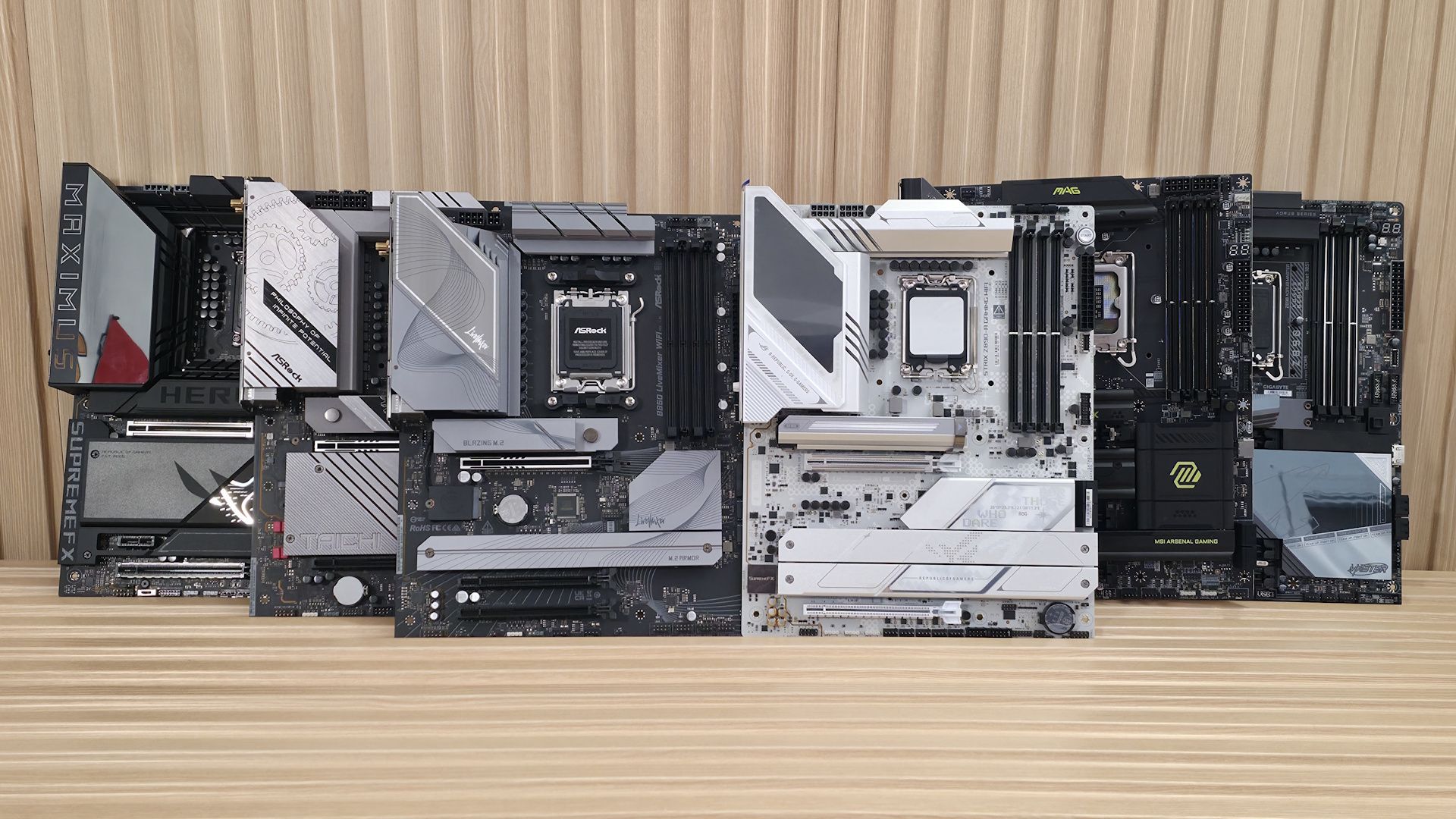
For Gigabyte, we see a lot of familiar faces in the list, including the flagship Aorus Xtreme, Aorus Master (now in three different SKUs), Aorus Pro and Elite (six total SKUs), and it even looks like they are planning multiple rear-connect Aorus Stealth options. We’ll also see several Aorus Elite and more affordable Eagle SKUs, along with more Duo X boards (this time from different families), all presumably using a 2-DIMM topology that supports high-density CQDIMMs. Micro ATX and Mini-ITX boards are also listed along with the wood-accent Aero models that made a splash this year.
ASRock is offering six different models, from the flagship-class Taichi (White) and Taichi Creator to the budget Pro RS Wifi and Z990 Challenger SKUs. In between, they have multiple variants of the Steel Legend Wi-Fi. What we don’t see from here are Micro ATX or Mini-ITX form factors, or any Z970 or B960 offerings out of the gate. We'll almost certainly be seeing those before long.
Asus has been tight-lipped, and as of this writing, we haven’t heard a peep about their boards. I’m confident we’ll see the usual ROG Maximus, ROG Strix, ProArt, TUF, and Prime lines (among others), with their typical Asus flair and value-add features like AI-assisted functionality (automating performance, optimizing cooling, managing network traffic, etc.).
MSI has also kept its cards close to the vest, and we haven’t seen much from them yet. But we do expect to see the company's lineup in full force. We expect to see the flagship Godlike board from the MEG series, high-end Ace, and mid-range MPG offerings like the Carbon and Edge, along with the MAG value series like the Tomahawk. I’d also imagine we’ll see some small-form-factor offerings, too, like a Z990 Edge Ti Wifi. In short, motherboard partners won’t miss the boat for a fresh revenue stream, and we’re sure to see a lot of options available come launch day.
Pricing for these future motherboards hasn't been listed. Still, you can imagine, with the increase in PCIe 5.0 bandwidth available and the copper needed to support it, hardware upgrades, and other external factors, it's safe to assume most SKUs will increase in price, or, with some luck, be the same as previous-gen versions. Either way, this is the start of a new platform, and those looking for a long-lasting socket should get in on the ground floor, assuming the performance is good, of course.
So who are these motherboards for, really? With the cost of video cards, storage, and, of course, RAM through the roof, upgrading to the new platform isn’t going to be cheap, especially if you want to get the most out of it. While RAM speeds tend not to make a significant difference in many cases, it can in others. So reaching the base memory speeds of this new platform will cost an arm and a leg. As mentioned earlier, it will run with existing RAM below that value. Still, performance losses will range from negligible to notable, depending on differences in speed and timings, as well as the work being executed and the application used.
Nova Point-based motherboards are shaping up as a meaningful step for Intel’s new platform: a new LGA 1954 socket, 12 PCIe 5.0 lanes attached to the chipset for Z990, Thunderbolt 5 support, and increased base memory speed to DDR5-8000. We even saw Intel add another enthusiast chipset to bridge the gap between enthusiast and mainstream in these trying times. Most of this information comes from leaks and rumors, and without a firm launch date from Intel, details and lineups could change before the Nova Lake CPUs arrive, supposedly in early 2027. We expect to see a lot of boards at CES 2027, with launches following soon after.
If the new CPUs are competitive with AMD's X3D offering, we can imagine those also costing more than the Arrow Lake refresh chips. If you already have a capable system, waiting to see the official lineups, performance, and pricing is the smarter move. But if you want the most PCIe 5.0 storage and the fastest external connectivity with TB5, this platform is built for you. Otherwise, you can likely make do with what you have for a little while longer, hopefully until inflated prices on at least some major components drop.
Joe Shields Staff Writer, Components Joe Shields is a staff writer at Tom’s Hardware. He reviews motherboards and PC components.
Key considerations
- Investor positioning can change fast
- Volatility remains possible near catalysts
- Macro rates and liquidity can dominate flows
Reference reading
- https://www.tomshardware.com/pc-components/chipsets/SPONSORED_LINK_URL
- https://www.tomshardware.com/pc-components/chipsets/intels-next-gen-nova-lake-needs-new-motherboards-what-we-expect-from-nova-point-and-z990-z970-and-b960-chipsets#main
- https://www.tomshardware.com/my-account
- Nintendo Switch 2 sales dropped by 41% from last year due to console's price increase
- US Army successfully flies a hybrid electric drone with 3D-printed heavy-fuel rotary engine — uses advanced engineering to ditch a bulky liquid cooling system
- How Companies Are Using NVIDIA DSX to Break the Power Bottleneck
- Chinese AI lab Moonshot reportedly looked at European data centers to access Nvidia chips, report claims
- UPERFECT GR14BU portable monitor review: A 120 Hz 3K OLED touch display at a killer price
Informational only. No financial advice. Do your own research.