
Editor’s note: This post is part of Into the Omniverse , a series focused on how developers, 3D practitioners, and enterprises can transform their workflows using the latest advances in OpenUSD and NVIDIA Omniverse .
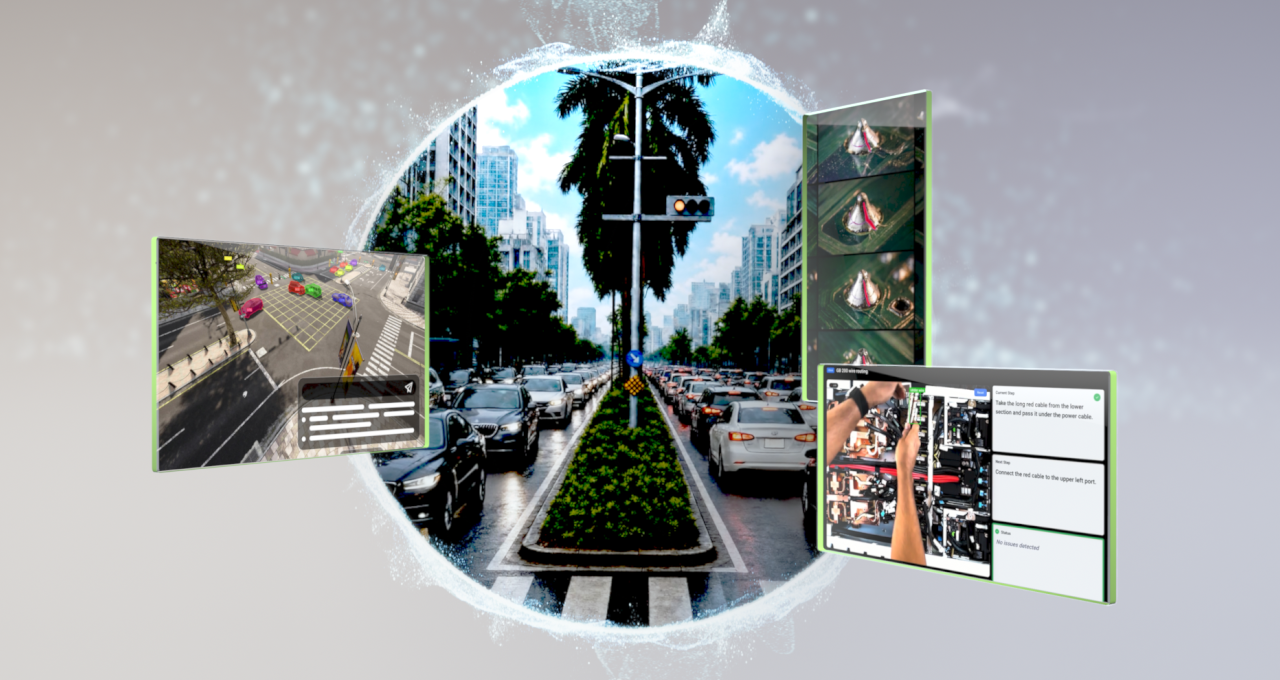
Vision AI agents are becoming a practical way to automatically turn video data from the physical world into operational intelligence in factories, cities, warehouses and transportation systems.
That shift is accelerating as more AI workloads move closer to where data is generated. Gartner projects that more than two-thirds of enterprise-managed data will be created and processed outside the data center or cloud by 2028, and that over two-thirds of all enterprises globally will deploy edge AI by 2029, up from 10% in 2025 (1) .
But more edge data doesn’t automatically create more intelligence. As much as 90% of existing edge data goes unprocessed, according to the same Gartner report. Turning that data into useful action requires vision AI agents that can understand video, adapt to real-world conditions and connect insights to operational workflows. These agents often run near cameras, machines and sensors, where models must meet latency, power, cost and connectivity requirements while adapting to site-specific conditions. To build those agents, developers need repeatable ways to generate training data, fine-tune models and deploy agentic video applications across edge and cloud environments.
NVIDIA Metropolis agent skills and blueprints give developers reusable workflows to build, operate and optimize vision AI agents across that lifecycle.
For the simulation and synthetic data side of that work, Universal Scene Description, or OpenUSD , provides a common framework for describing, composing and reusing 3D worlds. Built on OpenUSD, NVIDIA Omniverse libraries help teams build simulation, synthetic data generation and digital twin workflows that model real-world environments and expand scenario coverage across conditions such as lighting, weather, traffic patterns, camera angles, occlusion and rare events.
As organizations move toward autonomous vision agents, three challenges often come up:
Accuracy Plateaus With Data Gaps: Vision AI agents need to spot rare defects, abnormal events and changing environments. In manufacturing, for example, an inspection model may perform well on common scratches or dents but struggle with a new hairline crack not represented in the training data.
Lack of Fine-Tuning Expertise: Once teams identify a performance gap, improving the model is rarely a simple handoff. Fine-tuning requires labeled datasets, training configuration, experiment tracking, evaluation and decisions about whether there’s improvement for the target use case. Many organizations building vision AI agents don’t have large in-house machine learning teams to manage that process quickly, especially across many sites, products or camera views.
Complex, Time-Consuming Agent Assembly Workflows: Deploying a vision AI agent requires more than running inference. Developers have to stitch together video pipelines, AI models, metadata, embeddings, indexing, search, alerts, reporting and system integrations. Customizing that workflow for a specific environment adds significant time and requires specialized expertise. Without OpenUSD’s shared scene description layer, teams often rebuild 3D environments from scratch each time conditions or deployment sites change.
NVIDIA agent skills and blueprints — used alongside NVIDIA Omniverse for OpenUSD-based simulation and synthetic data generation, NVIDIA Metropolis for model development and video AI deployment — give developers reusable starting points for key parts of those workflows:
The Defect Image Generation skill helps create synthetic defect data.
Key considerations
- Investor positioning can change fast
- Volatility remains possible near catalysts
- Macro rates and liquidity can dominate flows
Reference reading
- https://blogs.nvidia.com/blog/vision-ai-agent-skills-omniverse-metropolis/#primary
- https://blogs.nvidia.com/blog/author/estherlee/
- https://blogs.nvidia.com/blog/vision-ai-agent-skills-omniverse-metropolis/#disqus_thread
- China claims chip exports nearly doubled to $177 billion in the first half of 2026 as memory prices surged — 96% year-on-year increase inflated by hikes
- Modder successfully runs Counter-Strike clone at 60 FPS on the original Sony PSP — created his own Rust-based 3D engine to power 480 x 272 gameplay, also works
- Cooler Master HAF II 500 Case Review: New HAF delivers on its name, with impressive airflow and a roomy chassis
- Joyride Through July With 12 Games Coming to GeForce NOW
- Lenovo's Legion 7a gaming laptop now comes with an RTX 5070 12GB GPU option — but it costs $3,375 paired with a Ryzen AI 9 CPU, SKU was previously limited to RT
Informational only. No financial advice. Do your own research.