
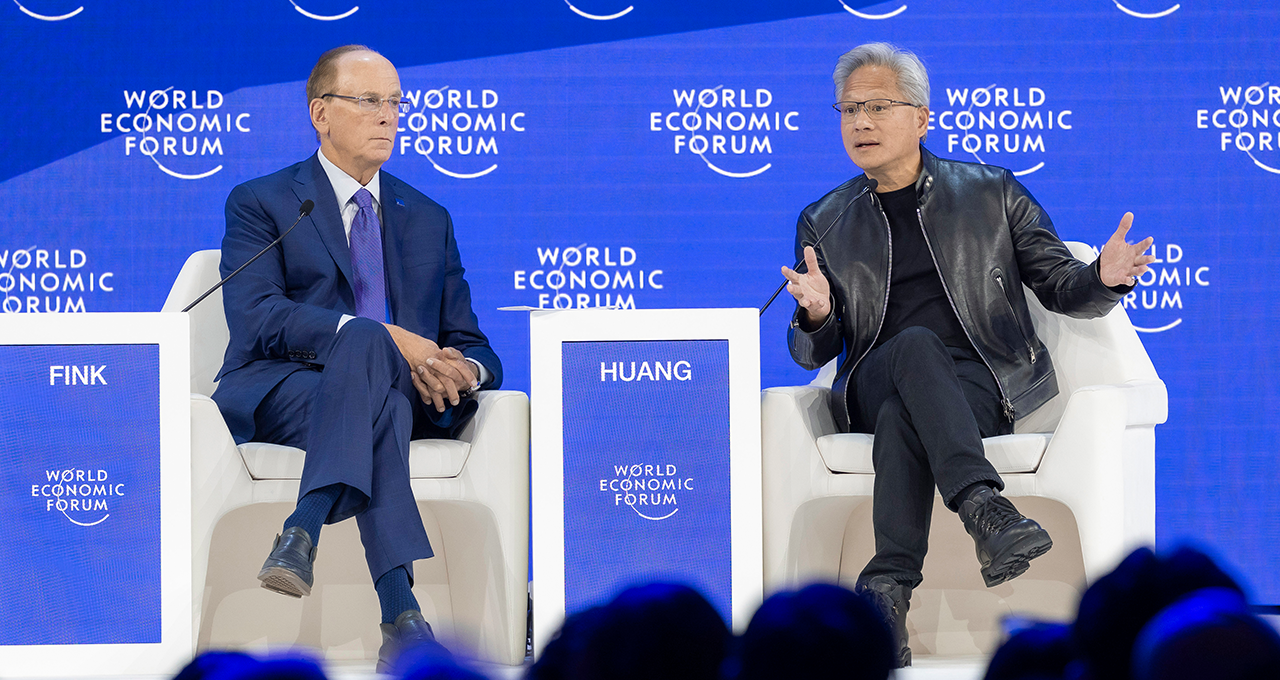
Huang framed AI as essential national infrastructure. “AI is infrastructure,” he said, arguing that every country should treat AI like electricity or roads. “You should have AI as part of your infrastructure.”
He urged countries to build their own AI capabilities, drawing on local language and culture. “Develop your AI, continue to refine it and have your national intelligence be part of your ecosystem,” he said.
Fink asked whether only the most educated people can use or benefit from AI. Huang countered that idea, emphasizing that AI’s rapid adoption stems from its accessibility.
“AI is super easy to use — it’s the easiest software to use in history,” he said, noting that in just two to three years, AI tools have reached nearly a billion people.
As a result, Huang said AI literacy is becoming essential. “It is very clear that it is essential to learn how to use AI — how to direct it, manage it, guardrail it, evaluate it,” he said, comparing those skills to leadership and people management.
For developing countries, Huang said AI offers a chance to narrow long-standing technology gaps. “AI is likely to close the technology divide,” he said, citing its accessibility and abundance.
Turning to Europe, Huang highlighted manufacturing and industrial strength as a major advantage. “You don’t write AI — you teach AI,” he said, urging countries to fuse industrial capability with artificial intelligence to unlock physical AI and robotics.
“Robotics is a once-in-a-generation opportunity,” he said, particularly for nations with strong industrial bases.
Fink summarized the discussion by saying that what he heard suggested the world is far from an AI bubble. Instead, he posed a different question: Are we investing enough?
Huang agreed, saying large investments are required because “we have to build the infrastructure necessary for all of the layers of AI above it.”
The opportunity, he said, “is really quite extraordinary, and everybody ought to get involved.”
He reiterated that 2025 was the largest year for global VC investment, with more than $100 billion deployed worldwide, most of it into AI-native startups.
“These companies are building the application layer above,” Huang said, “and they’re going to need infrastructure — and investment — to build this future.”
Fink added that broad participation in that growth is critical.
Key considerations
- Investor positioning can change fast
- Volatility remains possible near catalysts
- Macro rates and liquidity can dominate flows
Reference reading
- https://blogs.nvidia.com/blog/davos-wef-blackrock-ceo-larry-fink-jensen-huang/#content
- https://www.nvidia.com/en-us/
- https://blogs.nvidia.com/?s=
- Chinese semiconductor industry gears up for domestic HBM3 production by the end of 2026 — CXMT to produce chips, while Naura, Maxwell, and U-Preseason design to
- Congress wants veto power over Trump administration for AI chip exports — new proposed AI Overwatch Act would shift ultimate control of high-performance chip ex
- 3D-printed fan-less and pump-less liquid cooler can deliver 600 watts of cooling for data centers — passive design provides reusable heat, exceeds project perfo
- Japanese city deploys anti-bear drones as 'human casualties at an all-time high' — non-lethal spray can be delivered with 10cm accuracy radius, 1km range
- Steam client allegedly continues sharing your status with your friends even if you set it ‘Offline,’ report claims — setting is a ‘UI illusion’ and your friends
Informational only. No financial advice. Do your own research.