
He says it decodes one request faster than published DGX Spark stacks, at half the price of three.
a]:text-inherit [&>a]:underline">
When you purchase through links on our site, we may earn an affiliate commission. Here’s how it works .
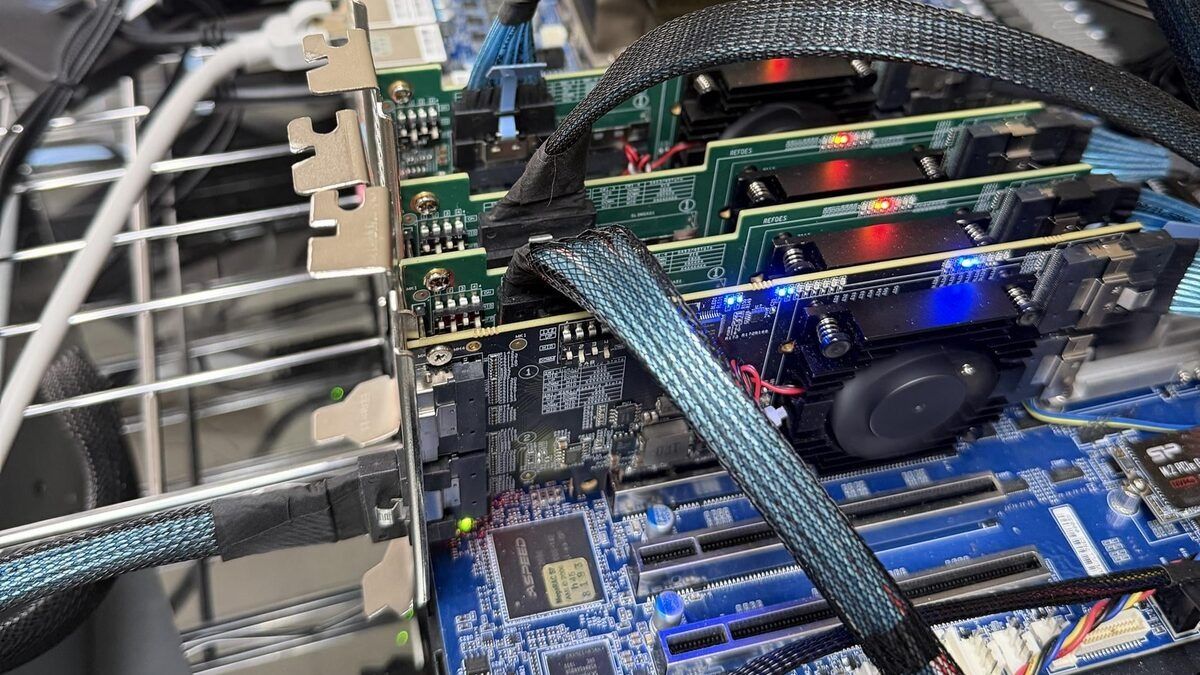
Some of the best movie franchises come in threes, and Nick Mermiges seems determined to match that, taking his original setup — which he previously upgraded with more memory and other fixes — and expanding it for fuller precision, after a previous upgrade got him most of the way there. The newest upgrade, this time, involves a third board of V100s, for a total of 12 with four per board. There may be a method to his madness.
The original eight 32GB cards could manage 254 GiB, but the experts for the chosen model , with Nvidia’s NVFP4 release, need 278.9 GiB. His previous workaround was to have every expert on the cards at 2-bit precision, with the most-used, 5,949 or about 38.7%, swapped to NVFP4 until the cards were full. Now, all 15,360 experts can live on the cards in their full glory, as he intended, with “none compressed further,” according to his GitHub repo. In a longer write-up on his site, he says the expert values “equal the ones in DeepSeek’s own release,” although other parts of the model use compact forms.
A keen observer will notice a limitation of the V100s, which he spells out: the V100 has no FP4 or FP8 tensor cores. Every NVFP4 number has to be unpacked in software, first, and into half precision. The compact experts still pay off “because the cards read fewer bytes, not because they compute faster.” This helps explain why a card from 2018 can run a format from the Blackwell era.
The model’s layers are, again, divided among the boards, this time with 0–13, 14–27, and 28–39, and each board’s section is split across its own four cards. The cards on a board share Nvidia’s fast link, or NVLink, and the hand-offs between boards cross over the host’s PCIe through two separate PCIe switches. The first two boards share a PEX88096 switch, so their hand-off stays inside it, but the third board is behind a separate PLX 8749, so the second hand-off also has to cross the host’s PCIe bridges, which adds latency.
Lawyer’s eight-V100 AI server moves DeepSeek from 2-bit to near-NVFP4 precision
Key considerations
- Investor positioning can change fast
- Volatility remains possible near catalysts
- Macro rates and liquidity can dominate flows
Reference reading
- https://www.tomshardware.com/tech-industry/artificial-intelligence/SPONSORED_LINK_URL
- https://www.tomshardware.com/tech-industry/artificial-intelligence/lawyers-usd9-450-private-ai-server-of-12-used-nvidia-v100s-now-runs-every-deepseek-v4-1-flash-expert-at-4-bit-nvfp4-up-to-184-tokens-per-second-on-code-and-long-documents-start-answering-in-about-half-the-time#main
- https://futureplc.com/terms-conditions/
- Nvidia promises employee pay raises, equity before December to quell unrest in wake of Jensen Huang scandal
- CUDA at 20: How the Platform Transformed Scientific Computing
- $3.26 million in SpaceX AI data center revenue will be pumped back into the City of Memphis
- Nvidia says it’s ‘absurd’ to assume it predicted the agentic moment during Vera’s development
- Intel continues layoffs with cuts to its IT department, hundreds of employees reportedly affected
Informational only. No financial advice. Do your own research.