
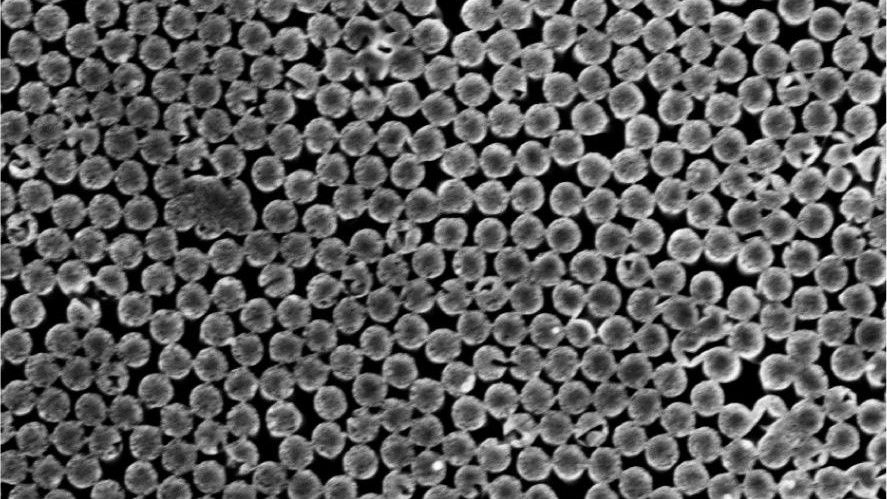
The electric field created by the ion imbalance helps drive the excited electrons through an external circuit, generating usable electrical current.
Heat further boosts performance in two ways. First, it accelerates evaporation, increasing ion transport through the liquid layer. Second, it modifies charge behavior at the silicon interface, strengthening the surface electric effects involved in power generation.
These combined effects across the device lead to measurable electrical output. In tests, the device achieves an open-circuit voltage of approximately 1 volt and a power density of 0.25 watts per square meter (10.76 square feet) under optimal conditions.
The output is tiny compared with commercial solar panels, which can generate hundreds of watts per square meter. However, the technology is not being developed as a conventional renewable electricity source. Its real promise lies in battery-free sensors, remote monitoring systems, smart agriculture nodes, wearable electronics, and Internet of Things devices deployed in environments where water, warmth, and sunlight are naturally available. For such low-power autonomous electronics, the test outputs are significant.
Another notable feature is the team’s “decoupled” design. By separating evaporation, ion transport, and electron collection into distinct layers, each stage can be studied and optimized independently. That gives engineers more control over performance and makes it easier to scale future versions.
For now, however, the entire system still exists at the nanoscale. The electricity is real, continuous, and scientifically meaningful, but the technology remains an early-stage microscopic energy harvester rather than a grid-scale power source.
Still, if the researcher can scale future versions cheaply and reliably, the idea of sensors and electronics quietly powering themselves from nothing more than impure water, ambient heat, and sunlight may no longer sound so far-fetched.
Follow Tom's Hardware on Google News , or add us as a preferred source , to get our latest news, analysis, & reviews in your feeds.
Etiido Uko is an engineer and technical writer with over nine years of experience in documentation and reporting. He is deeply passionate about all things gadgets, technology, and engineering. ","collapsible":{"enabled":true,"maxHeight":250,"readMoreText":"Read more","readLessText":"Read less"}}), "https://slice.vanilla.futurecdn.net/13-4-22/js/authorBio.js"); } else { console.error('%c FTE ','background: #9306F9; color: #ffffff','no lazy slice hydration function available'); } Etiido Uko Social Links Navigation News Contributor Etiido Uko is an engineer and technical writer with over nine years of experience in documentation and reporting. He is deeply passionate about all things gadgets, technology, and engineering.
Key considerations
- Investor positioning can change fast
- Volatility remains possible near catalysts
- Macro rates and liquidity can dominate flows
Reference reading
- https://www.tomshardware.com/tech-industry/SPONSORED_LINK_URL
- https://www.tomshardware.com/tech-industry/nanoscale-device-generates-continuous-electricity-from-evaporating-water-and-some-sunlight-paves-the-path-for-battery-free-sensors-wearable-electronics-and-more#main
- https://www.tomshardware.com
- Russian-Chinese Irtysh 32-core CPU runs The Witcher 3 at 30+ FPS — heavyweight chip still imposes CPU bottleneck despite impressive specs
- Linux kernel's ‘second-in-command’ uses local AI bot to hunt bugs, powered by 'clanker' system with AMD's Ryzen AI Max+ — Framework Desktop has resulted in clos
- Tag, You’re It: GeForce NOW Levels Up Game Discovery With Xbox Game Pass and Ubisoft+ Labels
- Get 32GB of Corsair DDR5 RAM for just $56 in this Newegg 9950X3D2 combo deal — $1,705 barebones kit for an AMD gaming PC also ships with a 2TB WD Black SSD and
- Palit Group says Galax GPU brand will continue to operate following restructure — Galax management centralized under Palit Group in 'pre-planned' shakeup
Informational only. No financial advice. Do your own research.