
Researchers can explore agent-assisted workflows that prepare simulation inputs, launch runs and summarize results, while the scientists validate the setup and conclusions.
Researchers can also train AI models that approximate slow simulations, then use them to refine wing designs toward minimum drag.
Before committing supercomputer time, a team can narrow a 10-million-cell simulation to the 50-500 dimensions that matter.
Kvantify is using NVIDIA cuQuantum, and reports running tensor-network simulations of quantum-chemistry circuits with up to 70 qubits and 975 gates on a single DGX Spark, benchmarking circuits generated for penicillin ground-state energy calculations.
CYRAN AI , an IIT Delhi spin-out, uses DGX Spark and its PixelFlux library to accelerate JPEG 2000 decoding for large satellite images, supporting local geospatial analysis.
OpenFold shows how researchers can fine-tune OpenFold3 on NVIDIA DGX Spark to improve protein-ligand structure predictions for drug discovery.
The Rubin Lab at IGI at University of California, Berkeley is using a DGX Spark and NVIDIA Evo 2 model to predict bacterial traits directly from genome sequences by comparing embeddings from genomic and protein language models against the classical baselines. With no 11-hour cluster queue times, results arrived 15x sooner on DGX Spark.
The Hartwig Group at UC Berkeley is using a DGX Spark to perform LoRA fine-tuning on the Nemotron 3 Super 120B-A12B model for chemistry machine learning, training a prediction head on experimental values. By running locally on the Spark using NVFP4 quantization, the lab successfully fit a 120B-class model on a single device and bypassed multi-day cluster queue times, allowing them to run continuous eight- to 24-hour training fits back-to-back.
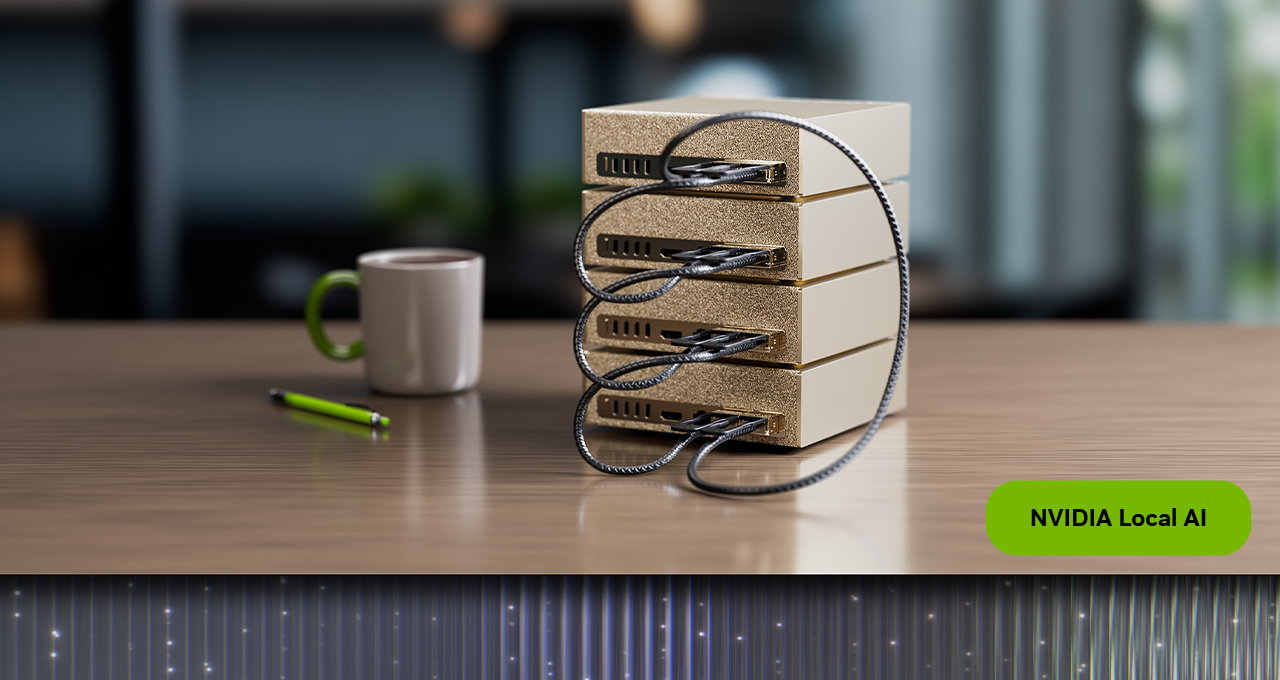
The developer kit is on display at SC26 and available for sale. DGX Spark products and cables can be purchased from top OEM partners and are also available through NVIDIA Marketplace .
Partners include Acer, ASUS, Dell Technologies, GIGABYTE, H3C, HP, Lenovo, MSI and xFusion.
An NVIDIA playbook for building and running the NVIDIA HPC SDK, a software development kit for scientific computing, is coming soon. Once available, it will give scientists and researchers a local platform to develop multi-node GPU applications, explore FP32 and mixed-precision algorithms and run molecular dynamics and materials simulations using LAMMPS with Kokkos before scaling to data center systems.
See notice regarding software product information.
Key considerations
- Investor positioning can change fast
- Volatility remains possible near catalysts
- Macro rates and liquidity can dominate flows
Reference reading
- https://blogs.nvidia.com/blog/dgx-spark-hpc-developer-kit-sc26/#primary
- https://blogs.nvidia.com/blog/author/allenbourgoyne/
- https://blogs.nvidia.com/blog/dgx-spark-hpc-developer-kit-sc26/#disqus_thread
- 403 hyperscale US data centers used staggering 82 terawatts of electricity in a year, more than 80% of Michigan’s entire consumption
- Jensen Huang could be plotting return as Nvidia CEO, report claims
- Samsung, SK hynix, and Micron form unlikely alliance to standardize robot charging as chipmakers push toward unmanned fabs
- Taipei 101 lit up in support of Jensen Huang
- Cockpit-Simulator 737X CDU (v2) Review: An Essential Component for Flight Sim Enthusiasts
Informational only. No financial advice. Do your own research.