
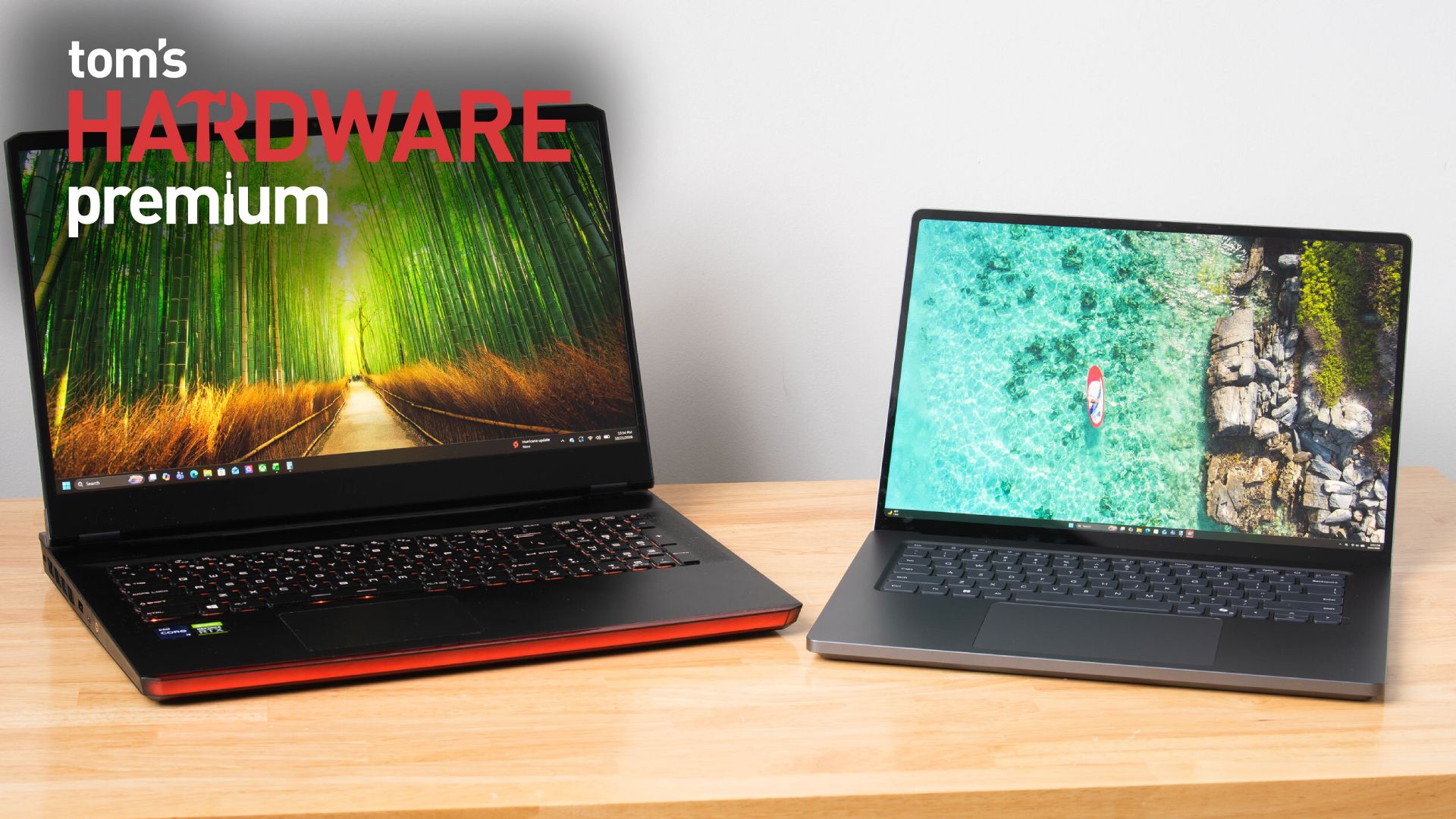
As someone who primarily games on our Ryzen 7 9800X3D GPU testing system and not a laptop, I wanted to make sure I wasn't setting unreasonable expectations for the Surface Laptop for input latency or CPU performance. So I hauled out an older 17" gaming laptop with a Core i9-11980HK and an RTX 3080 Mobile 16GB inside to get some perspective.
To level the playing field with the Surface Laptop Ultra and its native support for frame generation, I modded Optiscaler into Control Resonant on that system to enable Intel's Xe Frame Generation and Xe Low Latency features.
I conducted my testing with Control Resonant' s High raster preset and medium RT preset, which gets you a noticeable boost in image quality thanks in part to DLSS Ray Reconstruction .
Control Resonant performance – High raster, Medium RT, DLSS Ultra Performance, FG 2X Row 0 – Cell 0 Average FPS
You can see that with these settings, trying to upscale Control Resonant to the Surface Laptop Ultra's native resolution is too much to ask for a smooth or responsive gaming experience. Even with DLSS Ultra Performance (an input resolution of 1090×727) and 2X frame generation, we only just break 60 FPS, and latency is at an unacceptable 87 ms average. There's no latency budget left to turn up MFG without turning down other image quality settings.
Control Resonant performance – High raster, Medium RT, DLSS Quality, FG 2X Row 0 – Cell 0 Average FPS
With our 1764×1176 custom resolution, however, we're off to a great start with DLSS Quality upscaling (an input resolution of 1176×874). The resulting 83.4 FPS average, 42.9 1% low FPS, and an average input latency of 67.8 ms is a fine experience. We still have room to dial in MFG 3X, leading to a 123 FPS average and 55 FPS 1% lows while keeping latency a reasonable 71 ms.
The RTX 3080 Mobile system with XeFG and XeLL, meanwhile, turns in an 87.1 FPS average, 53 FPS 1% lows, and a 69 ms average input latency at 1920×1080 with the same image quality settings. Its key advantage is in 1% lows, but that win comes with significant trade-offs.
Plugged into our Watts Up meter, the RTX 3080 system draws 250 W from the wall to deliver the experience it does, but according to a USB-C power meter, the Surface Laptop Ultra pulls between 110 W and 120 W under load. Silicon has come a long way since Tiger Lake and Ampere.
The RTX 3080 system and its enormous power adapter together also weigh over nine pounds (4.1 kg). It's technically portable but practically a pain to haul around. The Surface Laptop Ultra and its 140W adapter weigh just 5.3 lb (2.39 kg), which isn't featherweight but won't break your back.
And the Surface will actually fit on a tray table or your lap, with enough battery life that you can use it through a transcontinental U.S. flight, say, and still have plenty of juice left for either side of the trip.
So at least in Control Resonant , the Surface Laptop Ultra is delivering largely the same gaming experience as that high-end RTX 3080 Mobile system, but in a much smaller and lighter total package that draws less than half the wall power. And if you want to stretch frame rates further with MFG 3X, the Surface has MFG support that the older system doesn't. Just add in the 1764×1176 intermediate resolution that Microsoft forgot, and you’ll be well on your way to a better gaming experience.
Jeffrey Kampman Senior Analyst, Graphics As the Senior Analyst, Graphics at Tom's Hardware, Jeff Kampman covers everything that has to do with graphics cards, gaming performance, and more. From integrated graphics processors to discrete graphics cards to the hyperscale installations powering our AI future, if it's got a GPU in it, Jeff is on it.
Key considerations
- Investor positioning can change fast
- Volatility remains possible near catalysts
- Macro rates and liquidity can dominate flows
Reference reading
- https://www.tomshardware.com/video-games/pc-gaming/SPONSORED_LINK_URL
- https://www.tomshardware.com/video-games/pc-gaming/one-easy-change-makes-microsofts-surface-laptop-ultra-with-rtx-spark-a-better-gaming-system-custom-resolutions-make-dlss-easier-on-the-device#main
- https://www.tomshardware.com/my-account
- Intel installs production tools at Fab 62 in Arizona, provides updates on Ohio chip fab
- Modal taps Nvidia Vera CPUs after firm's internal tests show 2x throughput over Intel and AMD chips
- Iran threatens to attack undersea cables in the Strait of Hormuz, calls them 'legitimate new targets' in future conflict
- FADU puts the filesystem inside the SSD's flash to bypass host CPUs
- Micron's Taiwan union will launch a one-day strike this week, threatening memory production
Informational only. No financial advice. Do your own research.