
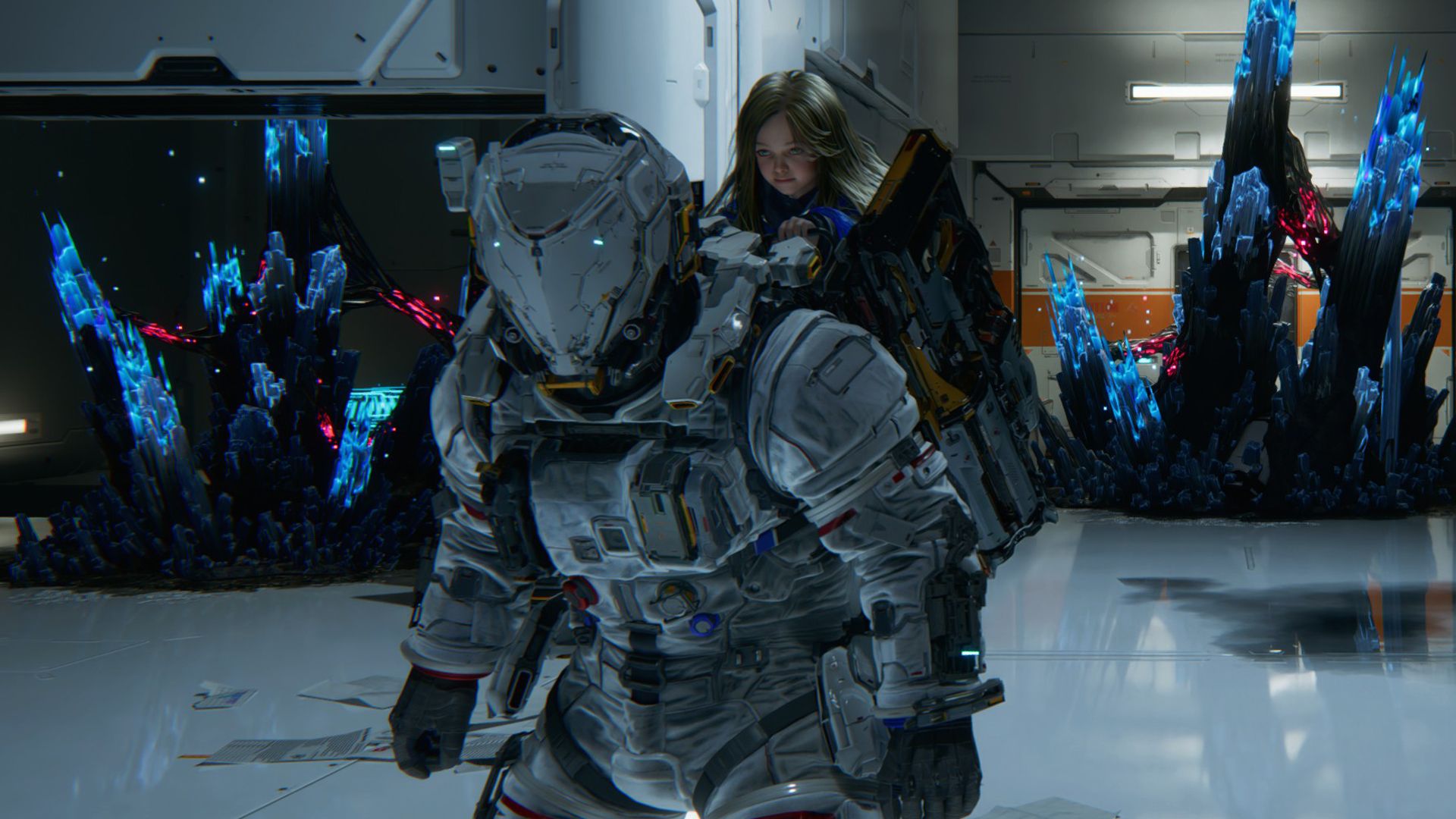
We gathered our Pragmata performance data in the Interconnecting Passage area of the Mass Production Array level, which resembles Times Square and is full of cars, buses, and puddles that all catch reflections from the giant screens and signs that ring the area. It’s much more demanding than the confined interior corridors of the Cradle.
Graphics cards that can manage stable performance in the Shelter hub area or similar confined spaces can fall flat once you reach the more expansive “outdoor” areas like the one we tested, so we favored this more demanding scenario to highlight any potential performance cliffs.
(Image credit: Future) (Image credit: Future) (Image credit: Future) Starting at 1080p max settings, it’s obvious that Pragmata runs great on Radeons, allowing the RX 9070 and 9070 XT unusual victories over the RTX 5070 Ti and RTX 5080. But you don’t need an expensive card for a good time here. Even the RTX 5050 hands in a 60 FPS average.
The minimum-spec RTX 3060 12GB falls shy of that mark, though, and the RE Engine isn’t kind to the Arc B580, either. Both of those cards might benefit from lower settings or upscaling, or both, here.
At 1440p, 60 FPS can be had from the RTX 5060 Ti on up, and higher-refresh-rate power is easily accessible through the still relatively affordable RTX 5070 and RX 9070. At 4K, though, you’ll really want an RX 9070 or RTX 5070 Ti or better for a 60 FPS experience.
We didn’t have time to test a wide range of older cards in this title, but we were able to work in a couple for your reference. The midrange RTX 4070 and RX 7800 XT hang out near the middle of our charts across the board, while the older RTX 3070 and RX 6700 XT go neck and neck toward the back of the pack. Check out the GPU benchmark hierarchy if you need to know how your own graphics card compares to these reference points.
Despite its extra VRAM versus the 3070, the RX 6700 XT doesn’t distance itself from that card until we hit 4K, emphasizing the fact that maxing out Pragmata ’s raster eye candy doesn’t ask for a lot of VRAM in return. That same trend applies to the RTX 3060 and its 12GB of VRAM. You’ll run out of horsepower well before that card’s extra memory makes a difference versus the 8GB RTX 3070.
(Image credit: Future) (Image credit: Future) (Image credit: Future) Pragmata ’s basic RT implementation is relatively easy on hardware compared to many we’ve seen, and every card but the RTX 5050 can still put up a 60 FPS average at 1080p. At 1440p, however, 12GB and 16GB cards start to separate themselves from their 8GB stablemates, as the RX 9060 XT 16GB and RTX 5060 Ti 16GB show. And at 4K, only the most powerful cards can turn in a 60-FPS-ish baseline without upscaling.
Our performance analysis of path tracing in Pragmata has several layers we need to build up for a full picture, so get comfortable. We'll start with native PT performance across all the Nvidia cards that support it.
(Image credit: Future) (Image credit: Future) (Image credit: Future) Native path tracing is a whole different beast than ray tracing in Pragmata . Only the RTX 5090 can clear 60 FPS at 1080p, and performance rapidly falls off from there. Our 4K results are purely academic for even the RTX 5090.
Nvidia and Capcom clearly expect you to use upscaling and some degree of framegen to achieve a playable experience with path tracing enabled, and unless you’re on an older card that simply doesn’t support DLSS Frame Generation or Multi Frame Generation, that’s a totally reasonable bargain at this stage.
As we’ve explored in past coverage, as long as your input latency remains within reasonable bounds, the image quality of DLSS Frame Generation and Multi Frame Generation has improved to the point where any artifacts they might introduce are minor, and the arrival of the DLSS 4.5 upscaling models allows owners of RTX 40-series and 50-series cards to get away with lower input resolutions than they might have needed in the past for the same high output image quality. That all means higher performance as a framegen baseline and less reason for concern about latency as a limiting factor.
If you have a capable enough RTX 40-series or 50-series card and a high-refresh-rate monitor to match, and you haven't tried DLSS Frame Generation or MFG at this point, I don't know how else to say it: you're missing out. And Pragmata is just the latest example of a game where the path-traced visuals are well worth using those tools to their fullest.
The many combinations of DLSS quality presets and frame generation multipliers are far too numerous to comprehensively cover across every graphics card in our arsenal, so I’ve chosen what I feel are reasonable starting points for each output resolution and noted them on each chart below.
Since the RTX 3070 doesn’t support DLSS framegen, I enabled FSR 3 FG for this testing for fairness. Be aware, however, that FSR 3 FG’s image quality is far worse than the latest DLSS framegen model in this title. It’ll allow you to get a taste of path tracing, but it introduces plenty of artifacts (especially on particle effects and translucent UI elements) that you will instantly notice.
And we had to exclude the RTX 3060 12GB from this testing entirely, as no amount of DLSS upscaling or FSR framegen juice allowed it to get to a playable, low-latency experience without totally sacrificing image quality.
(Image credit: Future) (Image credit: Future) (Image credit: Future) (Image credit: Future) (Image credit: Future) (Image credit: Future) On to the results. We’ve charted both performance and average PC latency (as measured/estimated by Nvidia FrameView) above for each resolution so you can judge for yourself whether the resulting framegen performance is truly playable. Our past testing on the TH GPU rig has suggested that 60 ms or so of input latency is about the most we want for a playable experience with the average AAA game. 70 ms is high but tolerable, and anything higher than that is too much.
Here’s a shocker: even with path tracing enabled, Pragmata is easy enough on VRAM at 1080p that you can get framegen working with DLSS Quality, even on 8GB cards. The experience is not playable on the RTX 5050 and RTX 5060 due to high input latency, but it works as a party trick. The RTX 5060 Ti 8GB actually manages to be playable under these settings, but you’re one misplaced megabyte away from a performance cliff. Proceed at your own risk.
From the RTX 5060 Ti 16GB on up, any of these cards deliver a fine path-traced experience at a 1080p output res using the settings I picked, and thanks to Pragmata 's well-managed input latency, even juicing a 40-FPS-ish baseline with framegen feels totally fine.
At 1440p, the RTX 4070 and RTX 5060 Ti 16GB are past the 60 ms mark, where one might want to drop down to DLSS Performance for a snappier experience, but even so, input latency is tolerable. All of the Blackwell cards are well within the playability ballpark. Our 8GB cards are all suffering, though, and none of them deliver a playable experience despite delivering seemingly OK frame rates on the top line.
At 4K with DLSS Performance, the RTX 5060 Ti 16GB and the RTX 4070 are well past their limits, and the RTX 5070’s 1% low frame rates aren’t fantastic. The RTX 5070 is still delivering playable input latency, but it’s on the high side. Only the RTX 5070 Ti, RTX 5080, and RTX 5090 are solidly playable this way. But if you wanted to explore DLSS Ultra Performance and DLSS 4.5 Preset L on the RTX 4070 and RTX 5070 to lower latency and chase higher frame rates, you certainly could.
Again, all these results go to show that we are firmly in an era where DLSS Frame Generation is perfectly usable. As long as you’re monitoring input latency and managing your settings ambitions accordingly, there is no real reason to avoid it other than a lack of hardware support on your GPU or stubborn contrarianism.
Pragmata may have an impressive list of technical features for pixel-peepers like yours truly to dig into, but I’m happy to report that it’s an enjoyable game first and foremost. Its lunar setting comes full of 3D-printed mechs to blast apart through strategic gunplay and split-second puzzle solving, and that combo really grabbed me.
From a technical standpoint, Pragmata offers one of the most vendor-dependent experiences that I can remember. The game’s headlining path tracing mode is only available to GeForce cards, and it’s not as freely adjustable as I’d like for the best experience.
If you’re a GeForce gamer, you get access to all of Nvidia’s latest and greatest software features, and those all add up to make a big difference to image quality. DLSS—whether used as DLAA or for upscaling—is a great improvement over the RE Engine’s rough TAA implementation with RT off.
But enabling Pragmata’s basic ray tracing mode introduces prominent noisy artifacts and can even remove desirable reflections in some parts of the image at times. You have to decide whether those issues are more troublesome than the average screen-space error to your eye if you’re not going all the way with path tracing.
And you should absolutely give path tracing a shot if your graphics card can handle it. As we’ve come to expect, native PT is so demanding that DLSS upscaling and frame generation are mandatory for a smooth experience. But that’s a total non-issue on RTX 40-series and 50-series cards nowadays (at least for those with 12GB of VRAM or more), as the image quality of DLSS upscaling and frame generation has advanced to the point where you can enable both features alongside path tracing and just enjoy the game.
Path tracing offers the richest and most stable image quality of all the options on offer, and it pays off with plenty of little moments that make Pragmata ’s setting feel startlingly realistic. It’s far and away the best way to play .
RTX 30-series cards without DLSS Frame Generation support will technically run path tracing, but you’ll need higher-end models with as much VRAM as possible to enjoy it. And you’re stuck with FSR 3 framegen if you need it, which can improve smoothness but introduces image quality issues of its own.
Radeon gamers can enjoy strong raster and RT performance in this title as a baseline, but Capcom’s implementation of FSR tech in this title could be better. Pragmata supports FSR 4 on compatible cards, but no FSR native AA option to match Nvidia’s DLAA on any Radeon. That feels like an easy fix in a future patch, though. Happily, RDNA 4 owners also get access to the latest ML Frame Generation model, which is a major upgrade over FSR 3 framegen, so smooth performance is well within reach at practically any setting.
But getting entirely locked out of path tracing—especially when the latest RDNA 4 hardware can clearly handle it—may be an unforgivable snub for some Radeon gamers, and I wouldn’t blame them for giving this game a pass for that reason alone.
Meanwhile, none of Intel’s XeSS features are present in Pragmata at all, and baseline performance is low even on the Arc B580, so Arc gamers will have to lean on FSR 3 upscaling and perhaps frame generation to get a more playable experience.
All told, Pragmata is both engaging to play and full of eye candy, and especially if you’re a GeForce RTX 40- or RTX 50-series owner looking for a showcase for everything your card can do, it’s a satisfying pick-up. I’m eager to get back to it as soon as I can so that I can learn how Hugh and Diana’s story plays out.
As the Senior Analyst, Graphics at Tom's Hardware, Jeff Kampman covers everything to do with GPUs, gaming performance, and more. From integrated graphics processors to discrete graphics cards to the hyperscale installations powering our AI future, if it's got a GPU in it, Jeff is on it.\u00a0 ","collapsible":{"enabled":true,"maxHeight":250,"readMoreText":"Read more","readLessText":"Read less"}}), "https://slice.vanilla.futurecdn.net/13-4-20/js/authorBio.js"); } else { console.error('%c FTE ','background: #9306F9; color: #ffffff','no lazy slice hydration function available'); } Jeffrey Kampman Senior Analyst, Graphics As the Senior Analyst, Graphics at Tom's Hardware, Jeff Kampman covers everything to do with GPUs, gaming performance, and more. From integrated graphics processors to discrete graphics cards to the hyperscale installations powering our AI future, if it's got a GPU in it, Jeff is on it.
coolitic This is what happens when you try and ship half-baked, tech-demo rendering-pipelines for production games. It's certainly not the worst offender that I've recently seen in that regard, but it's still part of an annoying, contemporary trend. Reply
PEnns In the first graph, the the 9060 XT 8 GB beats the 16 GB version ?? Is that correct, and if yes, why?? Reply
Gururu I wanted Crimson Desert badly but no Arc support saved me $70. After a couple weeks, it's not even on my radar anymore. I guess this is a step up but sadly lack of XeSS going to save me another $70. Hopefully it gets XeSS support before it's not on my radar anymore. Reply
usertests PEnns said: In the first graph, the the 9060 XT 8 GB beats the 16 GB version ?? Is that correct, and if yes, why?? The >8 GB VRAM doesn't matter at 1080p. The gap is unusual but could be explained by slight differences between the cards tested. Reply
txfeinbergs coolitic said: This is what happens when you try and ship half-baked, tech-demo rendering-pipelines for production games. It's certainly not the worst offender that I've recently seen in that regard, but it's still part of an annoying, contemporary trend. herp derp Reply
Jeff Kampman PEnns said: In the first graph, the the 9060 XT 8 GB beats the 16 GB version ?? Is that correct, and if yes, why?? Small differences in performance (in this case, ~2%) can be explained by run-to-run benchmark variance, differences between board cooling solutions, etc. – when things are this close the dice can sometimes land this way. Our RX 9060 XT 16GB is a compact PowerColor Reaper model, while the RX 9060 XT 8GB is a slightly larger and better-cooled Asus Dual version, so that likely explains why things worked out that way here. As has been noted, we are not VRAM-limited with Pragmata at 1080p with pure raster settings, so all of these small factors can add up and lead to an 8GB card running a tiny bit ahead of a 16GB model. If the difference was 10% or 20% or something, it would be cause for concern. Reply
PEnns Jeff Kampman said: Small differences in performance (in this case, ~2%) can be explained by run-to-run benchmark variance, differences between board cooling solutions, etc. – when things are this close the dice can sometimes land this way. Our RX 9060 XT 16GB is a compact PowerColor Reaper model, while the RX 9060 XT 8GB is a slightly larger and better-cooled Asus Dual version, so that likely explains why things worked out that way here. As has been noted, we are not VRAM-limited with Pragmata at 1080p with pure raster settings, so all of these small factors can add up and lead to an 8GB card running a tiny bit ahead of a 16GB model. If the difference was 10% or 20% or something, it would be cause for concern. Thanks for the feedback. Much appreciated. Reply
rluker5 Nvidia driver 596.21 and Intel driver 32.0.101.8724 with support for Pragmata are out now. Reply
vinay2070 Downloaded the demo and tried to play it for a few minutes and the hacking part became boring very quickly. Not sure if I will buy this game. Reply
Jabberwocky79 I was pleasantly surprised how well the demo ran on a 9070XT with RT enabled. Looks beautiful. The gameplay OTOH was not worth a $60 price tag. I found movement and controls to be very clunky. Reply
Key considerations
- Investor positioning can change fast
- Volatility remains possible near catalysts
- Macro rates and liquidity can dominate flows
Reference reading
- https://www.tomshardware.com/video-games/pc-gaming/SPONSORED_LINK_URL
- https://www.tomshardware.com/video-games/pc-gaming/pragmata-pc-performance-review#main
- https://www.tomshardware.com
- Google and Pentagon in talks to run custom AI chips inside classified environments — Google pushes for tight controls for TPUs surrounding use for mass surveill
- AMD to resurrect Ryzen 7 5800X3D AM4 with 10th anniversary edition, leaker claims — return of legendary CPU a sign of bleak PC building landscape
- Press Start on April: GeForce NOW Brings 10 Games to the Cloud
- Smooth Moves: 90 Frames-Per-Second Virtual Reality Arrives on GeForce NOW
- Nvidia RTX 5070 spotted at rare MSRP price in Woot flash sale — move fast to secure a bargain, 38% off saves you $340
Informational only. No financial advice. Do your own research.