
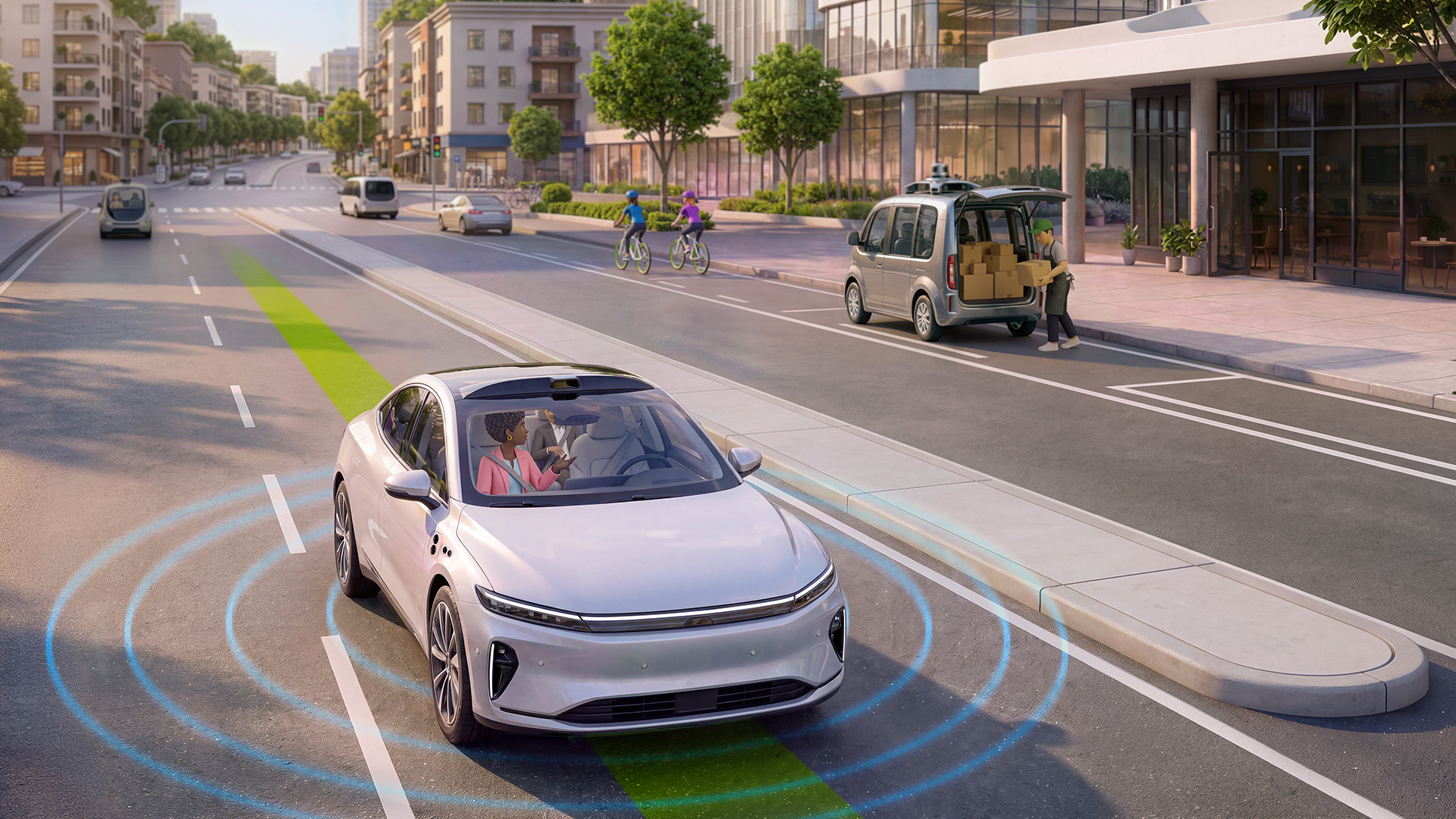
The global robotaxi market — physical AI’s first commercial breakthrough — is projected to reach $400 billion by 2035 , with over 6 million commercial vehicles in operation as driverless fleets are already moving people through some of the world’s busiest and most complex streets.
Deploying a driverless vehicle is one challenge. Scaling a fleet is a next-level computing challenge; it means delivering the same safe, reliable performance across thousands of vehicles.
Meeting those demands requires enormous amounts of compute across the robotaxi development lifecycle, from preparing and training AI models to simulating and validating driving behavior, as well as real-time processing in the vehicle.
NVIDIA provides an open platform for AI training , simulation and safety validation , with libraries, software development kits, workflows and models that developers can use alongside their own technology stacks.
Every major robotaxi program operating at commercial scale today is running on NVIDIA’s modular stack, spanning AI training, simulation, in-vehicle computing — or a combination of the three — to develop and deploy fleets at scale.
A robotaxi technology stack is the end-to-end set of technologies used to develop, validate and deploy autonomous vehicles (AVs) — from data and AI model training to simulation, safety validation and real-time in-vehicle computing.
NVIDIA’s robotaxi and AV platform brings these capabilities together in a three-computer solution: the model training computer, simulation and validation computer, and in-vehicle computer.
Robotaxi intelligence advances as programs turn growing volumes of fleet data into increasingly capable models. Driving models can be trained on NVIDIA DGX systems.
The NVIDIA Alpamayo portfolio of open reasoning vision language action (VLA) models, simulation frameworks and physical AI datasets gives developers building blocks they can adapt to their own data, requirements and technology stacks. Its reasoning models help address long-tail AV challenges by breaking complex driving situations into smaller steps, reasoning through each one and selecting the safest trajectory.
NVIDIA also provides physical AI datasets, reinforcement learning blueprints and recipes for post-training and distillation, helping developers optimize models for their target vehicles.
Robotaxi programs can’t rely on physical miles alone to capture rare, long-tail driving scenarios. NVIDIA Omniverse NuRec models reconstruct real-world driving scenarios from sensor data, while NVIDIA Cosmos world foundation models generate physically based variations of them, enabling developers to turn thousands of real-world corner cases into millions of combinations of driving behavior, traffic, weather, lighting and sensor conditions.
Running on NVIDIA RTX PRO Servers , NVIDIA Omniverse and Cosmos support closed-loop simulation and validation. The NVIDIA AlpaSim simulation framework extends the workflow for training and evaluating reasoning-based autonomous-driving models, helping developers identify weaknesses before deployment.
NVIDIA DRIVE Hyperion is NVIDIA’s modular in-vehicle compute and sensor reference architecture for level-4-ready robotaxis. DRIVE Hyperion 10 pairs dual NVIDIA DRIVE AGX Thor systems-on-a-chip, built on the NVIDIA Blackwell platform , with 14 high-definition cameras, nine radars, three lidars and 12 ultrasonics for real-time, 360-degree sensor fusion. Its redundant compute and sensing design supports fail-operational driving if a sensor or compute component fails.
The dual DRIVE AGX Thor is designed to run modern AI workloads — including VLA models — for perception, reasoning, path planning and driving actions.
NVIDIA Halos provides a production-ready safety foundation through Halos OS, and a broader validation and certification framework spanning independent inspection, system validation, large-scale simulation and continuous testing from cloud to car.
NVIDIA’s robotaxi ecosystem spans every region where commercial robotaxi services are emerging today: Asia, Europe, the Middle East and North America. Across these markets, mobility providers, AV developers and automakers are adopting NVIDIA’s three-computer architecture to train AI models, simulate and validate driving behavior, and deploy autonomous vehicles at scale.
Uber is scaling its fleet of NVIDIA DRIVE Hyperion, with plans to reach 28 cities by 2028. Uber and NVIDIA are also building a robotaxi AI data factory on NVIDIA Cosmos to curate fleet driving data for rare scenarios. Together, Uber and NVIDIA are collaborating with Autobrains, Avride, Lucid, May Mobility, Mercedes-Benz, Momenta, Nissan, Nuro, Pony.ai, Stellantis, Waabi, Wayve, WeRide and Zoox to bring NVIDIA-powered robotaxi services to the Uber platform.
May Mobility is planning to operate autonomous ride-hailing services through Uber’s network, while developing its software stack on the NVIDIA DRIVE platform.
Bolt uses NVIDIA technologies to develop and scale AVs across Europe.
Key considerations
- Investor positioning can change fast
- Volatility remains possible near catalysts
- Macro rates and liquidity can dominate flows
Reference reading
- https://blogs.nvidia.com/blog/robotaxi-leaders-full-stack-open-platform/#primary
- https://blogs.nvidia.com/blog/author/alikani/
- https://blogs.nvidia.com/blog/robotaxi-leaders-full-stack-open-platform/#disqus_thread
- Libernovo Omni Pro Review: Cooler than you think
- OpenAI's rogue AI agents accessed more websites to communicate than originally believed — defiant LLMs accessed old wikis and abandoned websites to co-ordinate
- Super Smash Bros Melee gets fully decompiled after over six years of effort — ambitious and technically impressive project delivers GameCube classic as C code
- Sony threatens to cut off customer support and pursue legal action over harassment as backlash to PlayStation’s physical-disc phaseout intensifies — company to
- Developer uses Claude to vibe code a Windows 3.1 shell in an hour — reanimated 12MB retro launcher runs on both Windows 11 and Apple Silicon
Informational only. No financial advice. Do your own research.