
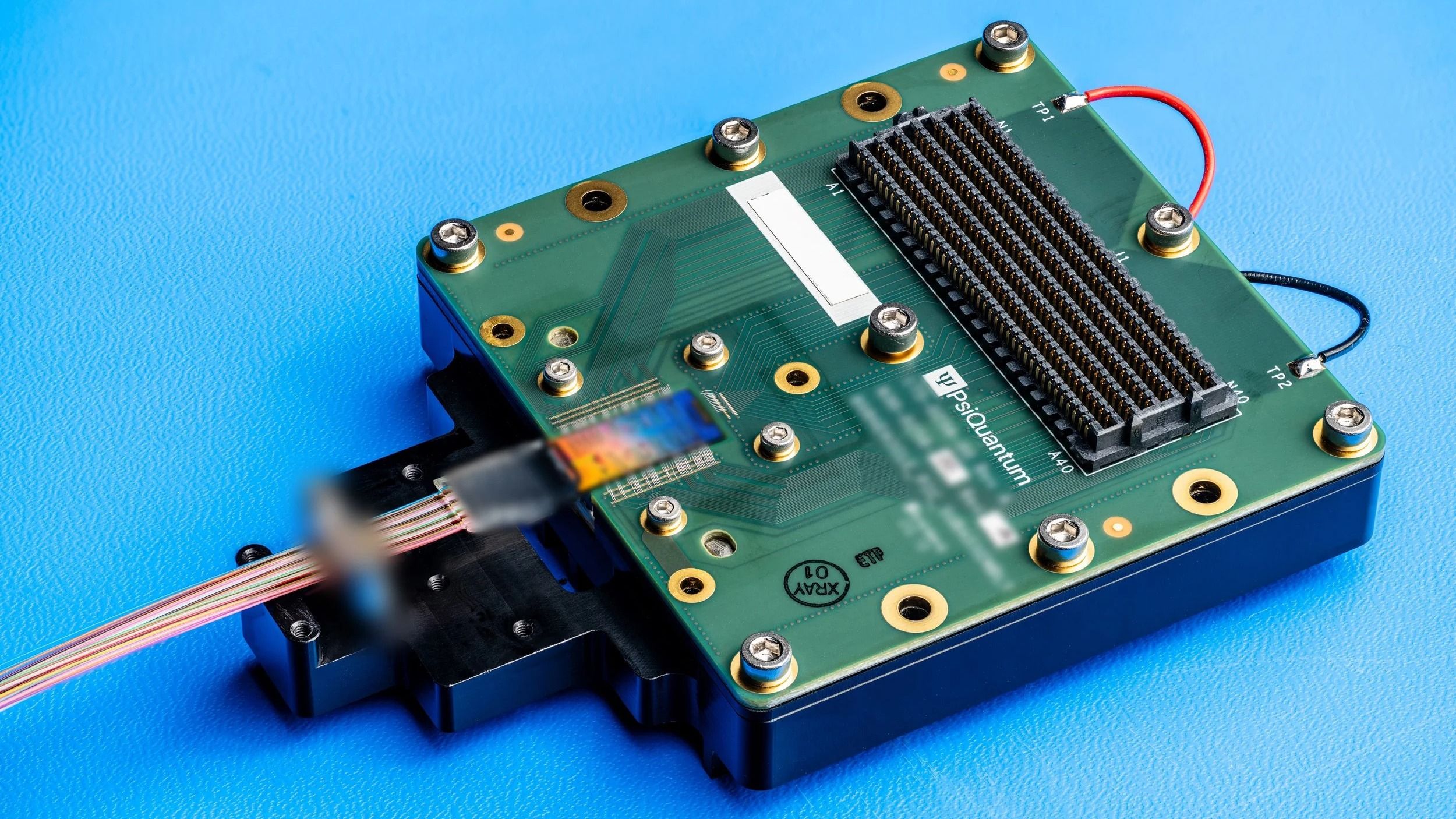
There is quite a lot of room for speed to improve, and PsiQuantum already has a material for that, used in an existing 64-port switch for its quantum systems, which need to switch light at gigahertz rates. The material, barium titanate (BTO), changes how it bends light when a voltage is applied, and the company chose it over lithium niobate, a more common selection, because BTO had the strongest effect it could find. This keeps switching elements short and losses low at speeds roughly a million times faster than the demo. BTO is “not required for the demonstration vehicle or initial products,” which use a thermally switched silicon nitride platform, but it is “an additional path to faster, more advanced future products.”
An argument for starting now is that building thousands of such switches for conventional applications would reduce the risk for the packaging, assembly, and supply chain of parts PsiQuantum builds for quantum computing. AI and quantum computing are “complementary technologies,” it says, and this is the chance to put its technology into action. When PsiQuantum hired Rob Soderbery as an executive vice president in July, it said he would advance its silicon photonics platform, “accelerating its application across AI networking and other next-generation computing infrastructure,” hinting at the roadmap. The company’s CHIPS award was finalized in September for “high-performance optical switches,” among other components.
Co-founder Pete Shadbolt praised Google’s alternative MEMS switch but would prefer to have similar-quality switching on a monolithic chip that needs no moving parts. Nvidia has a stake through its venture arm, NVentures, and collaborates with PsiQuantum on “GPU-QPU integration,” that is, graphics and quantum processing units, as well as silicon photonics. Nvidia also joined rival iPronics’ $125 million round in September to develop its second-generation optical switch.
Right now, inside Google, OCSes rewire AI clusters, and research firm Cignal AI expects most deployments to stay there through the end of the decade; outside of Google, OCS is still at “proof-of-concept and early trial.” The firm raised its market estimates earlier this year, though, roughly threefold for 2026 and by more than 40% for 2029. An opening exists for PsiQuantum in GPU networks, which ties into Nvidia’s interest, though adoption there is expected to be limited until then. The company says samples and testing kits have already gone to several computing companies, including GPU vendors and hyperscalers.
PsiQuantum should have commercial products “announced in the coming months,” along with updates on larger devices, while competitor Salience has already demonstrated 64 ports at this year’s European Conference on Optical Communication. Salience’s roadmap already has 128- and 256-port products. Scaling is always an issue, but if PsiQuantum’s figures, which haven’t been independently verified, hold up at 64 ports without amplifiers, then larger monolithic OCSes are on the way.
Shane Downing Social Links Navigation Contributing Writer Shane Downing is a Contributing Writer for Tom’s Hardware, covering consumer storage, PC hardware, and AI.
Key considerations
- Investor positioning can change fast
- Volatility remains possible near catalysts
- Macro rates and liquidity can dominate flows
Reference reading
- https://www.tomshardware.com/tech-industry/photonics/SPONSORED_LINK_URL
- https://www.tomshardware.com/tech-industry/photonics/psiquantum-turns-its-photonics-know-how-into-an-optical-switch-for-supercharging-ai-data-center-gpu-networks-8×8-lab-prototype-loses-less-light-than-rivals-with-plans-to-develop-larger-devices#main
- https://www.tomshardware.com/my-account
- Deadly Intel Fab 28 explosion causes two-week shutdown, to cost $600 million and severely disrupt server chip manufacturing for six months
- AI demand triggers massive PCB shortage for PC makers as order books full until 2030
- SK hynix-owned Solidigm is plotting a new $45 billion flash memory factory for the US, report claims
- Thin, Light and Built for Everything: NVIDIA RTX Spark Windows Laptops Gain New Models, Agent Tools and Games
- Fujifilm plans 5x production boost of 100TB magnetic storage tapes driven by skyrocketing AI storage demand
Informational only. No financial advice. Do your own research.