
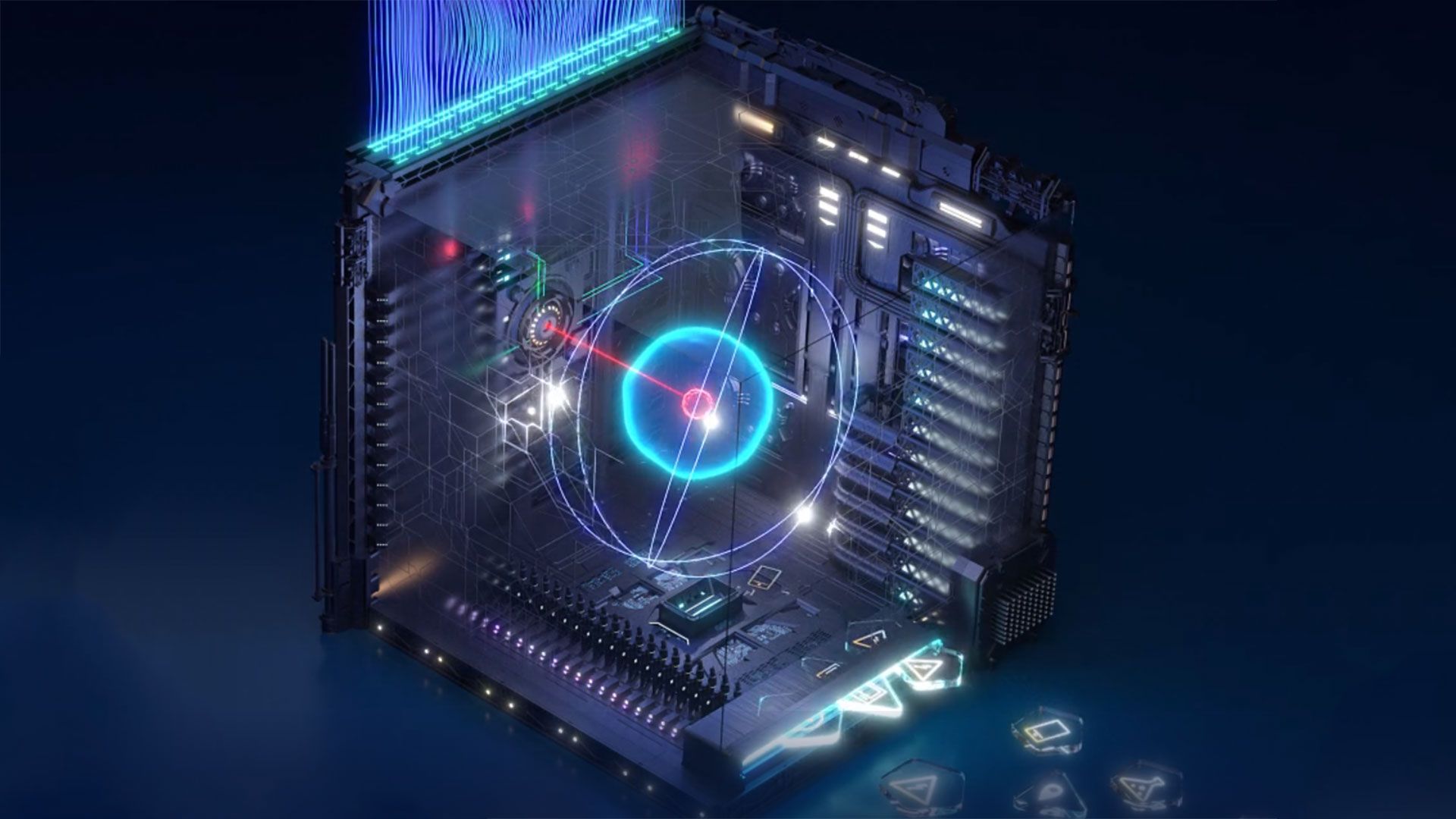
BlueQubit claims it can find a cryptographic key that a supercomputer would take 'years' to uncover in ‘just a few hours.’
When you purchase through links on our site, we may earn an affiliate commission. Here’s how it works .
(Image credit: BlueQubit ) Share Share by: Copy link Facebook X Whatsapp Reddit Pinterest Flipboard Email Share this article 0 Join the conversation Follow us Add us as a preferred source on Google Quantum-software firm BlueQubit has launched its Quantum Advantage Challenge, offering a 0.25 BTC wallet prize to the winner. The overall goal of the competition is to prove that a ‘ Quantum Advantage ’ exists in solving a real-world cryptography problem. BlueQubit says it can find a hidden bitstring in a 2 56 search space, the key to its 0.25 BTC prize wallet, in “under two hours.” Conversely, it reckons that even the fastest classical supercomputer would take “years” to solve the problem. The challenge is now open at www.bluequbit.io .
“We wanted a clear, public, and verifiable way to demonstrate quantum advantage,” said Hayk Tepanyan, BlueQubit CTO, explaining the idea behind the Quantum Advantage Challenge. “There’s no better proof than a problem where a quantum computer can extract a real cryptographic key in hours and where classical algorithms may simply be outmatched.”
A blog post published ahead of the prize launch explained how the challenge works and how the result is verifiable. It started by sympathizing with industry watchers being bamboozled with various solutions already claiming to have demonstrated a ‘Quantum Advantage’ or even 'Quantum Supremacy.'
IBM's boffins run a nifty quantum error-correction algorithm on conventional AMD FPGAs
Fear that quantum computing is on the cusp of cracking cryptocurrency's encryption lead to downgrades
New Chinese optical quantum chip allegedly 1,000x faster than Nvidia GPUs for processing AI workloads
The BlueQubit problem takes the form of a random circuit design with 2 56 possible output bitstrings, which is about 72 quadrillion possibilities. Specifically, the problem is built around peaked circuits, which are quantum circuits engineered to produce an extremely concentrated probability distribution, ‘peaking’ on a single hidden bitstring. An elegant verification protocol has been devised like this:
Alice constructs a peaked circuit, knowing which bitstring is the peak
Key considerations
- Investor positioning can change fast
- Volatility remains possible near catalysts
- Macro rates and liquidity can dominate flows
Reference reading
- https://www.tomshardware.com/tech-industry/quantum-computing/SPONSORED_LINK_URL
- https://www.tomshardware.com/tech-industry/quantum-computing/quantum-computing-firm-dangles-usd22-500-bitcoin-prize-all-you-have-to-do-is-uncover-a-private-key-hidden-inside-a-quantum-optimized-problem#main
- https://www.tomshardware.com
- 3D-printed fan-less and pump-less liquid cooler can deliver 600 watts of cooling for data centers — passive design provides reusable heat, exceeds project perfo
- NVIDIA DRIVE AV Raises the Bar for Vehicle Safety as Mercedes-Benz CLA Earns Top Euro NCAP Award
- How to Get Started With Visual Generative AI on NVIDIA RTX PCs
- More than half of CEOs report seeing no benefits from AI deployment so far — only 12% of business leaders hit the jackpot of higher revenues and reduced costs
- OpenAI commits to 'paying our own way' so that Stargate AI data centers don't increase energy bills — will fund grid upgrades and even flexible loads to reduce
Informational only. No financial advice. Do your own research.