
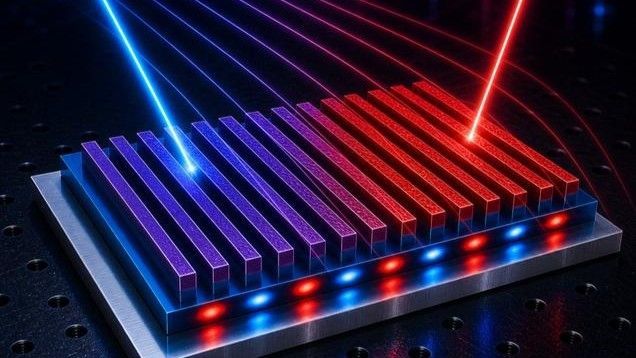
According to the researchers, the prototype achieved a nonreciprocity factor approaching 0.9 while operating at an incidence angle of just three degrees, much closer to normal incidence than the steep angles typically required by previous designs. The system also supports continuous tuning via changes in the magnetic field or incident angle, as well as digital on-off switching via the GST phase transition. The team further analyzed why the nonreciprocal effect weakens when GST changes state, concluding that the reduction results from a combination of optical field redistribution and increased damping rather than simple absorption losses alone.
Although the technology remains an early-stage research demonstration, the ability to program thermal radiation could eventually become valuable in computing hardware as processors continue to pack more transistors, chiplets, and photonic components into increasingly compact packages. Future thermal metasurfaces could give engineers another tool for directing heat away from hotspots, reducing thermal interference between neighboring chiplets, or stabilizing silicon photonic devices whose optical characteristics shift with temperature.
Beyond computing, the researchers also envision applications in radiative cooling, thermophotovoltaic energy conversion, infrared emitters, thermal communication systems, and photonic memory technologies. For now, however, the work remains a laboratory demonstration rather than a deployable technology. Considerable engineering challenges remain before programmable thermal emitters find their way into commercial electronics.
Follow Tom's Hardware on Google News , or add us as a preferred source , to get our latest news, analysis, & reviews in your feeds.
Etiido Uko is a news contributor for Tom's Hardware covering the latest updates in big tech and the PC industry. He is a mechanical engineer and senior technical writer with over nine years of experience in documentation and reporting. He is deeply passionate about all things engineering and technology, and is an expert in gadgets, manufacturing, robotics, automotive, and aerospace. ","collapsible":{"enabled":true,"maxHeight":250,"readMoreText":"Read more","readLessText":"Read less"}}), "https://slice.vanilla.futurecdn.net/13-4-25/js/authorBio.js"); } else { console.error('%c FTE ','background: #9306F9; color: #ffffff','no lazy slice hydration function available'); } Etiido Uko Social Links Navigation News Contributor Etiido Uko is a news contributor for Tom's Hardware covering the latest updates in big tech and the PC industry. He is a mechanical engineer and senior technical writer with over nine years of experience in documentation and reporting. He is deeply passionate about all things engineering and technology, and is an expert in gadgets, manufacturing, robotics, automotive, and aerospace.
Key considerations
- Investor positioning can change fast
- Volatility remains possible near catalysts
- Macro rates and liquidity can dominate flows
Reference reading
- https://www.tomshardware.com/tech-industry/manufacturing/SPONSORED_LINK_URL
- https://www.tomshardware.com/tech-industry/manufacturing/researchers-create-programmable-material-that-can-steer-heat-and-remember-its-state-without-power-breakthrough-could-eventually-aid-ai-chip-cooling-and-silicon-photonics#main
- https://www.tomshardware.com/subscription
- GeForce NOW Turns Up the Heat With New GeForce RTX 5080-Powered Toronto Server
- NVIDIA and Hugging Face Bring New Models and Frameworks to LeRobot for the Open Robotics Community
- Ex-Sega engineer creates 'super realistic' CRT monitor emulator — incredible retro offering even includes TV screen tapping to fix picture
- AMD Ryzen 7 5800X3D is back in stock with up to $173 in savings, thanks to these Newegg deals — free $70 MSI MAG cooler brings costs well below MSRP for the sta
- Elon Musk’s Colossus 2 data center installed 59 natural gas turbines without permission, report claims — thousands of tons of pollutants reportedly impact black
Informational only. No financial advice. Do your own research.