
When you purchase through links on our site, we may earn an affiliate commission. Here’s how it works .
A team of researchers from Rice University has achieved a new breakthrough in 3D printing that has unlocked the construction of brand-new electronic tech that was previously impossible. As reported by New Atlas , a paper published by the aforementioned team describes a new 3D-printing process using microwaves capable of heating up nanoparticle ink with extreme precision.
This bleeding-edge microwave tech, called “Meta-NFS” or metamaterial-inspired near-field electromagnetic structure, can heat ink in a concentrated zone as small as a human hair. Further still, the microwaves can be programmed to penetrate through an object's outer layer to heat the inside layers without causing damage to the exterior.
Watch On This incredible accuracy enables the printer to fuse circuits inside a 3D printed object, something that has been impossible to do with outgoing manufacturing methods, and is a problem that has plagued the industry for a decade. Current manufacturing methods use lasers and furnaces to heat nanoparticles in circuit boards from the outside in. This works for traditional electronic manufacturing, but prevents 3D printers from making specialized electronics that interface with softer materials.
You may like MIT-developed 3D printer can output a fully functional electric motor in a single process Chinese scientists 3D print tiny items in half a second using holographic light fields Inventor showcases 3D printer filament dryer that mines Bitcoins and dries filament with waste heat, capable of 6 TH/s Meta-NFS also allows 3D printers to use an expanded assortment of materials, including metals, ceramics, and thermoset polymers. Further, the tech also reportedly improves production efficiency through real-time adjustments in microwave power, enabling a Meta-NFS printer to create a print (in one continuous print) without swapping materials.
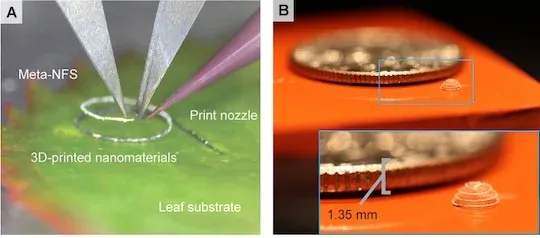
Meta-NFS's abilities are enabling the creation of new electronic tech that was previously difficult to accomplish with conventional manufacturing. A few of these applications include integration of electronics onto robots with soft skin, implants, and even plants. The researchers showed several examples, including using Meta-NFS to print wireless strain sensors on biocompatible polymers and create devices that can integrate into plants for real-time growth monitoring. This was only possible through Meta-NFS's compatibility with metal and carbon-based materials.
These are just a few of the applications Meta-NFS has in the electronic manufacturing industry. But it is expected that the tech will be a critical part of many groundbreaking technologies moving forward.
Follow Tom's Hardware on Google News , or add us as a preferred source , to get our latest news, analysis, & reviews in your feeds.
Get Tom's Hardware's best news and in-depth reviews, straight to your inbox.
Key considerations
- Investor positioning can change fast
- Volatility remains possible near catalysts
- Macro rates and liquidity can dominate flows
Reference reading
- https://www.tomshardware.com/3d-printing/SPONSORED_LINK_URL
- https://www.tomshardware.com/3d-printing/researchers-find-a-way-to-heat-3d-printer-filament-using-microwaves-enabling-fusing-circuits-inside-printed-objects-tech-supports-precise-heating-down-to-the-width-of-a-human-hair#main
- https://www.tomshardware.com
- Techie buys fake Ledger Nano S+ hardware crypto wallet and almost falls for phishing — a convincing clone would have caught newbies unaware
- Minisforum's beastly N5 Max NAS comes powered by AMD Strix Halo — $2,899 for 'AI NAS' with pre-installed OpenClaw, supports up to 200TB capacity
- Rethinking AI TCO: Why Cost per Token Is the Only Metric That Matters
- 40 years ago we entered the megabit memory era with IBM’s DRAM breakthrough — a major leap beyond the 64 kilobit chips common at the time
- New Adobe Premiere Color Grading Mode Accelerated on NVIDIA GPUs
Informational only. No financial advice. Do your own research.