
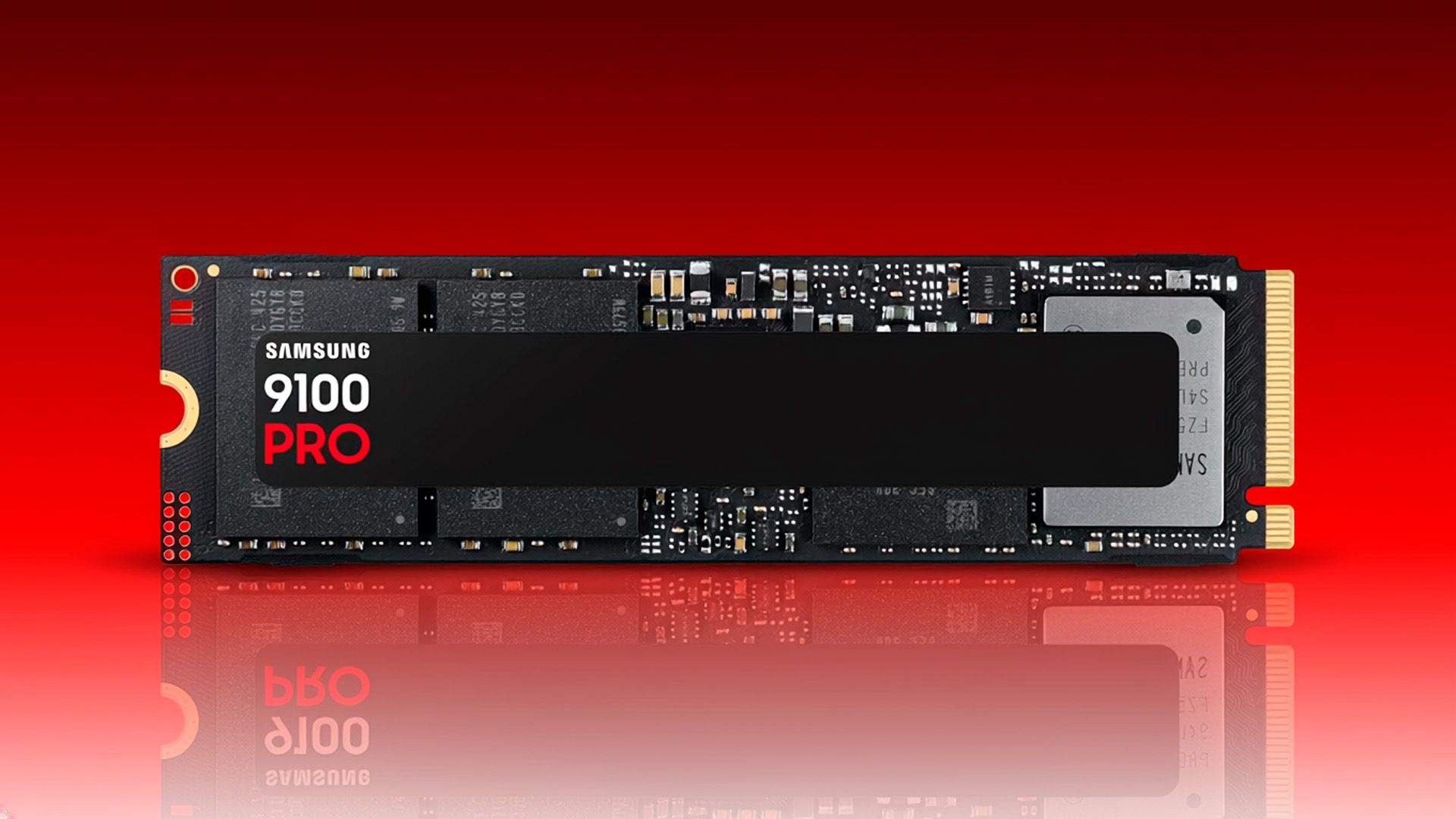
In today’s landscape with rapidly rising SSD prices, choosing a drive based solely on performance is no longer sufficient. The warranty matters just as much, and the Samsung 9100 Pro offers coverage that protects your investment. The PCIe 5.0 drive comes with a five-year limited warranty and very generous endurance ratings across the board. For example, the 2TB is rated for 1,200 TBW — for perspective, you could write one-third of the drive’s total capacity every day for the next five years and still be covered by the warranty.
The Samsung 9100 Pro is a high-end PCIe 5.0 SSD featuring Samsung's own Presto controller and 236-layer NAND. The 1TB model delivers sequential read and write speeds up to 14,700 MB/s and 13,300 MB/s, respectively.
The Samsung 9100 Pro is a high-end PCIe 5.0 SSD featuring Samsung's own Presto controller and 236-layer NAND. The 21TB model delivers sequential read and write speeds up to 14,700 MB/s and 13,400 MB/s, respectively.
The Samsung 9100 Pro is a high-end PCIe 5.0 SSD featuring Samsung's own Presto controller and 236-layer NAND. The 4TB model delivers sequential read and write speeds up to 14,800 MB/s and 13,400 MB/s, respectively.
The Samsung 9100 Pro is a high-end PCIe 5.0 SSD featuring Samsung's own Presto controller and 236-layer NAND. The 8TB model delivers sequential read and write speeds up to 14,800 MB/s and 13,400 MB/s, respectively.
The Samsung 9100 Pro is one of the top-performing drives in the PCIe 5.0 category. If you are coming from a PCIe 4.0 SSD or from the Samsung 990 Pro , its predecessor, the improvement is night and day. The Samsung 9100 Pro may not look as fast on paper because rivals have higher rated speeds. However, the Samsung 9100 Pro delivers strong real-world performance matched with good efficiency.
(Image credit: Tom's Hardware) (Image credit: Tom's Hardware) (Image credit: Tom's Hardware) (Image credit: Tom's Hardware) (Image credit: Tom's Hardware) (Image credit: Tom's Hardware) Image 1 of 6 View Original
At $0.199 per GB, the 2TB model provides the best value. Doubling the capacity from 1TB to 2TB raises the overall cost by roughly 60%, which still makes it an attractive option for many users. Upgrading to 4TB and 8TB raises the cost per GB to $0.28 and $0.287, respectively. The jump from 2TB to 4TB results in a 2.81 times price increase for double the capacity. In contrast, the price difference between 4TB and 8TB is nearly proportional, at a 2.05 times increase for double the capacity.
If you require 4TB of storage, purchasing two 2TB drives saves you $323 compared to a single 4TB drive. Similarly, buying four 2TB drives saves you $707 versus an 8TB drive. So, if you have the luxury of extra unused M.2 slots, smaller 2TB drives can save you a lot.
Get Tom's Hardware's best news and in-depth reviews, straight to your inbox.
Key considerations
- Investor positioning can change fast
- Volatility remains possible near catalysts
- Macro rates and liquidity can dominate flows
Reference reading
- https://www.tomshardware.com/pc-components/SPONSORED_LINK_URL
- https://www.tomshardware.com/pc-components/samsung-9100-pro-ssds-slashed-up-to-41-percent-while-supplies-last-huge-price-cuts-hit-all-capacities-from-1tb-to-8tb#main
- https://www.tomshardware.com/membership
- At AI Day Singapore, NVIDIA and Partners Showcase AI Advancements Across Southeast Asia
- China stockpiled 343 immersion DUV tools for advanced chipmaking
- From Enablement to Execution, Egypt’s AI Ecosystem Reaches Production Scale
- 32GB dethrones 16GB as top RAM capacity in gaming rigs despite memory shortage
- Russia's uncrewed robot tank fails during debut military display in front of President Putin
Informational only. No financial advice. Do your own research.