
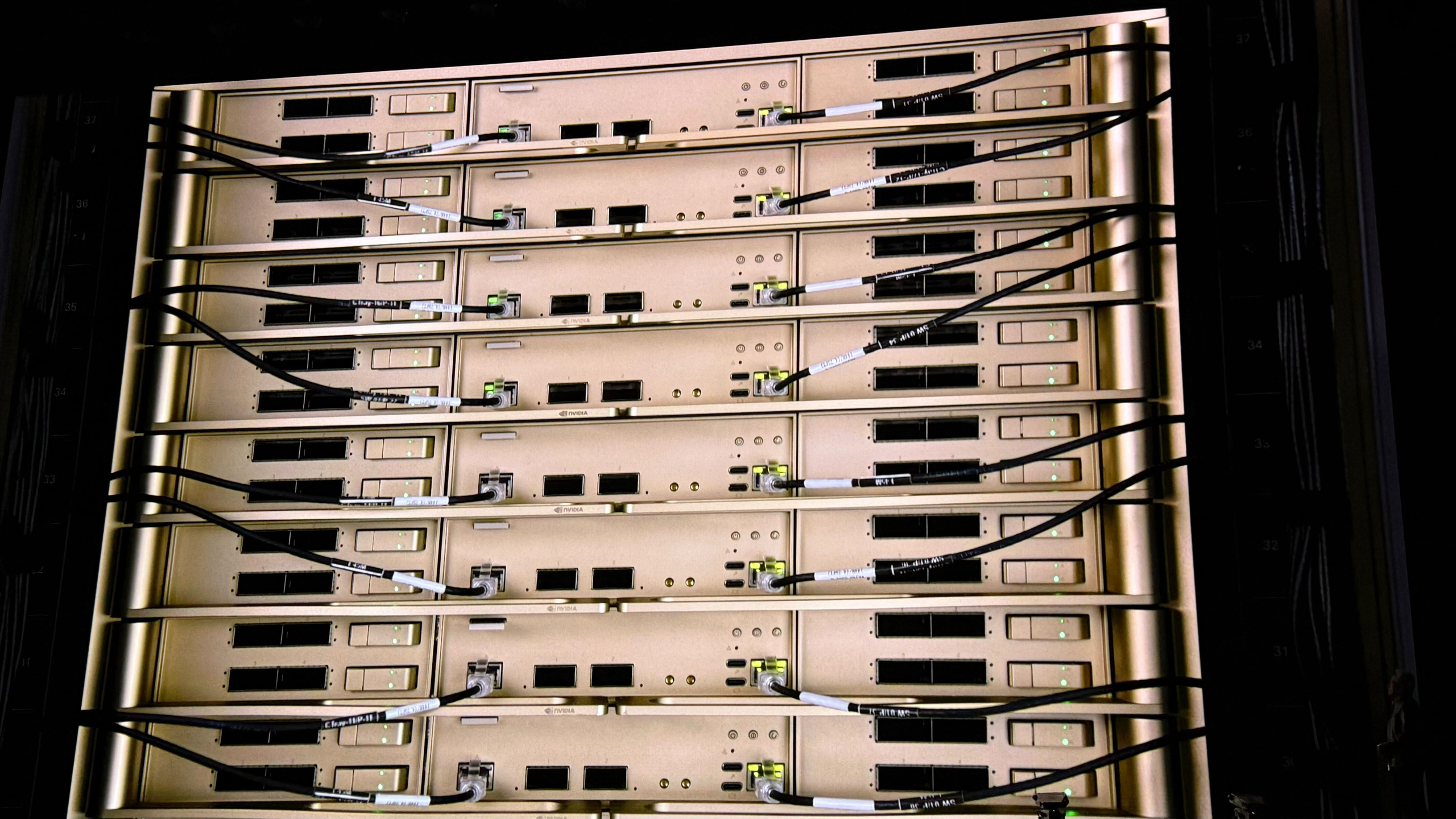
The Kessel system retains the fundamental configuration of Nvidia's Vera Rubin NVL72 platform, which comprises 72 GPU packages distributed across 18 compute trays and nine NVLink switch trays. However, instead of Nvidia's conventional arrangement with internal NVLink cable cartridges, SpaceX plans to position compute and switch trays back-to-back around a passive PCB midplane. The architecture resembles a smaller version of Nvidia's Kyber design with 576 AI GPUs (albeit in 144 packages), which also relies on a PCB-based interconnect rather than conventional cable assemblies, SemiAnalysis notes. Interestingly, the design is aimed at both terrestrial and orbital deployments, according to the analysts.
Arguably the most distinctive feature of Kessel is its 84-layer PCB midplane, which uses ultra-low-loss M10 copper-clad laminates (CCLs). By contrast, Nvidia's Kyber architecture relied on a backplane based on a considerably more complex 156-layer PCB featuring M9 CCLs. The reduction in layer count by nearly half could substantially improve manufacturability and production yields, but the more advanced copper-clad laminate will almost certainly increase material costs. In any case, an 84-layer PCB is a device that is exceptionally hard to build.
The move to a PCB midplane could simplify system assembly by eliminating numerous high-speed cable connections, but it would not necessarily reduce manufacturing costs. An 84-layer PCB that relies on ultra-low-loss M10 laminate is an exceptionally expensive component that requires sophisticated manufacturing processes and precise quality control. To put an 84-layer PCB number into context, modern high-end server motherboards use 15 – 20 layers, whereas server development boards use more than 20 layers to virtually eliminate any electrical issues with the board itself. Furthermore, manufacturing yields of an 84-layer PCB could become a major obstacle, as defects in internal layers may render an entire board unusable. Consequently, the economic viability of Kessel will depend on whether savings from cable elimination and independent component procurement can offset the cost of its complex midplane.
Perhaps more importantly, Kessel represents a departure from Nvidia's conventional system-level procurement model. Instead of purchasing Nvidia's assembled L6 compute boards or even L10 trays that Nvidia plans to sell with its Vera Rubin generation , SpaceX reportedly plans to acquire AI accelerators, CPUs, switches, and networking components directly from Nvidia and procure other components from third-party suppliers (one can wonder how easy it will be for SpaceX/xAI to procure memory amid today's shortages). This would enable SpaceX to select its own PCB manufacturers, component vendors, and manufacturing partners, optimize its hardware for its infrastructure (which will be important for orbital deployments), and perhaps reduce intermediary costs. Meanwhile, the company would assume greater responsibility for system design, validation, manufacturing quality, and supply-chain management, which is something that most hyperscalers have been doing in recent years.
SpaceXAI will deploy standalone Nvidia Vera CPUs for Grok's agentic workloads
Key considerations
- Investor positioning can change fast
- Volatility remains possible near catalysts
- Macro rates and liquidity can dominate flows
Reference reading
- https://www.tomshardware.com/tech-industry/artificial-intelligence/SPONSORED_LINK_URL
- https://www.tomshardware.com/tech-industry/artificial-intelligence/spacex-develops-its-own-kessel-rack-scale-system-featuring-72-nvidia-rubin-gpus-for-data-centers-in-space-report-claims-replaces-conventional-nvlink-cable-assemblies-with-a-massive-84-layer-printed-circuit-board#main
- https://futureplc.com/privacy-policy/
- Nvidia RTX PRO 6000 user’s cables almost melted, even when limited to 500W
- Memory shortage spurs smartphone makers to melt used memory off old devices, then re-solder it onto new products
- Elon Musk’s Terafab targets 1 million wafers a month after 2032
- Nintendo unleashes DMCA takedown wave against open-source Switch modchip firmware, 144 tools disabled
- Alice Huang reportedly instrumental in securing over $7.5 billion of Nvidia AI GPU imports during three-year relationship with Jensen Huang
Informational only. No financial advice. Do your own research.