
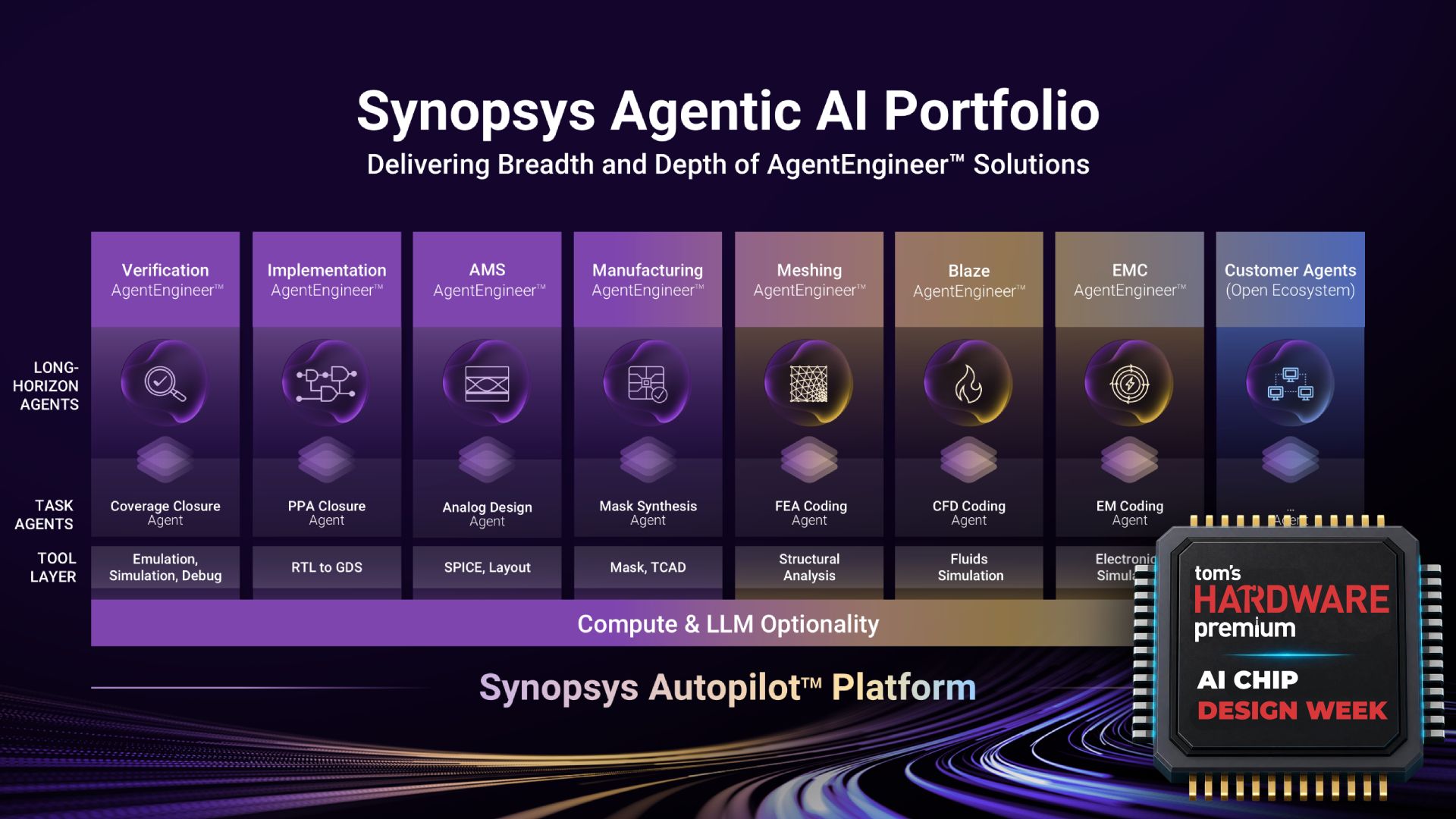
The blog outlines the verification loop — the agent plans, orchestrates task agents, checks what they return, and adjusts whenever an intermediate result falls short. When a test finds a bug, a root-cause analysis (RCA) agent reads logs, clusters errors, forms a hypothesis, and inspects waveforms to confirm it. The agent then makes “local rewrites of the RTL to prove that the bugs have indeed been fixed” and produces a bug fix manifest. When intermediate results drift from the objective, the agent will “course correct, adapt, react,” he said.
The performance numbers in Synopsys’ release are heady: up to 50x faster verification closure, 20% higher coverage, a 30% productivity boost, 2x better token efficiency, and lower latency. The 50x and 20% figures are not new. Synopsys told Tom’s Hardware Premium that they come from its July work with Nvidia, measured against its own verification workflows without AgentEngineer. The 30% number is at the top of the 10% to 30% range Fujitsu reported for its RTL code generation.
Those productivity gains are measured “compared to what the human experts would have done otherwise or are doing today,” Thiruvengadam said. The 2x token efficiency, meaning fewer tokens for a given task, is customer-reported: an unnamed customer compared Synopsys’ agents with its own, built on commercial agentic harnesses. No figure exists for the latency claim; the release and blog credit it in part to context intelligence, which suggests less time spent waiting on model calls.
Another engagement with results is AheadComputing, whose Vice President of Verification, Alon Mahl, said the Implementation AgentEngineer helped reduce manual engineering effort from RTL handoff through signoff, without giving a number. Intel, MediaTek, and Samsung also endorsed the technology. None gave hard results, but all supported the technology as promising. Today's launch is the portfolio and platform, without production details. Synopsys’ earlier AI tool from 2020, DSO.ai, has passed 100 production tape-outs , while the new agents are still in engagements.
How autonomous are these agents? Each vendor defines autonomy on its own scale, and Synopsys introduced its L1-to-L5 framework last year. “The original vision of L5 was fully autonomous execution. But not just fully autonomous execution, but also complexity,” Thiruvengadam told us, describing L5 as executing a complex workflow autonomously within human guardrails. “That was the idea, and that’s exactly where we are.” Synopsys confirmed that it characterizes the agents as L5. Cadence also claimed Level 5 on its own scale at Computex in June.
Earlier this year, Nvidia chief scientist Bill Dally said AI cut a 10-month, eight-engineer task, porting a standard cell library for GPU design, to one night, but that Nvidia is still “a long way” from having AI design a new GPU end to end.
Human engineers remain in the loop, but the amount of oversight varies. “The guardrails are still going to be defined by the humans, the crucial approval checkpoints are still going to be human-driven,” Thiruvengadam said. “Our customers will have to learn to trust these autonomous systems.” The blog adds that teams can set checkpoints where people inspect results, validate decisions, and redirect the workflow, then “reduce intervention” as confidence grows. No vendor has yet described when its agents stop retrying or escalate to an engineer.
Synopsys says the capabilities are already there; its next goal is general availability. Eyes will be on whether Synopsys reaches general availability by the end of 2026, and names a customer in production when it does. Cadence expects Level 5 early access in the second half of 2026, and Siemens has promised self-verifying capabilities in forthcoming releases. The product exists and works in customers’ hands, and the speedup claims, if they can be realized beyond internal evaluations, and especially if backed by independent testing, appear to be extremely promising.
Shane Downing Social Links Navigation Contributing Writer Shane Downing is a Contributing Writer for Tom’s Hardware, covering consumer storage, PC hardware, and AI.
Key considerations
- Investor positioning can change fast
- Volatility remains possible near catalysts
- Macro rates and liquidity can dominate flows
Reference reading
- https://www.tomshardware.com/tech-industry/semiconductors/SPONSORED_LINK_URL
- https://www.tomshardware.com/tech-industry/semiconductors/synopsys-debuts-autopilot-platform-for-developing-chips-autonomously-using-ai-new-agentengineer-platform-is-poised-for-general-availability-by-the-end-of-2026#main
- https://www.tomshardware.com/membership
- Emerald AI, Google and NVIDIA Launch Alliance to Advance Flexible AI Data Centers
- The Netherlands is rolling its own software and services after U.S. sanctions took Microsoft off the table
- OpenAI and Anthropic are reportedly investigating tens of thousands of AI security incidents; OpenAI pauses testing after AI 'kill switch' fails to stop a rogue
- ASRock X870E Challenger Wifi Motherboard Review: A value X870E board packed with features
- North Korea named as primary suspect in $387 million Bitget crypto hack
Informational only. No financial advice. Do your own research.