
This implementation variability reflects the flexibility of USB4’s architecture. The specification allows device makers to scale features based on cost and power constraints, especially in thin-and-light systems. For users, however, the USB4 label alone does not guarantee any particular performance characteristic without checking controller documentation or certification badges.
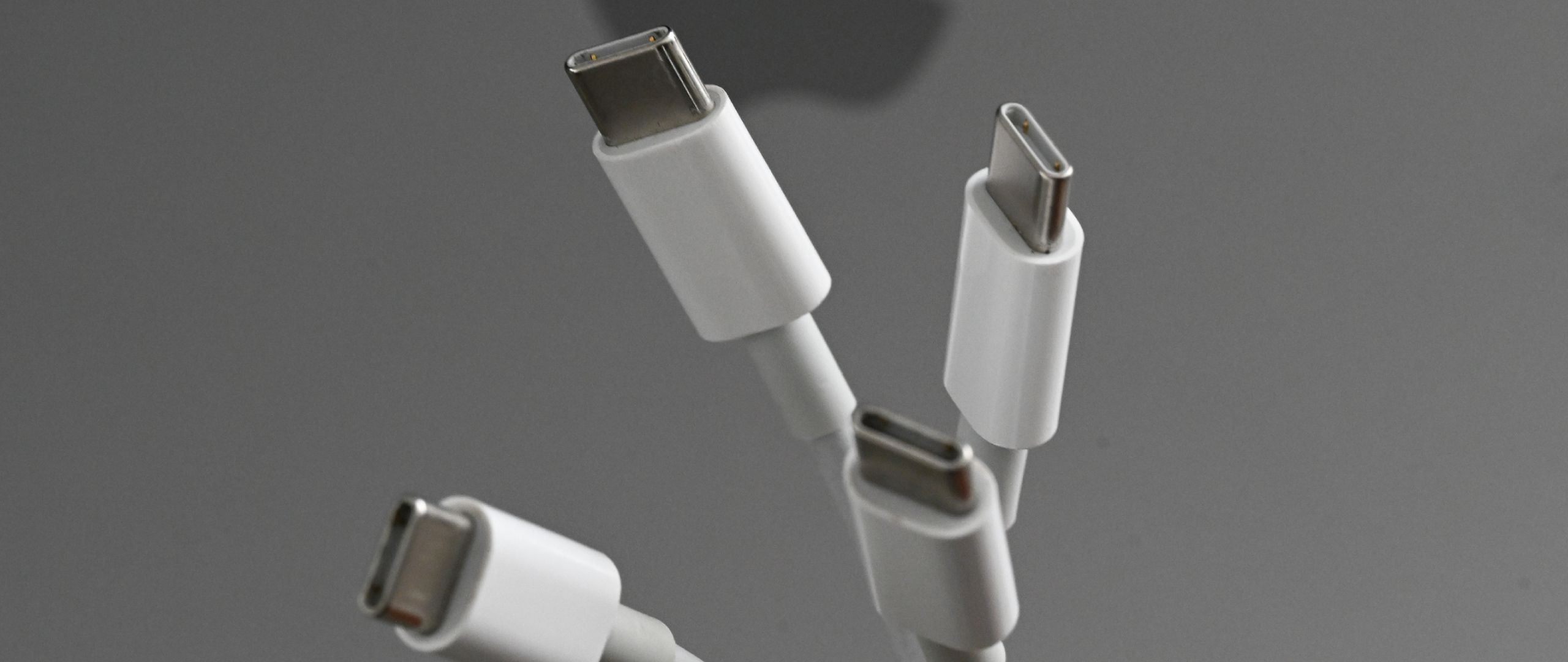
USB-C’s role has grown alongside this transition. The connector now consolidates power, data, and display signaling, and it is the required physical interface for USB4, Thunderbolt 3, Thunderbolt 4, and Thunderbolt 5. With Power Delivery 3.1, USB-C can negotiate up to 240W via 48V Extended Power Range modes across fixed 28V, 36V, and 48V power profiles. A single cable can power a high-end notebook, drive a high-resolution display, and host multiple data devices simultaneously because power negotiation occurs on the separate Configuration Channel, rather than the high-speed lanes.
USB4 Version 2.0 marks the largest technical jump in USB signaling since the transition from USB 2.0 to USB 3.0. Instead of adding more lanes, the new specification doubles throughput by replacing NRZ signaling with PAM3 modulation. PAM3 encodes three amplitude levels per symbol, enabling 40 Gbps per lane across the same physical wires that carried 20 Gbps in previous generations. With two bonded lanes in each direction, USB4 v2 reaches 80 Gbps symmetrical bandwidth. An asymmetric mode increases this to 120 Gbps in one direction for display-oriented workloads, while the reverse direction can be reduced.
The transport layer receives several upgrades. PCIe tunneling now supports PCIe Gen4, which doubles per-lane throughput for external SSDs and eGPU boxes, relative to Gen3 tunneling in USB4 v1. DisplayPort tunneling advances to DisplayPort 2.1 with UHBR20 signaling, enabling dual 8K or a single 12K display with full chroma and high refresh rates. Backward compatibility with USB4 v1, Thunderbolt 3, and Thunderbolt 4 devices is retained, although those devices fall back to older signaling modes when connected.
Many certified passive USB-C cables up to one meter will support 80 Gbps, but anything longer typically requires active retimers. These active cables include embedded signal processing and sometimes operate directionally, which introduces design considerations for things like hubs and monitors . The USB-IF’s new labeling scheme identifies cables explicitly as USB 40 Gbps, USB 80 Gbps, or USB 240W to mitigate the long-standing ambiguity that accompanied earlier USB 3.x naming.
Thunderbolt 5 rides alongside USB4 v2 as its highest-fidelity implementation, with Intel’s specification guaranteeing features that USB4 v2 only defines as optional. These include mandatory 80 Gbps symmetrical operation, 120 Gbps asymmetric display mode, PCIe Gen4 tunneling with at least 32 Gbps of sustained throughput, and support for 240W charging. Thunderbolt 5 also mandates lane symmetry and strict latency targets to support high-bandwidth, low-jitter peripherals such as external GPUs, docked workstations, and multi-display gaming setups. We can see that in higher-end systems in mid-2026, the full-fat Thunderbolt 5 spec is rolling out, with our recently reviewed Razer Blade 16 (2026) coming fully equipped with the port.
Because Thunderbolt 5 builds directly atop the USB4 v2 physical layer, its cables and controllers are interoperable across the USB4 family, but with stricter certification criteria. In practice, Thunderbolt 5 functions as the version of USB4 v2 that guarantees complete feature exposure, similar to how Thunderbolt 4 served as the reference point for the USB4 v1 era.
There has been some discussion among users and industry analysts about what the future of USB might look like. A likely future USB5 standard might see schemes beyond PAM3, if USB-C’s electrical characteristics prove capable of sustaining higher speeds. PAM4 could be a candidate here. Meanwhile, copper links are approaching practical limits at these data rates, prompting the active commercialization of optical USB-C cables that embed fiber transceivers inside standard connectors. While expensive today, optical links could carry future USB4 v3 or USB5 signaling across tens of meters, without electromagnetic interference or the attenuation challenges of copper.
Power delivery beyond 240W is another open question. The 48V EPR ceiling aligns well with current mobile workstations and most gaming laptops, but heavier categories such as portable displays, desk-dock hybrids, and workstation replacements may increase pressure for higher wattage tiers. Whether USB-C remains the long-term vehicle for that expansion or yields to a successor connector will depend on thermal constraints and cable reliability at elevated voltages.
The USB-IF’s renewed emphasis on clear labeling may ultimately define how smoothly the transition unfolds. The shift from version-based branding to explicit “USB 40 Gbps,” “USB 80 Gbps,” and “240W Certified Cable” identifiers is intended to eliminate the ambiguity that has characterized the standard for nearly a decade. Adoption will, of course, depend on consistent enforcement by manufacturers and retailers.
USB has moved far beyond its origins as a peripheral interconnect. The convergence of USB4 v2, Thunderbolt 5, and expanded Power Delivery turns the USB-C port into a high-bandwidth, multi-protocol backplane for modern systems.
A single connector can now supply workstation-class PCIe bandwidth, high-resolution video, and sustained charging for devices that previously required dedicated power bricks. The next steps in the roadmap take USB into signaling regimes that challenge copper’s limits while retaining full backward compatibility with the ecosystem that grew around USB 2.0 and USB 3.x.
As the 80Gbps era proliferates, users will encounter hardware that behaves less like a simple peripheral port and more like an external extension of a system’s internal fabric. As we move through the second half of the decade, OEMs are now starting to standardize full-feature implementations rather than the partial configurations that marked the early years of USB4.
If that consolidation takes place, the connector that started as a replacement for serial and parallel ports will continue its evolution into one of the most capable physical interfaces in computing.
Luke James is a freelance writer and journalist.\u00a0 Although his background is in legal, he has a personal interest in all things tech, especially hardware and microelectronics, and anything regulatory.\u00a0 ","collapsible":{"enabled":true,"maxHeight":250,"readMoreText":"Read more","readLessText":"Read less"}}), "https://slice.vanilla.futurecdn.net/13-4-25/js/authorBio.js"); } else { console.error('%c FTE ','background: #9306F9; color: #ffffff','no lazy slice hydration function available'); } Luke James Social Links Navigation Contributor Luke James is a freelance writer and journalist. Although his background is in legal, he has a personal interest in all things tech, especially hardware and microelectronics, and anything regulatory.
Key considerations
- Investor positioning can change fast
- Volatility remains possible near catalysts
- Macro rates and liquidity can dominate flows
Reference reading
- https://www.tomshardware.com/peripherals/usb/SPONSORED_LINK_URL
- https://www.tomshardware.com/peripherals/usb/usbs-next-decade#main
- https://www.tomshardware.com/my-account
- How Open Models Are Driving AI Research
- AI tech companies have ‘hidden debt’ worth around $1.65 trillion, report claims — amount is 122% of debt reflected on the balance sheets of Alphabet, Amazon, Me
- Save $400 on a new 14-inch MacBook Pro M5 — 48GB of RAM, a 1TB SSD, and a 16-core processor for $2,699
- New plugin unlocks granular VRAM temperature tracking on Nvidia RTX 50-series GPUs — community cracks open Blackwell's forbidden telemetry sensors
- Chinese modder gets GeForce RTX 4060 working in Windows 11 on Huawei Arm workstation — uses modified driver borrowed from an Nvidia RTX Spark
Informational only. No financial advice. Do your own research.