
But even then, input latency was above what I would consider acceptable on our standard GPU test rig, and enabling ray tracing at all dipped frame rates and spiked input latency even further, so I had to stick to raster-only rendering for the best results.
Overall, my early RTX Spark gaming verdict is that you can do it, and you can have a fine enough time, but it is not the primary focus of this platform. Gaming performance with the relatively limited memory bandwidth of the RTX Spark Superchip, combined with the system's CPU performance and the overhead of Prism emulation, mean that you'll be searching for a narrow range of settings where baseline frame rates, upscaling, image quality, and the smoothness boost of frame generation still yield acceptable input latency.
When I first approached gaming on this platform, I had expected that DLSS upscaling would be a required part of the experience, but in practice, you really need to lean on DLSS Frame Generation, as well, whether that's for added smoothness (as in Gears of War ) or for both smoothness and the benefits of Nvidia Reflex due to developer choices behind the scenes (as in Control Resonant ).
Even with Reflex, though, the Grace CPU generally seems to deliver input latencies significantly higher than I'm used to on our Ryzen 7 9800X3D test rig, and it's hard to get them much lower in these AAA titles by tweaking settings.
If you demand the lowest input latency and the highest performance with cutting-edge games, especially if you plan to enable RT, a separate gaming laptop with a dedicated RTX 50-series GPU will still provide a superior experience. And if you just don’t care about local AI at all, that advice applies even more strongly.
Nvidia's RTX Spark is an ambitious new PC platform for the traditional workloads of today and the potential agentic AI work of tomorrow. How often do we see an entirely new player try to elbow into the crowded and competitive PC space, especially one with a sweeping vision for how the PC will be used in the years to come? An incremental move this is not.
Our general performance tests and new agentic AI tests show that despite providing merely solid CPU performance and relatively low bandwidth for a unified memory architecture on paper, the Blackwell GPU on board GB10 has enough AI horsepower in practice to let the RTX Spark platform come out ahead of Apple's latest top-end M5 Max and AMD's Ryzen AI Max+ 395, aka Strix Halo, SoCs.
Whether you choose the highly intelligent dense Qwen 3.8 27B model and trade raw speed for intelligence, or make the opposite trade with the lighter and faster Qwen 3.6 35B A3B, the RTX Spark comes out on top. That bodes well for pairing popular agents like Hermes with intelligent local models on this platform.
But Nvidia's mission to reinvent the PC isn't a total grand slam in this first iteration.
First, this platform won't replace a dedicated gaming laptop. Even for those who only game on the side and have more forgiving standards for frame rates and input latency, the RTX Spark's gaming performance may not measure up to expectations.
When you put the overhead of Prism x86 emulation on top of the merely adequate performance of the Grace CPU, it’s clear that the Spark platform will have to work hard to keep up in the vast range of games that don’t have an Arm port.
The CPU-heavy Gears of War: E-Day is particularly unkind to the Prism-on-Grace stack, but even when a title like Control Resonant doesn't lean so heavily on the CPU, the limited and shared memory bandwidth of the GB10 SoC still poses an obstacle to cranking settings to the max despite the large amount of theoretical compute horsepower on tap.
We're also still waiting for Windows to fully catch up to Nvidia's ambitions for secure, manageable local agents. Our laptop expert Andrew Freedman and I couldn't test Microsoft's secure agentic AI promises within Windows 11 , as the supporting features that Microsoft and Nvidia have promised to that end just aren't ready yet.
Still, for a first-generation mobile platform that joins complex silicon IP from multiple design teams onto one chip and relies on several OEM partners to bring it to life in highly integrated notebook form factors, the maturity of the RTX Spark platform is an impressive achievement. (Take it from someone who has seen a couple of rough product launches from the inside.)
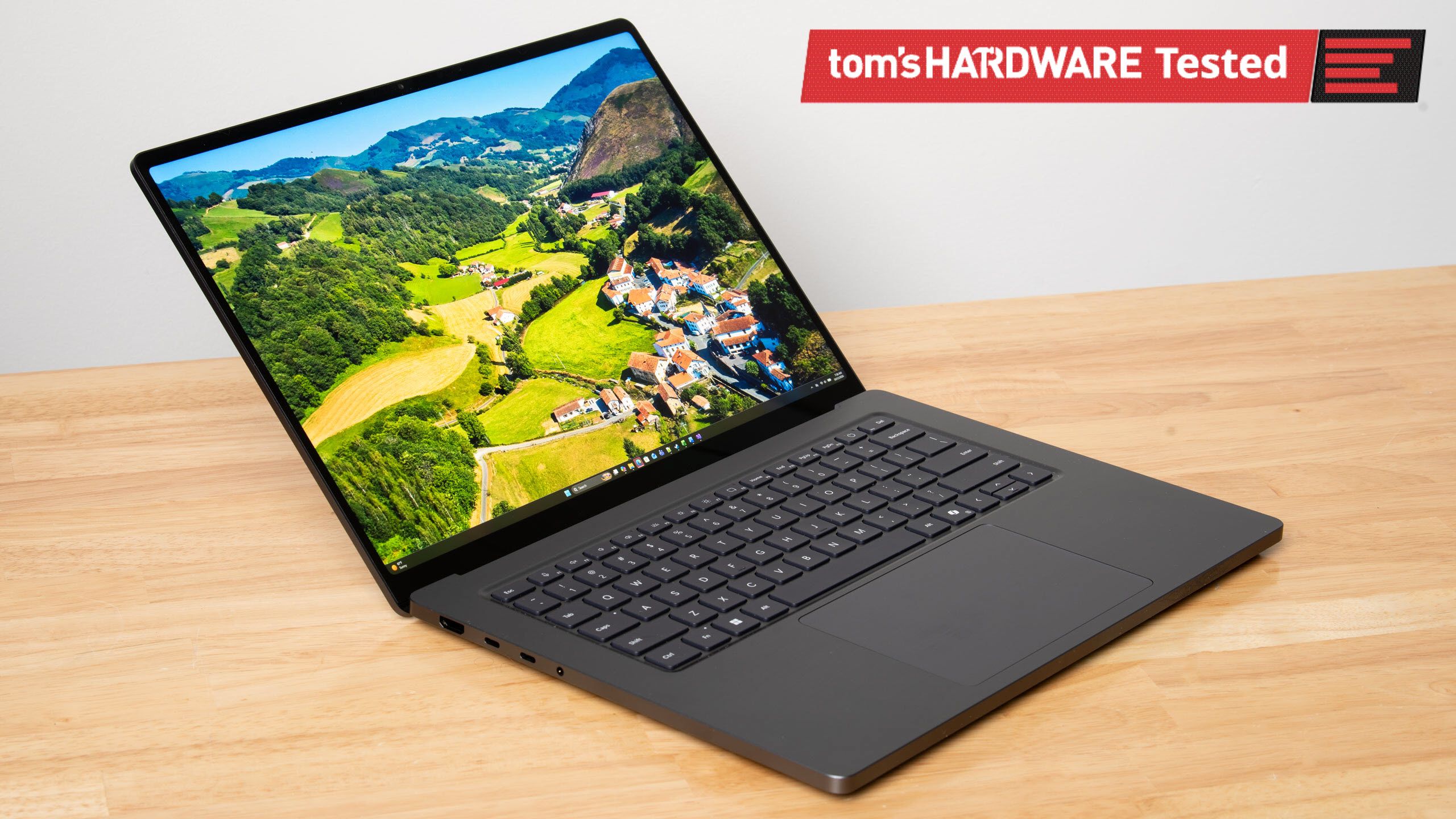
Over the past week, I've been using the RTX Spark-powered Surface Laptop Ultra as I would any other Windows laptop, and aside from a couple of tiny paper cuts, I have mostly just gotten my work done as I would with any other computer. And that’s a great — albeit a very, very expensive — place to be as the local agentic AI future coalesces.
Perhaps the biggest challenge for the RTX Spark platform is that the eye-watering price tags for the range of systems available at launch still buy a lot of cloud tokens from OpenAI and Anthropic. Emphasis on a lot . The Surface Laptop Ultra we tested lists for $5899 with only 1TB of storage, and lead times for that system are already out to late December.
If you're not as concerned about keeping sensitive data out of those labs’ clouds, or you don't expect to run afoul of acceptable usage policies, you'll get much smarter tokens much faster than you will from a local token factory like the RTX Spark, and you can get them on most any reasonably powered traditional PC you have available.
Nvidia’s efforts to reshape personal computing will face strong headwinds in the immediate future from the sky-high DRAM and NAND price hikes that the company’s own Vera Rubin rollout is partially responsible for. Perhaps when the dust settles in the next two to three years, and products built around the next-generation RTX Spark Superchips arrive, we can more confidently assess whether the company has accomplished its goal.
For now, the RTX Spark feels like a platform for those who fervently believe that open AI models will continue to get more intelligent within relatively small memory footprints, and that those potential future improvements are worth a hefty chunk of change to get ready for today. Maybe that's a smart bet in a world where compute is an increasingly precious resource. But unless you're a true believer with cash to burn, our first impressions suggest that you should wait until Microsoft and Nvidia fully lay the software foundation needed for this platform to deliver on its promises.
Jeffrey Kampman Senior Analyst, Graphics As the Senior Analyst, Graphics at Tom's Hardware, Jeff Kampman covers everything that has to do with graphics cards, gaming performance, and more. From integrated graphics processors to discrete graphics cards to the hyperscale installations powering our AI future, if it's got a GPU in it, Jeff is on it.
cknobman Microsoft and Nvidia, 2 of the most greedy anti consumer tech companies out there. Hard pass. Reply
excalibur1814 Apple and nVidia, 2 of the most greedy anti consumer tech companies out there. Pass hard. Reply
sseemaku Is superchip a brand name or everything nvidia makes is called superchip these days? Reply
bit_user sseemaku said: Is superchip a brand name or everything nvidia makes is called superchip these days? It bugged me when Nvidia tried to call their little SoCs "supercomputers", in the past. But, I'll grant that they have a legit argument, here. A small one, in this day and age, but I can see the point. It stems from the fact that RTX Spark is comprised of two (mostly) independent dies. It basically works out to there being a CPU and a GPU die, integrated into a single package. So, it's multiple chips which function as an integrated whole. I think the modern definition of a super computer is: multiple computers that can function as an integrated whole. So, there's an argument that's more than mere marketing fluff. The same language is extended to their server-based 2-chip modules, which pair CPU and GPU chips. So, you'll find them also using the term to describe their Grace-Hopper, Grace-Blackwell, or Vera-Rubin solutions, where Grace and Vera are the CPUs and Hopper, Blackwell, and Rubin are GPUs. That said, I'd rather they not call it a super chip. But, this is Nvidia and they like to hype everything up to the nth degree. Reply
Vicecrow I like the price tag. Cheap cheap. Time to find another hobby Reply
Key considerations
- Investor positioning can change fast
- Volatility remains possible near catalysts
- Macro rates and liquidity can dominate flows
Reference reading
- https://www.tomshardware.com/laptops/SPONSORED_LINK_URL
- https://www.tomshardware.com/laptops/we-test-the-rtx-spark-superchip-in-microsofts-surface-laptop-ultra-nvidias-windows-on-arm-platform-impresses-in-local-ai-but-gaming-isnt-its-strong-suit#main
- https://www.tomshardware.com/membership
- Formlabs Form Studio 1 Review: Professional status, consumer price tag
- From Scan to Treatment Plan, AI Helps Close Breast Cancer’s Deadliest Gaps
- Nvidia GPU prices spike in Japan; prices up to 41% higher than Amazon US
- Nvidia GPU prices spike in Japan; prices up to 41% higher than Amazon US
- Unsupervised AI agent deletes TV show’s entire edit weeks before release; program can't air
Informational only. No financial advice. Do your own research.