
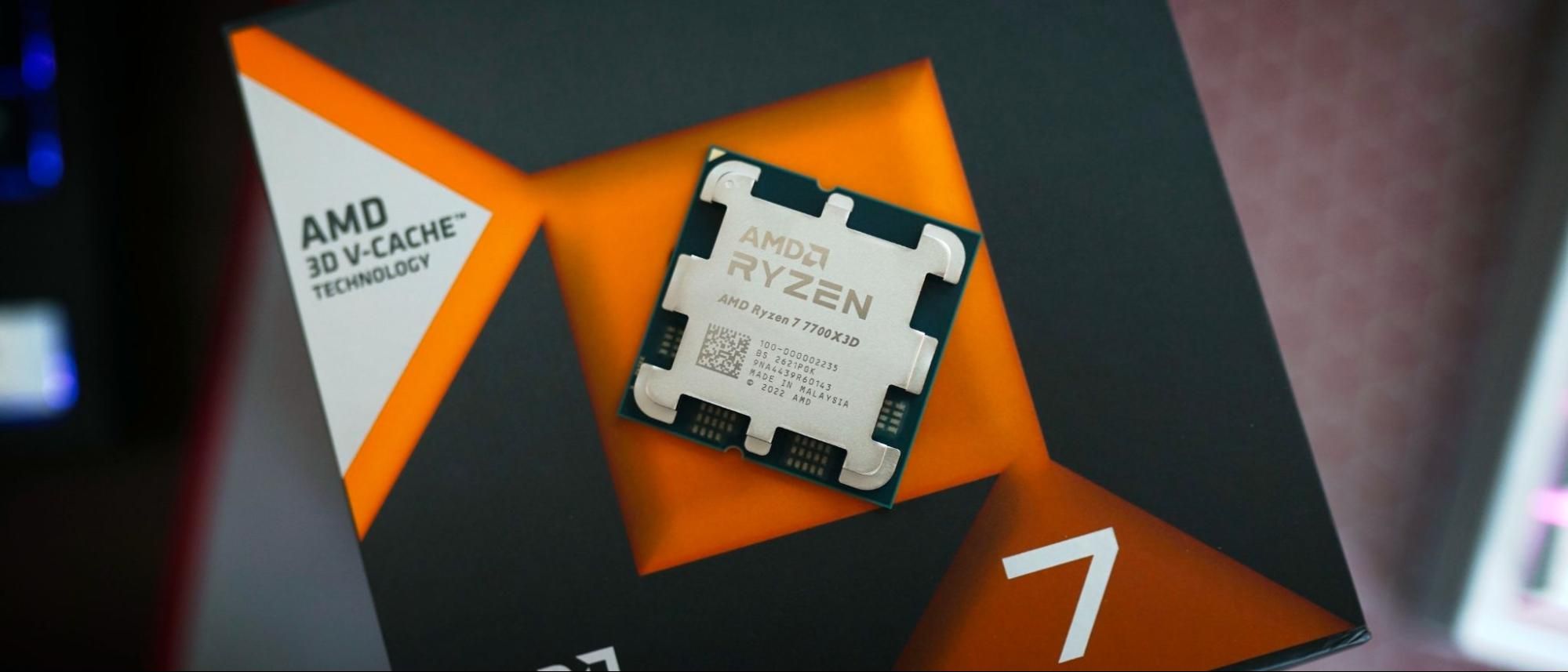
If the 7700X3D followed in the 5700X3D’s footsteps and released at $250 (even after three years of the 7800X3D on the market), it’d be a slam dunk. That’s not where we are for release, so let’s hope a price cut is waiting in the wings.
There’s a good chance the Ryzen 7 7700X3D is the last X3D processor we’ll see sporting AMD’s Zen 4 architecture, short of a potential Ryzen 5 7500X3D in the future. It further segments AMD’s last-gen lineup, and although there’s good pricing separation between each of the Zen 4 options, the spec differences are small.
For the Ryzen 7 7700X3D, the only spec difference it carries is a cut to clock speed compared to the Ryzen 7 7800X3D. You lose 200 MHz on the base clock and 500 MHz on the maximum boost clock. It’s a similar setup to what we saw with the Ryzen 7 5800X3D and 5700X3D, just a bit more aggressive. The 5700X3D shaved 400 MHz off the base and boost clock of the 5800X3D.
Otherwise, you’re getting the same eight Zen 4 cores available in the 7800X3D, along with 104 MB of combined L2 and L3 cache (64 MB of that L3 is stacked on the CCD). It also comes with the same rated TDP of 120W, though as we’ll see throughout our benchmark results, the 7700X3D never crossed into triple-digit wattages during our testing.
The 7700X3D slots into existing 600- and 800-series motherboards, and AMD says that it will boot on existing AM5 BIOS images (though the company recommends flashing the latest firmware). We didn’t need to install a specific BIOS image or chipset drivers to boot with the 7700X3D, so if you already have an AM5 motherboard, you should be set. In addition, the 7700X3D does not come with a stock cooler, despite arriving in AMD’s larger box design that we saw in the previous generation.
Outside of the step up to the 7800X3D, there’s a step down to the 7600X3D, which trades two cores (and consequently 2 MB of L2 cache) for a bump to a 4.7 GHz boost clock. As we’ll get to in our gaming benchmarks , there’s something about the range of 4.5 to 4.8 GHz where these Zen 4 X3D chips hit their stride, and the 7700X3D just barely hits that range without PBO assistance.
The 7700X3D arrives at a recommended retail price of $330, putting it in hotly contested waters. Intel has its newer 270K Plus around that same price, while the last-gen Core i7-14700K lands closer to the $380 mark. Down a step, the 250K Plus is more than $100 cheaper at $220, while the Core i5-14600K is available for around $250.
For AMD, you can step up to the 7800X3D for a $50 premium (at current prices) or down $90-$100 and get the 7600X3D. Of this tight grouping of Zen 4 X3D chips, none of them are bad options purely for gaming. Deciding between them is tricky. We’ve seen the 7800X3D on sale for as low as $348, which is a negligible price difference compared to the 7700X3D. And even at list price, the Ryzen 5 7600X3D is significantly cheaper, yet comes within just two points of the average gaming performance of the 7700X3D.
It’s impossible to give a concrete conclusion about which is the best because even a minor sale of $20 or $30 off tips the scales. The 7700X3D isn’t a bad processor, but there are a lot of situations where it’s not the optimal choice, mainly due to its proximity in price to the 7800X3D. Given the 7700X3D’s performance, it would ideally be priced around $260 to $280.
You’ll spend much more if you want to get one of AMD’s latest X3D chips with the Zen 5 architecture, which represent somewhere around a 15% to 20% improvement in average gaming performance. The 9800X3D is the cheapest Zen 5 X3D processor right now, and you can expect to spend about $450 to $480 on one. AMD suggested to Tom’s Hardware that it’s looking into a cheaper Ryzen 5 9600X3D for a future release, but that’s not available at the moment.
Jake Roach is the Senior CPU Analyst at Tom\u2019s Hardware, writing reviews, news, and features about the latest consumer and workstation processors. ","collapsible":{"enabled":true,"maxHeight":250,"readMoreText":"Read more","readLessText":"Read less"}}), "https://slice.vanilla.futurecdn.net/13-4-25/js/authorBio.js"); } else { console.error('%c FTE ','background: #9306F9; color: #ffffff','no lazy slice hydration function available'); } Jake Roach Social Links Navigation Senior Analyst, CPUs Jake Roach is the Senior CPU Analyst at Tom’s Hardware, writing reviews, news, and features about the latest consumer and workstation processors.
usertests The market will correct the price… possibly by raising the 7800X3D price. It's good and efficient out of the box. Reply
-Fran- Another swing and miss from AMD! Like… Why even release this CPU in this market AMD? Why not just stock pile it and sell it later when it makes more sense? You're barely moving the 7800X3D at really good prices, how do you expect to move this thing at a worse P/P ratio? HOW? Regards. Reply
Key considerations
- Investor positioning can change fast
- Volatility remains possible near catalysts
- Macro rates and liquidity can dominate flows
Reference reading
- https://www.tomshardware.com/pc-components/cpus/SPONSORED_LINK_URL
- https://www.tomshardware.com/pc-components/cpus/amd-ryzen-7-7700x3d-cpu-review#main
- https://futureplc.com/privacy-policy/
- Tower Semiconductor revives shuttered Panasonic-era fab in $3 billion Japan photonics expansion — METI-backed plan targets $3.6 billion revenue by 2028
- Developer successfully ports Linux to 1994 Sega 32X — Genesis and MegaDrive expansion runs open-source OS on paltry 23MHz processors and 256KB of RAM
- OpenAI's first hardware device is an RGB macropod — 'Codex Micro' features 13 low-profile keys and a joystick for controlling AI coding agents
- Elon Musk's Starlink releases smaller and lighter V5 residential kit — offers speeds of up to 375 Mbps and almost half the power consumption of V4
- Ex-Sega engineer creates 'super realistic' CRT monitor emulator — incredible retro offering even includes TV screen tapping to fix picture
Informational only. No financial advice. Do your own research.