
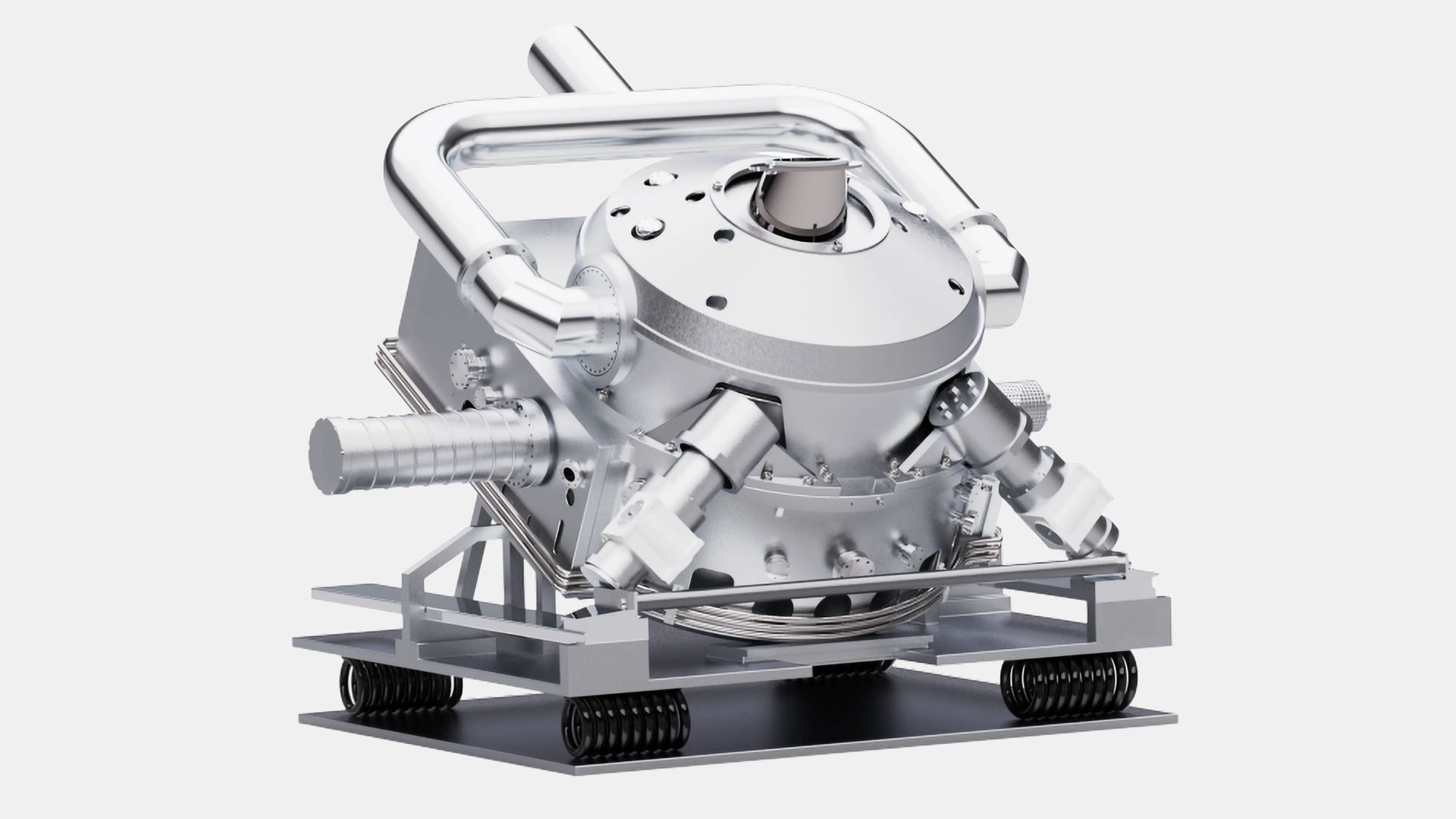
Langdao Silex, which was established in 2024 by Tsinghua University's Gas Discharge Plasma Laboratory alumni, demonstrated its EUV light source prototype at the 26 th China International Industry Fair in Shanghai, for obvious reasons, without lighting it up. Just like modern light sources from ASML, the company's low-power FlintNano LPP-OXXO system uses laser-produced plasma (LPP) technology that produces EUV radiation by bombarding tiny heated metal droplets with high-energy laser pulses to create extremely hot plasma. The system features a 1,000W driving laser (presumably a CO 2 one) with an operating frequency of 1 kHz – 20 kHz and conversion efficiency exceeding 2%. Its EUV output exceeds 15W (presumably measured at the plasma rather than at intermediate focus, as the company has not demonstrated a complete EUV collection system) while its brightness reaches 100 W/(mm²·sr). The source has an étendue of 1 × 10⁻³ mm²·sr and generates plasma with a diameter of 60 μm.
According to Langdao's specifications, the FlintNano LPP-OXXO can operate continuously for over 100 hours with plasma stability of 3% RMS and EUV output power stability of 5%. These characteristics make the system suitable for semiconductor exposure experiments, although its output remains insufficient for high-volume chip production. Meanwhile, the 'over 100 hours' availability is very impressive for a pre-production light source, though we must admit that there is no way to verify the claim.
Langdao is also developing the FlintMicro-LPP high-power EUV source, which has completed proof-of-principle validation, according to reports. However, Langdao has not disclosed its output power, conversion efficiency, or operating lifetime.
On paper, Langdao's EUV source is comparable in output to some of the earliest EUV sources developed by Western and Japanese equipment makers, albeit with a major caveat: Langdao seems to measure EUV power at the plasma rather than after the collector or at intermediate focus as ASML does. ASML's early EUV demonstration equipment used approximately 10W at intermediate focus DPP sources in 2007, while Cymer's LPP sources installed in early NXE:3100 systems delivered up to 11W during wafer exposure in 2012 (note that ASML's machines are source agnostic, so some NXE:3100 prototypes used DPP sources, while others used LPP sources). By 2013, Cymer demonstrated approximately 40W at intermediate focus over extended operating periods. Meanwhile, Japan's Gigaphoton targeted 25W with its first prototype in 2013 and demonstrated 43W in early 2014. By late 2014, Gigaphoton had achieved 118W during a 10-minute test. However, since these historical figures involve different measurement conditions and operating durations, direct comparisons are vastly inaccurate.
China's DUV technology 'at a similar stage to ASML in 2004,' analyst claims
Key considerations
- Investor positioning can change fast
- Volatility remains possible near catalysts
- Macro rates and liquidity can dominate flows
Reference reading
- https://www.tomshardware.com/tech-industry/semiconductors/SPONSORED_LINK_URL
- https://www.tomshardware.com/tech-industry/semiconductors/china-startup-demoes-prototype-euv-light-source-15w-of-output-power-and-90-percent-domestic-components-still-years-away-from-viability#main
- https://www.tomshardware.com/membership
- From Scan to Treatment Plan, AI Helps Close Breast Cancer’s Deadliest Gaps
- Microsoft Surface Laptop Ultra review: RTX Spark in a straight-up beautiful Windows PC
- SpaceX limits Starlink service for Ukraine’s high-speed military drones without prior warning
- NVIDIA Announces New Investments in the UK Startup Ecosystem
- Gun-rights activist unveils world's first 'AI-made' 3D-printed firearm — .22 caliber handgun created by an 'AI that can generate guns' called GatGPT
Informational only. No financial advice. Do your own research.