
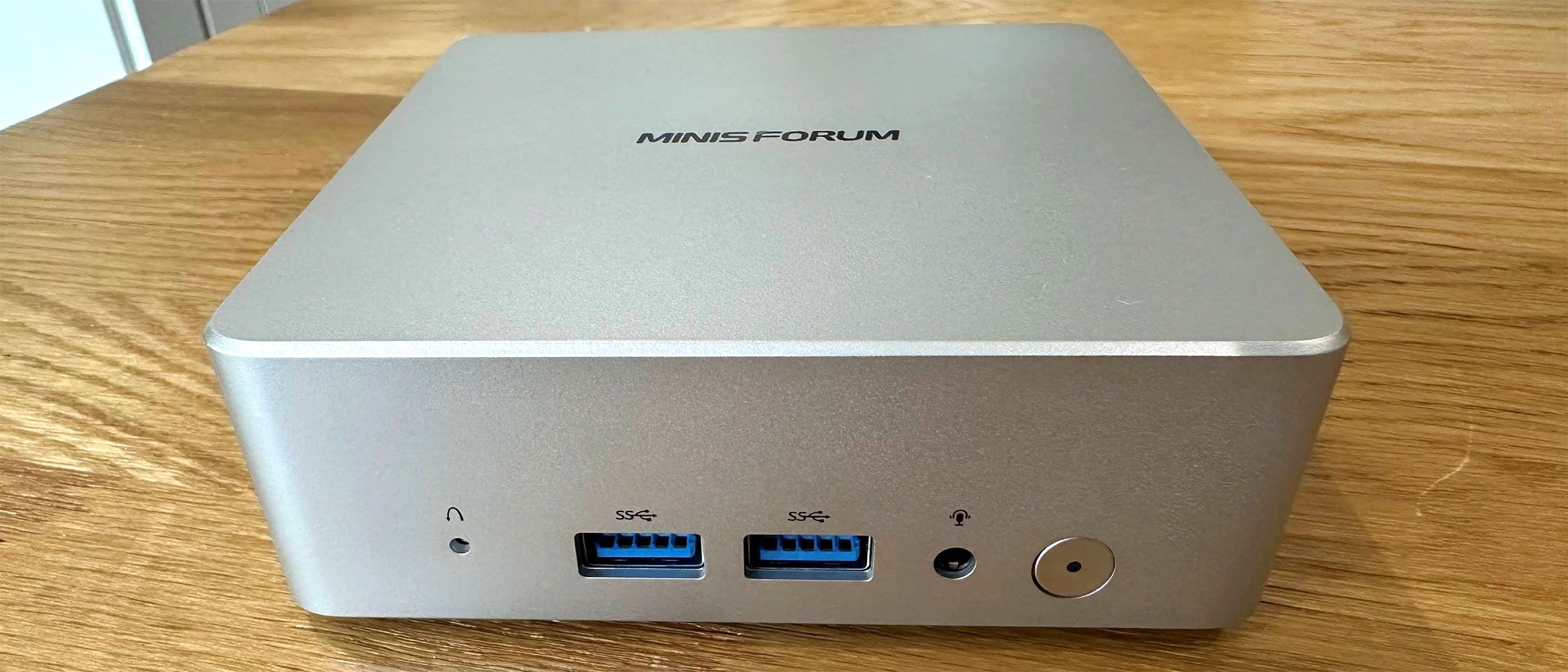
We have Intel’s latest 18A silicon inside this tiny PC, but not that much of it. Our review unit came with an Intel Core 3 304 "Wildcat Lake" chip that runs up to 4.3 GHz. Previous mini PCs based on Intel 300 series mobile silicon like the previously MSI and the GMKtec Evo-T2 came with a 16C/16T CPU. However, here we have just 5C/5T, and that’s just one performance core supported by four low power efficiency (LPE) cores.
Still, single core performance continues to be important for system and app responsiveness. The proof of the pudding is in the testing, though. And while this system felt perfectly usable in Windows 11, internet browsers, and word processing — preparing and writing this review, for example — the benchmarks are somewhat tougher.
(Image credit: Tom's Hardware) (Image credit: Tom's Hardware) (Image credit: Tom's Hardware) (Image credit: Tom's Hardware) (Image credit: Tom's Hardware) (Image credit: Tom's Hardware) (Image credit: Tom's Hardware) (Image credit: Tom's Hardware) Image 1 of 8 View Original
Multi-Threaded Image 1 of 11 (Image credit: Tom's Hardware) (Image credit: Tom's Hardware) (Image credit: Tom's Hardware) (Image credit: Tom's Hardware) (Image credit: Tom's Hardware) (Image credit: Tom's Hardware) (Image credit: Tom's Hardware) (Image credit: Tom's Hardware) (Image credit: Tom's Hardware) (Image credit: Tom's Hardware) (Image credit: Tom's Hardware) Image 1 of 11 View Original
As we expected, the single core tests show Wildcat Lake has some bite. It easily beats its AMD-based rivals in the POV Ray single core rendering tests, for example. Moreover, in tests like Cinebench 2024 single core, the Mini M2 Air might trail the pack, but not by very much. It's roughly 107 points is actually within touching distance of the 120 points scored by ‘high performance’ mini PCs like the Beelink SER10 MAX (Gorgon Point) and MSI Cubi NUC AI+ 3MG (Panther Lake).
Multicore tests exposed obvious weaknesses of the 5C/5T CPU configuration with single-channel RAM. All the other mini PCs we’ve tested this year come with 12C/24T (AMD) or 16C/16T (Intel), so the productivity benchmarks we run which can take advantage of multithreading for demanding rendering or encoding tasks make the Minisforum here seem weak. However, it might still be acceptable for transcoding a short video or two, occasionally, as long as you aren’t in a rush. If you are coming from an older, less efficient desktop sporting something like an i7-7700K or i5-10400, this 15W Wildcat Lake chip is an improvement in both single and multicore performance.
During our demanding tests, the Minisforum Elite Mini M2 Air-304 stayed cool and quiet thanks to its 15W processor and capable cooling.
For anything other than the most casual gaming or emulation of older consoles you should look at other devices. We’ve looked at Intel 300 silicon powered devices with iGPUs packing 12 Xe3 cores, and four Xe3 cores, but this just has one, and it is further hampered by sharing the single-channel system RAM.
Prepare to see some low frame rates / scores in our standard tests. I felt that some of these tests probably shouldn’t be run on this mini PC, but did it anyway, for completeness. However, some 3DMark benchmarks simply wouldn’t run, as Intel has pruned the features that work on this iGPU due to limited resources. For example, 3DMark Solar Bay doesn’t run on this system, and neither does Speed Way . Error messages about unsupported hardware pop up when you try these tests.
Steel Nomad ran, though, and the Minisforum and its solo Xe3 core achieved a score of 135. The aforementioned Evo-T2 with Intel Core Ultra X7 358H and (B390) iGPU with 12x Xe3 cores scored 1,624. That’s incredibly close to 12x faster than the Core 3 304’s ‘Intel Graphics.’ A score of 135 means Steel Nomad ran at just a little more than 1 FPS, which actually doesn’t hurt your eyes to watch as much as 10 FPS.
Using the multi-scene benchmarks built into Shadow of the Tomb Raider and Cyberpunk 2077 using our standard settings selections resulted in some unpleasant experiences. Performance of no better than 10 or 12 FPS was observed in these tests. To achieve 25 or even 30 FPS in these titles I found that reducing the game resolution to 720p and low/lowest settings would just about get there.
(Image credit: Tom's Hardware) (Image credit: Tom's Hardware) (Image credit: Tom's Hardware) (Image credit: Tom's Hardware) (Image credit: Tom's Hardware) (Image credit: Tom's Hardware) Image 1 of 6 View Original
During my day-to-day use, the Minisforum system consumed around 9W when idling on the desktop. When under the heaviest loads I threw at it, the highest system power consumption I saw was around 31W.
I didn't find it surprising that this low-power system ran cool and quiet. System tools showed that during light activities like browsing the web the CPU temperature remained in the low 30s Celsius. Playing games or benchmarking for length periods, I never saw the reported CPU temperature rise beyond the low 70s Celsius.
Minisforum’s tiny mini PC was a quiet operator at idle and under load. My measurements from about half a foot in front of the device show noise levels under 30 dBA at idle, which is very quiet and actually said to be beneath the measurement threshold of my meter. Stressing the system with simultaneous CPU and GPU loads I managed to observe just a reading of a little over 37 dBA from the system.
The Mini M2 Air ships with Windows 11 Pro installed in the configuration we received. I found no pre-installed bloatware. The official specs don’t mention compatibility with other OSes like Linux.
Minisforum sells this mini PC with a two-year warranty and a 30-day money-back guarantee.
Minisforum sells only two Elite Mini M2 Air-304 configurations in the U.S. There’s a barebones model, or the configuration we tested with pre-installed RAM, SSD, and OS.
At the time of writing our 16GB / 500GB / Windows 11 Pro configuration is listed by the mini PC maker at $559 but the product page says the price is normally $699. The barebone model is currently $263, discounted from $329. We don’t know when the prices might get adjusted. However, we’ve noted U.S. retailers like B&H Photo are now selling the 16GB / 500GB model at $729.
Though the Mini M2 Air’s performance may lack in performance, it also probably the smallest cheapest, and least power-hungry mini PC we’ve tested all year. If these kinds of qualities are important to you, the Minisforum might be appealing.
It is admirable that this mini PC is so small but leaves RAM and storage upgrades on the table for later. Other positives are the sturdy build, despite the use of plastic for the top shell, and a good port selection considering its size. In addition to being easy to hide due to its small stature, and supplied VESA mount, you probably won’t hear it very much, either.
Of course, the performance is a weakness that can’t be ignored, especially in the context of our ever-growing tested mini PCs chart from 2026. It is great to see this latest-gen processor barebones at just over $260 direct from Minisforum. If you have a spare DDR5 SODIMM and SSD, perhaps from a laptop upgrade or wherever, this might help you get a new mini PC system up and running cheaply. However, the 16GB RAM and 500GB SSD (and Windows 11 Pro license) currently more than doubles the list price (it adds $296). That’s a bit painful.
Furthermore, if the Minisforum Elite Mini M2 Air ever rises to its apparent MSRP of $699, we’d definitely look elsewhere. Around this price, especially during sale periods, you can shop for mini PCs employing far more powerful previous-gen processors. One good alternative candidate might be the Geekom IT13 Max 2026 we reviewed in August at $799. Price trackers show this Core Ultra 185H machine with 24GB RAM has been available for under $600 with discount / coupon over the last few months. There are also a lot of capable older gen AMD mini PCs to ponder over at attractive prices.
Mark Tyson Social Links Navigation News Editor Mark Tyson is a news editor at Tom's Hardware. He enjoys covering the full breadth of PC tech; from business and semiconductor design to products approaching the edge of reason.
Key considerations
- Investor positioning can change fast
- Volatility remains possible near catalysts
- Macro rates and liquidity can dominate flows
Reference reading
- https://www.tomshardware.com/desktops/mini-pcs/SPONSORED_LINK_URL
- https://www.tomshardware.com/desktops/mini-pcs/minisforum-elite-mini-m2-air-304-review#main
- https://futureplc.com/terms-conditions/
- Jailbroken PS4 runs 9-billion-parameter AI model at up to 43 tokens per second
- NVIDIA DGX Spark Developer Kit Turns a Desk Into a Supercomputing Lab
- 403 hyperscale US data centers used staggering 82 terawatts of electricity in a year, more than 80% of Michigan’s entire consumption
- Jensen Huang could be plotting return as Nvidia CEO, report claims
- Samsung, SK hynix, and Micron form unlikely alliance to standardize robot charging as chipmakers push toward unmanned fabs
Informational only. No financial advice. Do your own research.