
When you purchase through links on our site, we may earn an affiliate commission. Here’s how it works .
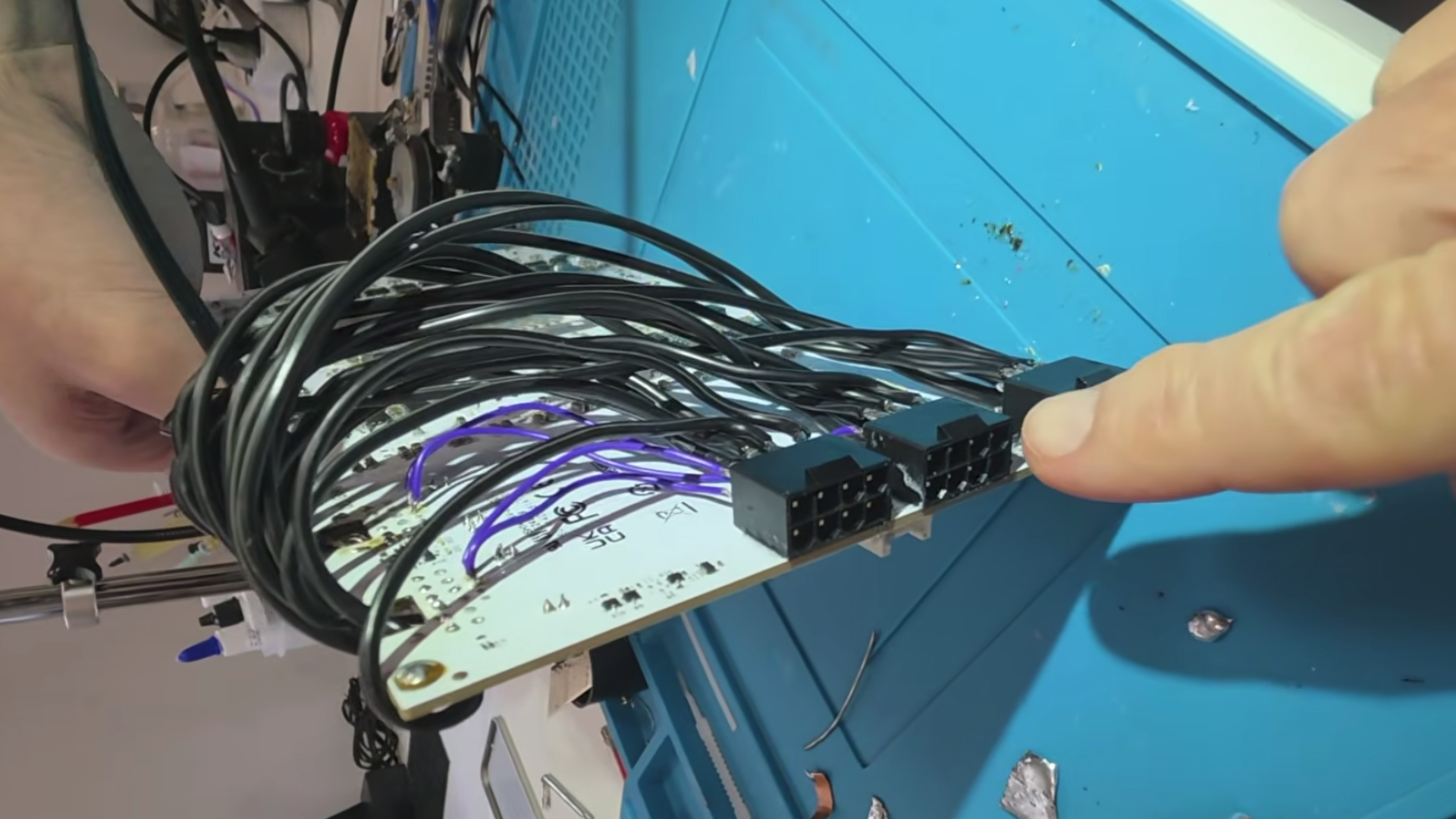
The card chosen for the experiment was a Galax GeForce RTX 5090D HOF OC LAB XOC, which is a top-of-the-line model that features a beefy cooler as well as dual 16-pin power connectors. The modders essentially dismantled the entire graphics card along with the dual 16-pin power connectors, stripping it down to just the bare PCB. Next, three 8-pin power connectors were installed at the rear, with each connector soldered directly to the power regulators on the PCB using heavy-gauge cables. Additionally, the sense pins had to be rewired to ensure that the card could reach its maximum power load without any restrictions. To keep the temperatures in check, they used a liquid cooling system with a GPU block.
An 8-pin PCIe power connector is officially rated for 150W, although its actual maximum capacity is much higher. During the one-hour livestream, the modders tested the GPU by gradually increasing the power draw, starting at 400W and going all the way up to 900W using three 8-pin power cables. At its peak, the modified RTX 5090 pulled more than 120A, with clock speeds reaching as high as 3,400 MHz. Notably, the mod was limited to only the hardware level, with no software or BIOS tweaks performed.
To further test the capability of the 8-pin connectors, the modders tested the modified RTX 5090 with just two cables. The overall power draw dropped to 66A, while clock speeds remained at a respectable 3,200 MHz. Going a step further, the card was tested with just one cable, which surprisingly only dropped the figures down to 65A and 3,100 MHz.
Despite the PCI-SIG (PCI Special Interest Group) revising the 16-pin power connector (12V-2×6) to improve reliability, reports of melting GPU connectors continue to haunt gamers. The issue is particularly more common among high-performance models, though not limited to Nvidia RTX 50 and RTX 40 series, as certain AMD Radeon graphics with the 16-pin connector are also at risk. TecLab's experiment shows that GPU manufacturers may want to reconsider the tried-and-tested 8-pin connector and explore whether it could still be a viable option in high-end graphics cards.
Modders solder power cables directly to RTX 5090 PCB to eliminate notorious melting 16-pin connector
Enthusiast says DLSS 5 pushed RTX 5090 past 600W and melted the 16-pin connector
PC gamer vibe-codes a safeguard against RTX 5090 power connector failures
Key considerations
- Investor positioning can change fast
- Volatility remains possible near catalysts
- Macro rates and liquidity can dominate flows
Reference reading
- https://www.tomshardware.com/pc-components/gpus/SPONSORED_LINK_URL
- https://www.tomshardware.com/pc-components/gpus/modded-rtx-5090-ditches-16-pin-power-for-triple-8-pin-connectors-draws-up-to-900w-and-hits-3-400-mhz#main
- https://www.tomshardware.com/membership
- TSMC, Samsung, and Intel shore up support with ASML to deploy larger High-NA EUV photomasks — 6×12-inch photomask transition may take years despite unified effo
- Nintendo unveils The Legend of Zelda 40th Anniversary Switch 2 for $520 — First-ever special-edition Switch 2 drops October 19, alongside $100 Pro Controller, p
- This $389 32GB DDR5 RAM kit is the cheapest on sale right now for a gaming PC upgrade — higher-spec RAM for $415 gives PC builders rare choice as the AI boom co
- Physical AI Takes the Wheel: How the World’s Robotaxi Leaders Are Building With NVIDIA Technologies
- Libernovo Omni Pro Review: Cooler than you think
Informational only. No financial advice. Do your own research.