
As you can glean from the charts above, all of the results are generally close together, a range of around 15 degrees Celsius, for this set of mainstream and enthusiast-class motherboards. Even the hottest board is still 10s of degrees away (think 30 degrees or more) from running ‘too hot’ and potentially throttling.
The next set of charts hails from our motherboard reviews and shows the performance of all the boards across a wide variety of tests, including gaming, productivity, and creative workflows. As you can see, none of the boards, ranging from $179.99 to over $1,000 (new/MSRP), throttled with our flagship Intel Core Ultra 285K, nor did any using the Ryzen 9 9900X.
(Image credit: Tom's Hardware) (Image credit: Tom's Hardware) Image 1 of 2 View Original
While we know the 9900X isn’t AMD’s current flagship, it still produces a fair amount of heat (~150W in our testing) for an upper-midrange processor. Even if we had used a high-power Ryzen 9 9950X, it wouldn’t have changed things much.
On the Intel side, we don’t have many datasets as we haven’t reviewed as many of the company’s Z890 motherboards at the time of this writing (we’re covering more now with the release of the new Intel Core Ultra 270K Plus and 250K Plus processors). That said, we’re confident the story remains the same, and you’ll get everything out of your processor on this and the B860 chipset-based boards. But if you plan on extended periods of high CPU use, you should always get more than you need, if only for longevity.
The last set of charts covers previous-gen Intel and AMD, including Z790, B760, and H770 for Intel and X670E and B650 for AMD (though still AM5, like 800-series). In the following multi-threaded tests, you can see a significant difference in performance between budget-class boards and mainstream and enthusiast boards.
Intel budget boards tend to take a bigger hit, as their CPUs use more power than AMD's Ryzen 9 7950X. On the AMD side, we still saw performance differences, but overall not extreme when looking at these data sets, even in some of the cheapest mainstream boards we tested. This could also be due to throttling or BIOS settings, as some budget/business-class boards strictly limit the processor to its baseline specification. In contrast, others take liberties with settings, especially with Intel processors.
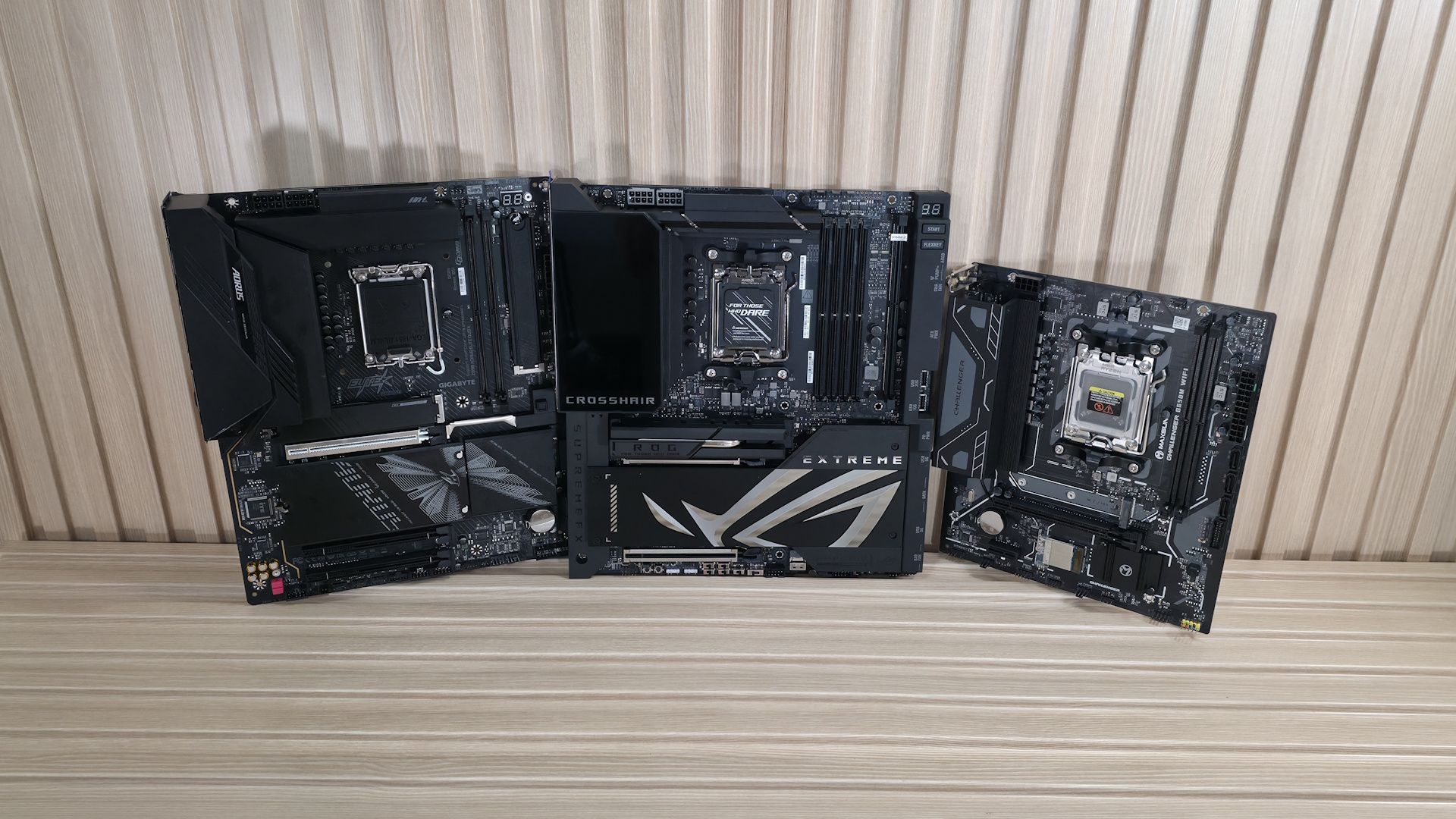
Ultimately, a vast majority of the boards we've tested were able to get the most out of the processor we use for testing. It’s typically only the absolute entry-level offerings, most in the budget/business class, that notably hinder performance. Sadly, there isn’t a smoking gun of ‘…if you’re using this processor, then you want this many phases/amps.’ But at a high level, the more phases and the higher the amperage rating, the better off you are.
Whether you can utilize a budget-tier board depends on several factors. If your primary use cases are office productivity and gaming with a mid-range or budget CPU, you’ll likely encounter few issues. However, if your workflows consist of sustained, heavily multi-threaded workloads, investing in a more capable board is advisable. On top of having paltry power delivery, the cheap boards tend to have fewer ports, slower overall connectivity (think USB and networking), a basic audio solution, and they just don’t look as good as mid-range to high-end boards that offer more and faster connectivity.
Does this mean a flagship motherboard is the only solution? Simply put, no. The vast majority of users don’t require extreme-class VRMs and would do fine with any motherboard from the mainstream or enthusiast chipsets. Your goal should be to find a balance that provides sufficient power headroom for your CPU and usage patterns.
However, if you intend to push high-TDP processors to their limits or want to overclock, VRM quality should be one of your top priorities, aside from the connectivity you need. Now that we have a better idea of what you may need, check out our curated best motherboards article or best motherboard deals to find a board that’s right for you.
Joe Shields is a staff writer at Tom\u2019s Hardware. He reviews motherboards and PC components. ","collapsible":{"enabled":true,"maxHeight":250,"readMoreText":"Read more","readLessText":"Read less"}}), "https://slice.vanilla.futurecdn.net/13-4-25/js/authorBio.js"); } else { console.error('%c FTE ','background: #9306F9; color: #ffffff','no lazy slice hydration function available'); } Joe Shields Staff Writer, Components Joe Shields is a staff writer at Tom’s Hardware. He reviews motherboards and PC components.
TechieTwo Back in the day when AMD released the FX-8xxx series CPUs, I was building PC systems with Gigabytes excellent Ultra Durable series mobos. I discovered that the VRM would overheat on these mobos with the FX-8xxx if run hard and then the CPU would be throttled. I notified Gigabyte several times and they claimed that there was no VRM overheating issues. It took them over a year of denial before they finally released an uprated mobo specifically for use with the AMD FX-8xxx CPUs. I haven't used Gigabyte mobos since. Reply
salgado18 Without real budget motherboards, like A620, this is just a validation of "adequate motherboards are adequate". None really have an issue, they just add a small and acceptable variation in temperature. No throttling in AMD, some throttling in Intel, no actual useful conclusion. I wanted to see 16+ core cpus on those really cheap motherboards, because they do show as compatible. I have a small server with an A320 and a Ryzen 1600, but it says it's compatible with the 5950X. What will happen if I do switch the cpu to the top AM4 one? I know it will throttle, but will it catch fire? This deserves a broader investigation, and an article of its own. As it is, there's no useful conclusion: mid-range is enough, top end is also good. :/ Reply
wussupi83 Good Article. Just last week I was debating spending $50 more for a 16 phase 80A board over a 14 phase 60A board. So this information is good to see and know I was okay with the cheaper board. A few months ago I swapped my mild OC'd 265k and mild OC'd 285k between a 12 phase 80A board and a 16 phase 90A board. In both cases, cooling the processor's silicon was the thermal limit, not the board's power delivery. Reply
Vanderlindemedia It's safe to say that VRM as a selling point really is being overrated for the last 10+ years. Like people are buying such motherboards they are not even going to tap into the max potential such VRM's have to offer. Budget boards even can carry, high end chips. But they will get hot, because there's no budget for proper cooling. They might throttle due to the 110 Degree limit that's usually in place. But it will still work. Why? AMD has set strict build recommendations – if you wanna build a AMD motherboard it needs to qualify to their standards, which makes all sense in the world. This was different with the FX era. FX was a wild west in regards of motherboard makers; who would place VRM's that where not capable of running the higher end models. Some boards just caught on fire once powering on the machine: 8zTzpYjQ2MM View: https://www.youtube.com/watch?v=8zTzpYjQ2MM It does not make sense either to now buy a ultra-high-end-motherboard with a beefed up VRM from here to tokio – not even on LN2 you are able to reach for the maximum potential at all. Serverboards contain upmost 4 to 5 phases really – and they are rated for, 600W or even 24/7 usage. It tells you a lot about how consumers have no idea that a 16 phase VRM really is needed lol. My findings is; if you have a motherboard with certain features such as switching frequency of the VRM; you could actually dial in a higher one, and require a lower overall CPU voltage for Overclocking. That's one of the features i can think of and that actually helped me increase my OC with less heat. Reply
Key considerations
- Investor positioning can change fast
- Volatility remains possible near catalysts
- Macro rates and liquidity can dominate flows
Reference reading
- https://www.tomshardware.com/pc-components/motherboards/SPONSORED_LINK_URL
- https://www.tomshardware.com/pc-components/motherboards/motherboard-vrm-thermal-testing-budget-vs-high-end-boards-does-it-really-matter#main
- https://www.tomshardware.com/subscription
- 16-hour Xbox outage even stopped physical games from working — company blames licensing issue for incident that prohibited gaming across three generations of co
- AI enthusiast adds Nvidia Tesla V100 as loud as a lawnmower to gaming PC for $266 — 32GB of VRAM rig can run 27 billion parameter model at 32 tokens per second
- Nemotron Labs: How Open Models Give Enterprises and Nations AI They Can Trust, Control and Customize
- Physicists turn particles in chaotic orbits into liquid computers — but this fluid hardware still trails memristor rivals
- China begins mass production of homegrown immersion chipmaking machines in major breakthrough, report claims — first DUV lithography units will be delivered thi
Informational only. No financial advice. Do your own research.