
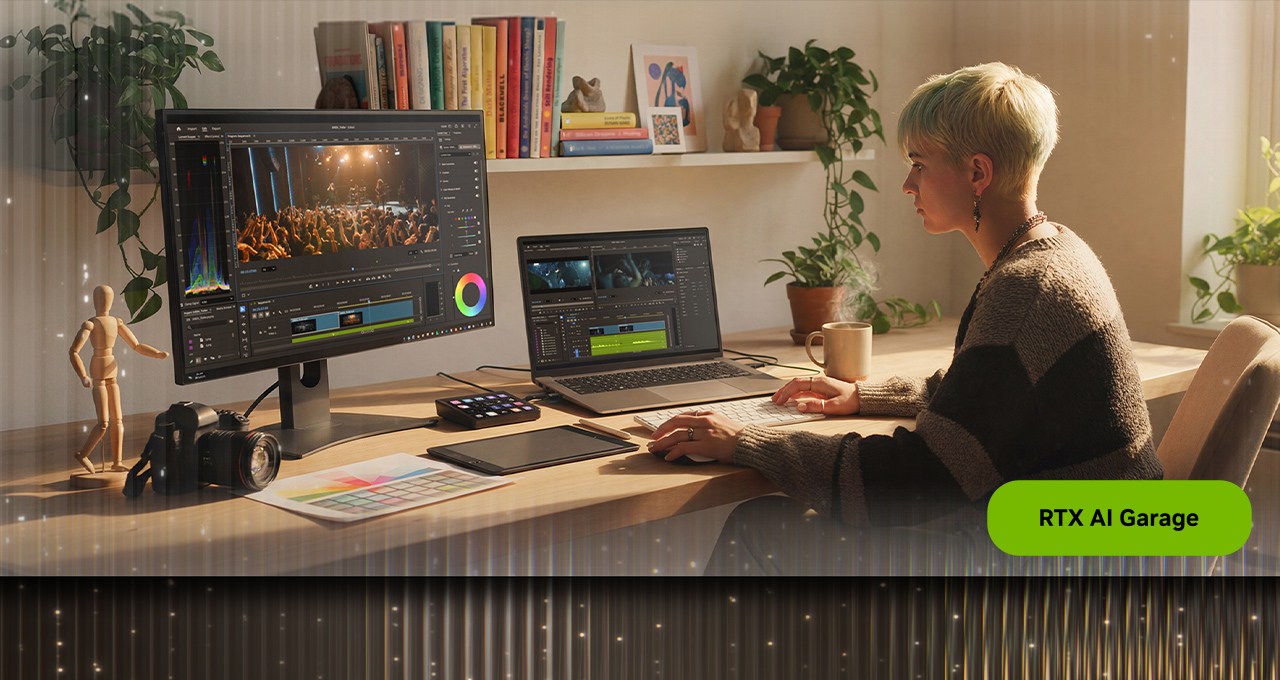
Designed to function as a dedicated grading environment nested directly within Premiere, it offers a clean, responsive interface that lets editors stay in their creative flow rather than relying on external tools for color correction. Tapping into GPU acceleration on NVIDIA GeForce RTX- and NVIDIA RTX PRO-equipped systems, this streamlined workflow, operating in 32-bit color depth for the first time, delivers significantly faster performance and quality.
NVIDIA also launched a new update to NVIDIA Project G-Assist — an experimental AI assistant that helps tune, control and optimize GeForce RTX systems.
Premiere’s Color Mode is a new clean, responsive interface within Adobe Premiere that enables editors to do color grading on native videos. Every element is designed to guide editors through the grading process without distractions. A large program monitor anchors the experience, providing immediate visual feedback as adjustments are made to enable faster decision-making and more precise control.
A clip grid view allows editors to visualize progression across shots in a sequence. This makes it easier to maintain consistency across scenes and ensure a cohesive look throughout a project.
Controls are organized into focused modules, each tailored to a specific aspect of color grading. Multiple modules can be active simultaneously, giving editors flexibility while maintaining clarity. Each control features a unique heads-up display (HUD), providing contextual guidance without cluttering the interface.
Color grading is one of the most computationally intensive tasks in post-production. Every adjustment — bidirectional controls, multi-zone tonal shaping and stacked color operations — runs on NVIDIA GPUs, accelerating playback, iteration and visual feedback.
Editors can work with up to six luminance adjustment zones, moving beyond traditional highlights, midtones and shadows models. This allows for more nuanced tonal control and finer adjustments across the image.
Visual scopes are context-aware, dynamically adapting based on the selected tool. HUD overlays provide visual cues directly within the scopes, helping editors understand how their adjustments affect the image without needing to interpret complex visual scopes and graphs.
The entire system now operates in 32-bit color depth precision, delivering maximum color fidelity and preventing unwanted clipping. Editors retain full control, with the ability to clip colors intentionally when needed for creative effect. Color styles can also be applied flexibly, at the sequence, clip, reel or custom group level, making it easier to manage looks across complex projects.
Download the Adobe Premiere (beta) to get started with Color Mode.
Key considerations
- Investor positioning can change fast
- Volatility remains possible near catalysts
- Macro rates and liquidity can dominate flows
Reference reading
- https://blogs.nvidia.com/blog/rtx-ai-garage-nab-adobe-premiere-color-mode/#primary
- https://blogs.nvidia.com/blog/author/joelpennington/
- https://blogs.nvidia.com/blog/rtx-ai-garage-nab-adobe-premiere-color-mode/#disqus_thread
- Intel's upcoming Xeon 7 'Diamond Rapids' server CPUs reportedly delayed to 2027 — Next-gen Coral Rapids lineup lands 2028 but can be accelerated, according to n
- Vendor slaps extra 'memory fee' on each tech purchase amid global chip crunch — the more you buy, the more you pay
- EXPO 1.2 only brings partial CUDIMM support due to lack of native IMC compatibility — Asus also working on updating older B650 and X670 boards with EXPO 1.2
- AMD's memory-boosting EXPO 1.2 is here, adds support for three Chinese memory vendors — performance gains could be muted until Zen 6
- Tag, You’re It: GeForce NOW Levels Up Game Discovery With Xbox Game Pass and Ubisoft+ Labels
Informational only. No financial advice. Do your own research.