
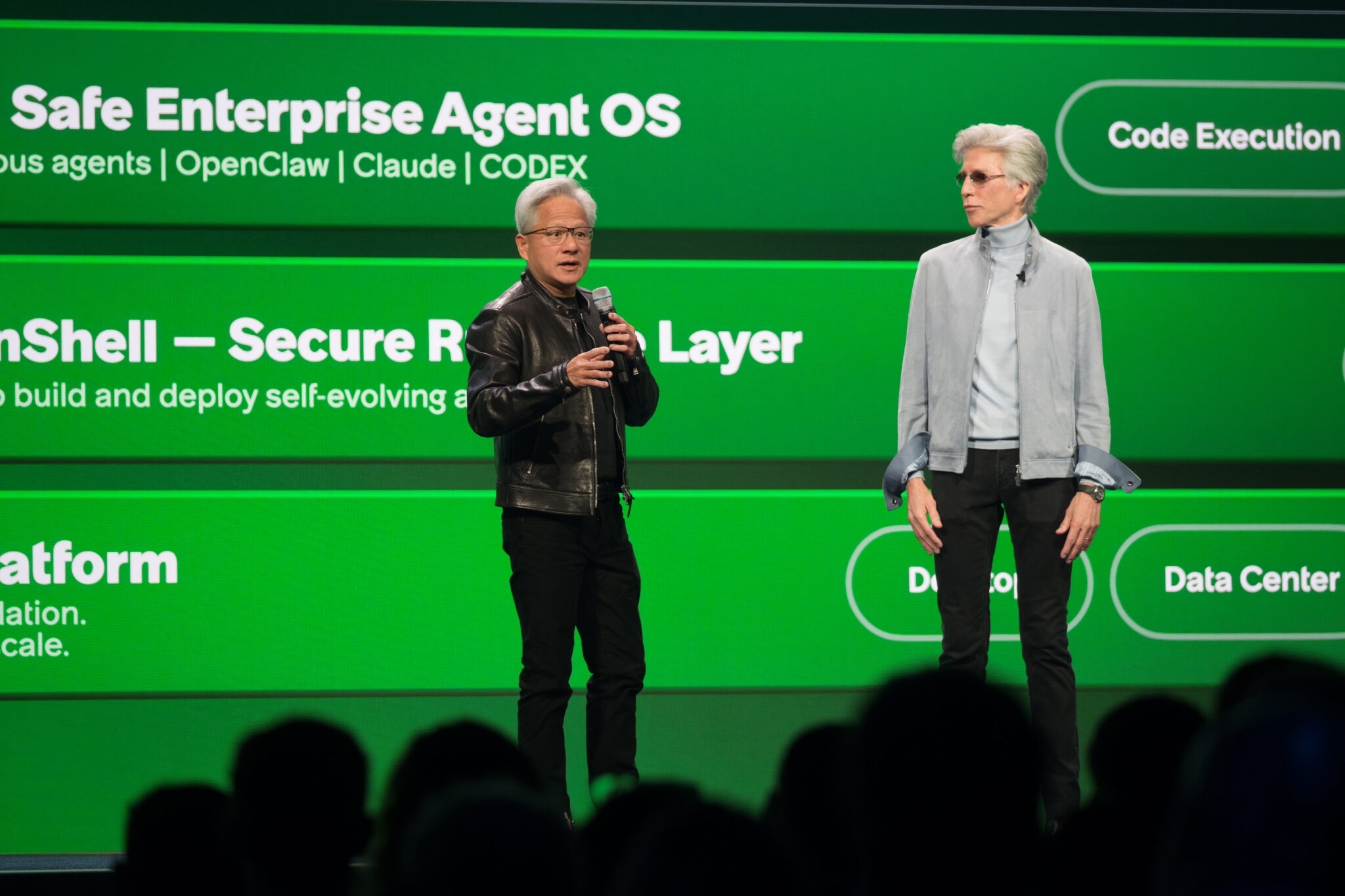
Project Arc uses NVIDIA OpenShell , an open source secure runtime for developing and deploying autonomous agents in sandboxed, policy-governed environments. ServiceNow is building on and contributing to OpenShell to advance a common foundation for secure, enterprise-grade agent execution. With OpenShell, enterprises can define what an agent can see, which tools it can use and how each action is contained.
“Project Arc represents the next step in our ongoing collaboration with NVIDIA, bringing autonomous execution to the desktop,” said Jon Sigler, executive vice president and general manager of AI Platform at ServiceNow. “By combining OpenShell’s runtime layer with ServiceNow AI Control Tower, and powered by ServiceNow Action Fabric, we’re delivering the governance and security that enterprise AI requires.”
To be effective, enterprise AI systems must be adaptable. NVIDIA and ServiceNow are building on an open ecosystem that allows organizations to tailor models and applications to their specific domains and data.
NVIDIA agent skills enable specialized agents, such as ServiceNow AI Specialists, to deliver targeted capabilities across enterprise workflows. For example, the NVIDIA AI-Q Blueprint for building specialized deep research agents empowers ServiceNow AI Specialists to gather context, synthesize information and support more complex decision-making across business functions.
In addition, the NVIDIA Agent Toolkit, including NVIDIA Nemotron open models, provide flexible building blocks and specialized skills for developing customized AI applications. To support real-world performance that these systems can perform reliably, the companies are also advancing NOWAI-Bench, an open benchmarking suite for enterprise AI agents, integrated with the NVIDIA NeMo Gym library. NOWAI-Bench includes EnterpriseOps-Gym , one of the industry’s most challenging enterprise agent benchmarks, where Nemotron 3 Super currently ranks No. 1 among open source models.
Unlike general benchmarks, these evaluations focus on multistep workflows — where enterprise AI systems often encounter real challenges — helping teams build agents that perform reliably in production environments.
As AI agents become long running and always on, scaling them across millions of workflows requires not just capability but efficiency — making token economics central to enterprise AI.
NVIDIA AI factories are built to deliver the lowest-cost, most-efficient tokenomics for production AI. The NVIDIA Blackwell platform delivers more than 50x greater token output per watt than NVIDIA Hopper, resulting in nearly 35x lower cost per million tokens. For enterprises running agents across millions of workflows, that efficiency can determine how quickly AI moves from pilots to broad production use.
ServiceNow AI Control Tower integrates with the NVIDIA Enterprise AI Factory validated design, extending governance and observability to large-scale AI workloads. With added agent observability capabilities, organizations can monitor behavior in real time and manage AI systems across their full lifecycle — from deployment to optimization.
AI is becoming a new way that work gets done. What’s changing now is that the core pieces required to deploy it at scale — capable agents, built-in guardrails and proven performance — are all coming together.
The companies that move fastest will be the ones that give agents the infrastructure to act, the context to make decisions and the governance to keep every action accountable — and NVIDIA and ServiceNow are making this a reality for the world’s enterprises.
Learn more about NVIDIA OpenShell and the NVIDIA AI-Q Blueprint .
Key considerations
- Investor positioning can change fast
- Volatility remains possible near catalysts
- Macro rates and liquidity can dominate flows
Reference reading
- https://blogs.nvidia.com/blog/servicenow-autonomous-ai-agents-enterprises/#primary
- https://blogs.nvidia.com/blog/author/karibriski/
- https://blogs.nvidia.com/blog/servicenow-autonomous-ai-agents-enterprises/#disqus_thread
- New Adobe Premiere Color Grading Mode Accelerated on NVIDIA GPUs
- Intel's P-core Core 9 273PQE 'Bartlett Lake' CPU beats 14900K by up to 9% in gaming tests — embedded-only chip is unofficially Intel's fastest gaming CPU (at 72
- Lenovo Yoga Slim 7i Aura Edition (2026) Review: Vibrant display, lightweight design, and an endurance champ
- No Need for Space Gear — Capcom’s ‘PRAGMATA’ Joins GeForce NOW on Launch Day
- SpaceX files for $55 billion semiconductor fab in rural Texas for Musk's Terafab — total chipmaking fab investment could reach $119 billion
Informational only. No financial advice. Do your own research.