
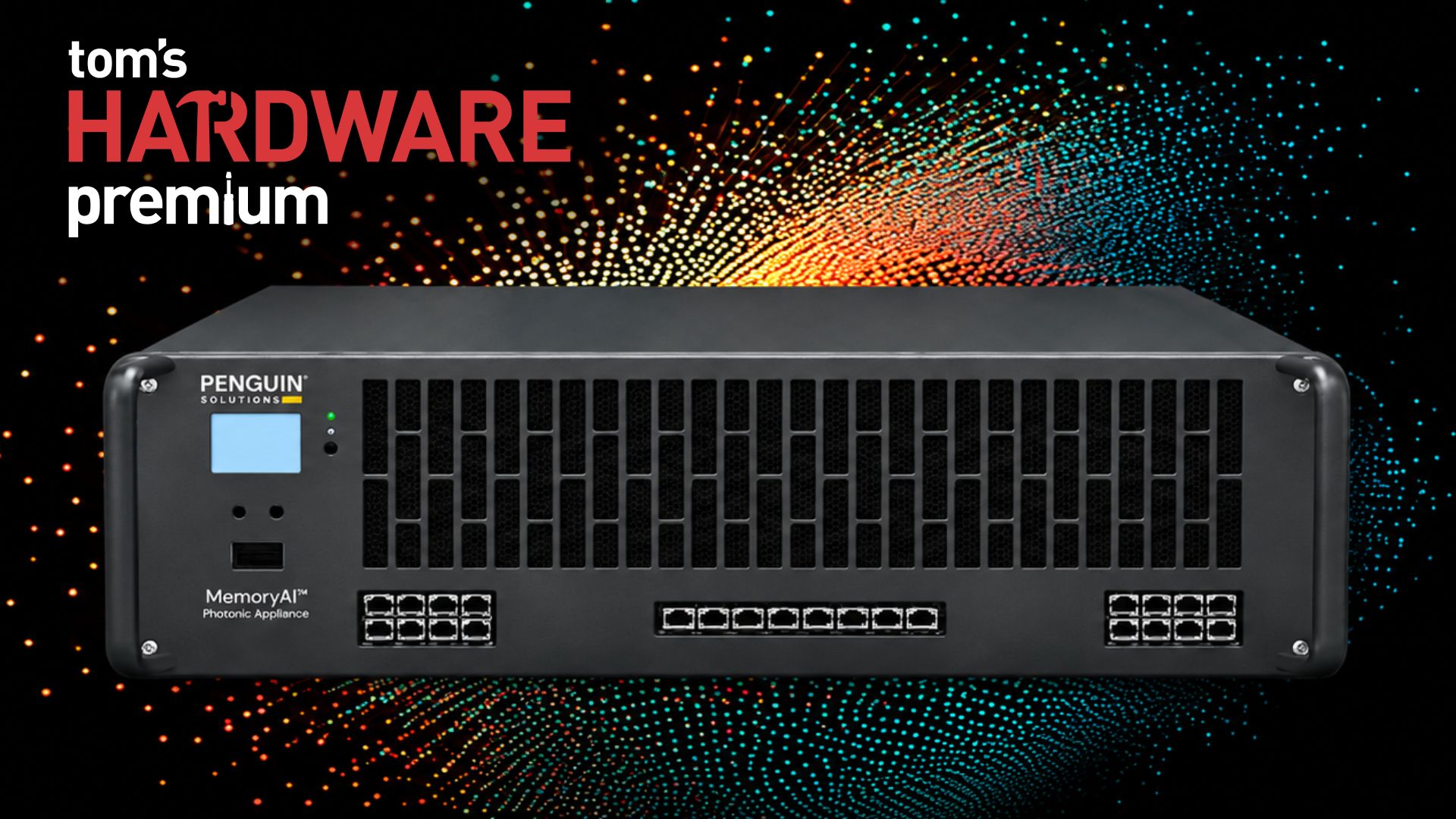
Nvidia's data center GPUs support PCIe, NVLink, and various memory management mechanisms, but they do not support a general-purpose CXL.mem host interface for memory expansion. Similarly, AMD's Instinct accelerators use PCIe and Infinity Fabric for connectivity, but they do not generally support CXL.mem. In theory, accelerators without native CXL.mem support could theoretically access the appliance through a CXL-capable CPU, provided their coherent interconnect supports access to CXL-attached memory. However, this would introduce additional latency, which will extend well beyond the advertised sub-350ns figure (which already excludes PCIe/CXL overhead), which could greatly reduce the actual performance benefits provided by extra capacity.
As a result, PFMMs and Penguin's MemoryAI Photonic Appliance can extend usable memory capacity only for select host systems without major performance penalties. These could include custom XPUs equipped with Marvell's Photonic Fabric chiplets, CPUs or other PUs that support CXL.mem and PF-NIC with memory mapping mechanism, and potentially future AI accelerators that support CXL.mem or integrate Marvell's Photonic Fabric. Obviously, this means that such systems will get an indisputable advantage over machines based on conventional accelerators from AMD and Nvidia in the form of memory upgrades.
Speaking of advantages, we must note that while an aggregate bi-directional bandwidth target of 7.2 TB/s (3.6 TB/s in both directions) seems formidable (it is only a bit lower than memory bandwidth of B300 SXM that comes at 7.7 TB/s), it is set to be shared between multiple accelerators (eight accelerators in a hypothetical scenario), which will provide limited bandwidth to each one. Although Penguin promises transparent access to external memory without modifications to applications, the appliance will require compatible memory management software (in addition to host hardware), which will treat external memory as another memory tier. While extra memory is always welcome, performance benefits of complex multi-tier memory subsystems depend heavily on workloads and efficient data placement. Consequently, the appliance's practical advantages remain to be demonstrated.
Penguin showcased the appliance this week; however, customer samples are scheduled for the second half of 2027, which likely means that the device and/or underlying hardware, firmware, and software need polishing. That said, practical performance and economic advantages of Penguin's MemoryAI Photonic Appliance remain to be seen when everything works as intended. In any case, do not expect deployments of such systems before 2028. This begs the question of where Penguin Solutions plans to source HBM3E in volume in 2028, when the industry will have transitioned to HBM4 and will be in the midst of transition to HBM4E.
Anton Shilov Social Links Navigation Contributing Writer Anton Shilov is a contributing writer at Tom’s Hardware. Over the past couple of decades, he has covered everything from CPUs and GPUs to supercomputers and from modern process technologies and latest fab tools to high-tech industry trends.
Key considerations
- Investor positioning can change fast
- Volatility remains possible near catalysts
- Macro rates and liquidity can dominate flows
Reference reading
- https://www.tomshardware.com/pc-components/dram/SPONSORED_LINK_URL
- https://www.tomshardware.com/pc-components/dram/penguin-shows-off-photonic-memory-box-at-sc26-that-can-expand-ai-accelerator-capacity-over-optical-links-device-sports-up-to-576gb-of-hbm3e-customer-samples-expected-in-2027#main
- https://www.tomshardware.com/my-account
- Homelabber's $3,500 build straps four 32GB Nvidia V100s to a Lenovo mini PC for 128GB of VRAM
- Sharge's Disk Pro 2 USB hub and actively cooled M.2 enclosure drops to its lowest-ever price
- Lambda Boosts AI Factory Resiliency and Efficiency With NVIDIA Photonics
- NVIDIA Announces Rubin HPC — A New GPU to Accelerate Agents for Science, Engineering and Analytics
- NVIDIA CUDA-X Libraries Give Agents the Tools to Accelerate Scientific Discovery
Informational only. No financial advice. Do your own research.